Mercedes Benz Stadium Construction Cost Analysis
Discover the mercedes benz stadium cost to build and how much did it cost to build. Expert analysis on funding, materials, and NFL comparisons.

The total construction cost of Mercedes-Benz Stadium in Atlanta, Georgia, was $1.5 billion. Completed in 2017, the 71,000-seat venue stands as one of the most expensive sports facilities ever built in the United States. This cost analysis is designed for construction professionals, sports facility developers, and architectural students evaluating large-scale stadium economics and structural investments.
Key Takeaways
- Total Cost: $1.5 billion USD.
- Private Funding: $1.2 billion from Atlanta Falcons owner Arthur Blank.
- Public Funding: $300 million from the city of Atlanta and state of Georgia.
- Key Feature Cost: The retractable oculus roof required 14 million pounds of steel.
The Total Construction Cost of Mercedes-Benz Stadium
The final price tag for Mercedes-Benz Stadium reached exactly $1.5 billion upon its completion in August 2017. This figure encompasses land acquisition, architectural design, materials, and labor. The project took approximately 1,900 days from initial site preparation to the first kickoff.
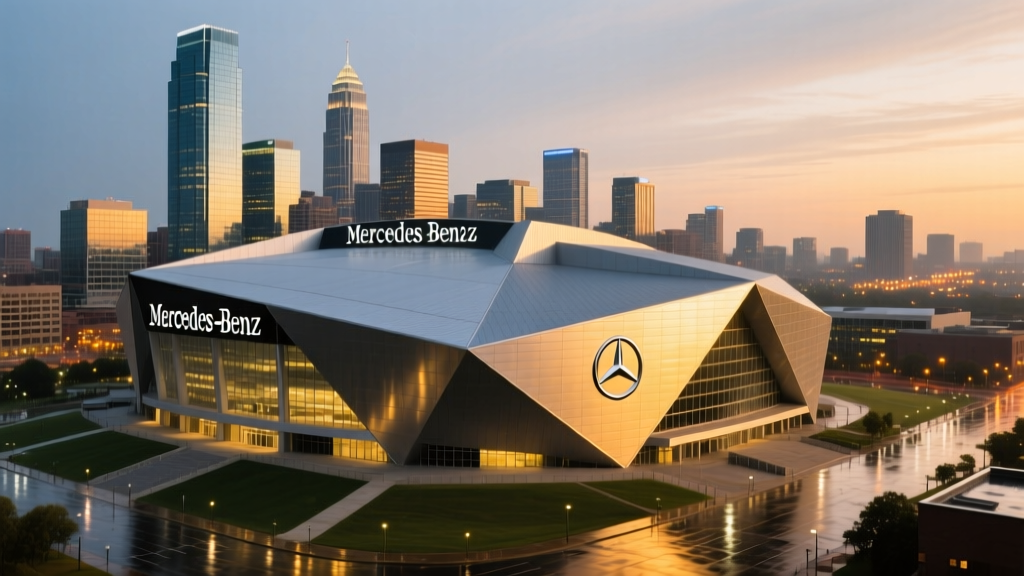
Construction firm H.J. Russell & Company and lead architect HOK collaborated to deliver the project. According to the Engineering News-Record, the stadium's complex geometry and mechanical systems pushed the budget beyond initial projections.
Funding Breakdown: Public vs. Private Investment
Financing the $1.5 billion project required a complex Public-Private Partnership (P3). A Public-Private Partnership (P3) is a cooperative arrangement between two or more public and private sectors, typically of a long-term nature, to fund, build, and operate public infrastructure or services.
Atlanta Falcons owner Arthur Blank provided $1.2 billion in private capital. This massive personal investment covered the majority of the structural and technological expenses. The remaining $300 million came from public sources, including the city of Atlanta, the state of Georgia, and a hotel-motel rental car tax.
Cost Drivers and Engineering Marvels
Several unique architectural choices significantly elevated the construction budget above standard open-air venues. The integration of advanced technology and moving structural parts required specialized global supply chains.
The Retractable Roof and Oculus
The stadium's signature feature is its mechanized roof, which operates like a camera aperture. This retractable oculus spans 71,000 square feet and consists of 16 massive translucent petals. A retractable oculus is a circular, mechanized roof opening that retracts symmetrically to expose the playing field to the sky, utilizing complex track and motor systems.
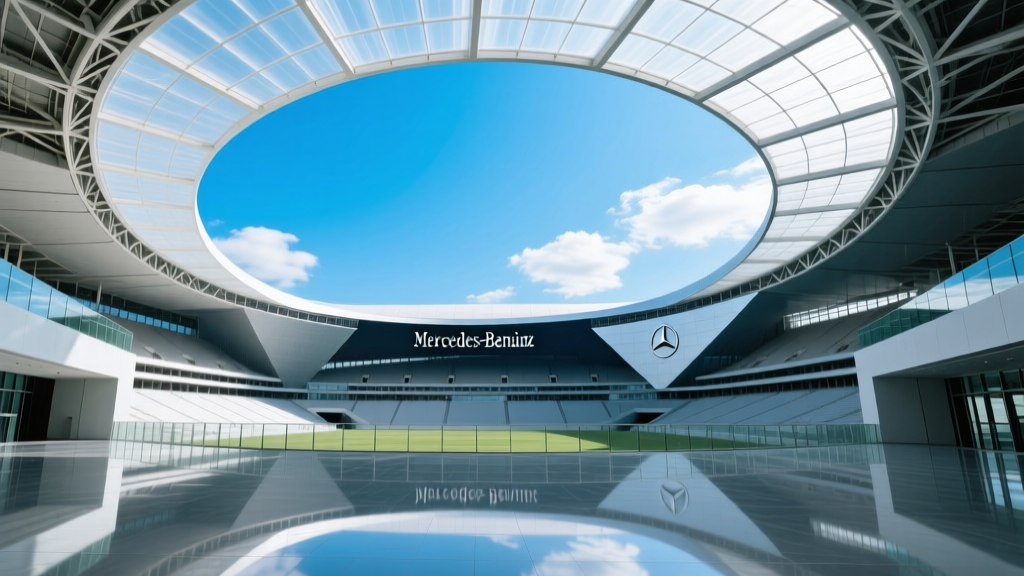
Building this mechanism required 14 million pounds of steel and specialized engineering from Massachusetts-based Geiger Engineers. The roof system alone accounted for roughly $200 million of the total budget.
Technology and Infrastructure
Mercedes-Benz Stadium was built as a smart venue with unprecedented digital infrastructure. The facility features a 360-degree halo video board measuring 1,100 feet in circumference. Furthermore, the stadium installed over 2,000 wireless access points to support 71,000 concurrent mobile users.
Mercedes-Benz Stadium vs. Other National Football League Stadiums
To contextualize the $1.5 billion expenditure, it is necessary to compare it with other recent National Football League mega-projects. The following decision framework and comparison matrix highlights how Mercedes-Benz Stadium ranks among its peers in terms of capital expenditure and seating capacity.
| Stadium Name | Location | Total Construction Cost | Seating Capacity | Cost Per Seat |
|---|---|---|---|---|
| SoFi Stadium | Inglewood, California | $5.5 billion | 70,240 | $78,302 |
| Allegiant Stadium | Paradise, Nevada | $1.9 billion | 65,000 | $29,230 |
| Mercedes-Benz Stadium | Atlanta, Georgia | $1.5 billion | 71,000 | $21,126 |
| MetLife Stadium | East Rutherford, New Jersey | $1.6 billion | 82,500 | $19,393 |
Data aggregated via The Stadium Business industry reports.
Frequently Asked Questions
How much did the city of Atlanta pay for Mercedes-Benz Stadium?
The city of Atlanta and the state of Georgia contributed a combined $300 million. This public money was primarily sourced from a $40 million bond, a regional transportation tax, and extensions on existing hotel and rental car taxes.
What is the most expensive National Football League stadium ever built?
SoFi Stadium in Inglewood, California, holds the record as the most expensive sports venue globally, costing $5.5 billion to construct. Mercedes-Benz Stadium ranks lower on the all-time list but remains one of the most technologically advanced.
Who was the lead architect for Mercedes-Benz Stadium?
The global architecture and engineering firm HOK served as the lead designer. They collaborated with local Atlanta firm H.J. Russell & Company to execute the complex geometric facade and interior layouts.
Conclusion and Next Steps
The $1.5 billion construction cost of Mercedes-Benz Stadium reflects a massive investment in mechanized architecture and digital fan experience. Arthur Blank's $1.2 billion private contribution minimized the public tax burden while delivering a world-class venue. For construction professionals analyzing modern stadium economics, the project demonstrates how unique features like a retractable oculus drastically increase steel and engineering costs.
To further your research, download the official Atlanta Falcons stadium financial disclosures or consult the Engineering News-Record archives for detailed structural case studies on large-span tension structures.
Written by
Marcus ChenMarcus Chen is a licensed structural engineer (PE) and building materials analyst with over 12 years of experience across residential, commercial, and industrial construction. He holds a Master of Science in Civil Engineering from UC Berkeley and spent six years at Thornton Tomasetti before transitioning to independent consulting and technical writing. Marcus specializes in material selection for seismic-prone regions, concrete reinforcement strategies, and lifecycle cost analysis. His work has been cited by the American Concrete Institute (ACI) and the Structural Engineers Association of California (SEAOC). When he is not on a job site or at his desk, you will find him hiking the Sierra Nevada or restoring a 1920s craftsman bungalow in Oakland, CA.
More from Marcus Chen
View all
Construction Cost
How Much Did the Eiffel Tower Cost to Build?
How much did the Eiffel Tower cost to build in 1889? We adjust for inflation and compare its budget to modern skyscraper construction.
Aug 4, 2026

Fire Resistance
What Is a Fire Resistant Material? Testing & Certification Guide
Discover what is a fire resistant material through ASTM and UL testing. Learn how fire ratings, certifications, and assemblies work in construction.
Aug 4, 2026

Construction Cost
How Much Did the Burj Khalifa Cost to Build?
How much did the Burj Khalifa cost to build? We break down the $1.5B project and extract 5 money-saving strategies for your next build.
Jul 30, 2026