How Much Does It Cost to Build an Inground Pool in 2026?
Discover how much it costs to build an inground pool in 2026. Breakdowns for concrete, fiberglass, and vinyl, plus excavation, permits, and hidden fees.

The 2026 National Average & Cost Ranges
Building an inground pool is a major capital improvement that requires precise financial forecasting. In 2026, the national average cost to build a standard-sized inground pool (approximately 14x28 feet or 16x32 feet) ranges from $55,000 to $95,000, with high-end custom gunite projects routinely exceeding $120,000. According to industry data tracked by Forbes Home, regional labor shortages and updated energy code compliance mandates have pushed baseline prices up by 4% to 7% compared to previous years.
The final invoice is rarely just the shell. A comprehensive budget must account for excavation, soil engineering, plumbing, electrical, mandatory safety barriers, and decking. Below is the baseline cost matrix for the three primary pool construction methods before site-specific variables are applied.
| Pool Type | Average Cost Range (2026) | Installation Timeline | Lifespan Before Major Renovation |
|---|---|---|---|
| Gunite / Shotcrete | $65,000 – $120,000+ | 3 – 6 Months | 10 – 15 Years (Resurfacing) |
| Fiberglass | $50,000 – $85,000 | 3 – 6 Weeks | 25+ Years (Gelcoat refresh) |
| Vinyl Liner | $35,000 – $65,000 | 4 – 8 Weeks | 7 – 10 Years (Liner replacement) |
Shell Materials Deep Dive: Gunite, Fiberglass, and Vinyl
Choosing your pool shell dictates not only the upfront cost but the structural engineering requirements and long-term maintenance liabilities.
Gunite (Dry-Mix Concrete)
Gunite pools are built on-site using a pneumatically applied dry-mix concrete process. They offer unlimited customization in shape, depth, and integrated features like tanning ledges and infinity edges. A structurally sound gunite shell requires an 8- to 12-inch thick application over a grid of 3/8-inch steel rebar tied on 10-inch centers. The concrete mix must achieve a minimum compressive strength of 3,000 to 4,000 PSI. While the design flexibility is unmatched, gunite is highly porous, requiring a plaster, pebble, or glass bead interior finish that will inevitably degrade from chemical exposure and require a $10,000 to $15,000 resurfacing every 10 to 15 years.
Fiberglass
Fiberglass pools are factory-molded, single-piece shells transported via flatbed truck and lowered into the excavation by a crane. The non-porous gelcoat surface resists algae growth, drastically reducing chemical and maintenance costs. However, fiberglass is constrained by highway transport regulations; shells cannot exceed 16 feet in width without requiring expensive oversize load permits and police escorts. Furthermore, the backfill process requires specific gravel or flowable fill materials to prevent hydrostatic pressure from popping the shell out of the ground if the water table rises.
Vinyl Liner
Vinyl pools utilize a custom-cut, 20- to 30-mil polymer membrane suspended over a frame made of galvanized steel, aluminum, or structural polymer panels. They offer the lowest initial entry price and a smooth surface that is gentle on skin. The critical vulnerability is the liner itself: sharp objects, pet claws, or improper chemical balancing can cause tears. Replacing a vinyl liner costs between $4,000 and $6,000, a recurring expense that narrows the long-term cost gap between vinyl and fiberglass.
Many builders quote 20-mil liners to keep initial bids low. Always upgrade to a 28-mil or 30-mil virgin vinyl liner with UV inhibitors. Thicker liners resist punctures and fading significantly better, delaying your first $5,000 replacement cycle by up to 4 years.
Site-Specific Variables: Where Budgets Go to Die
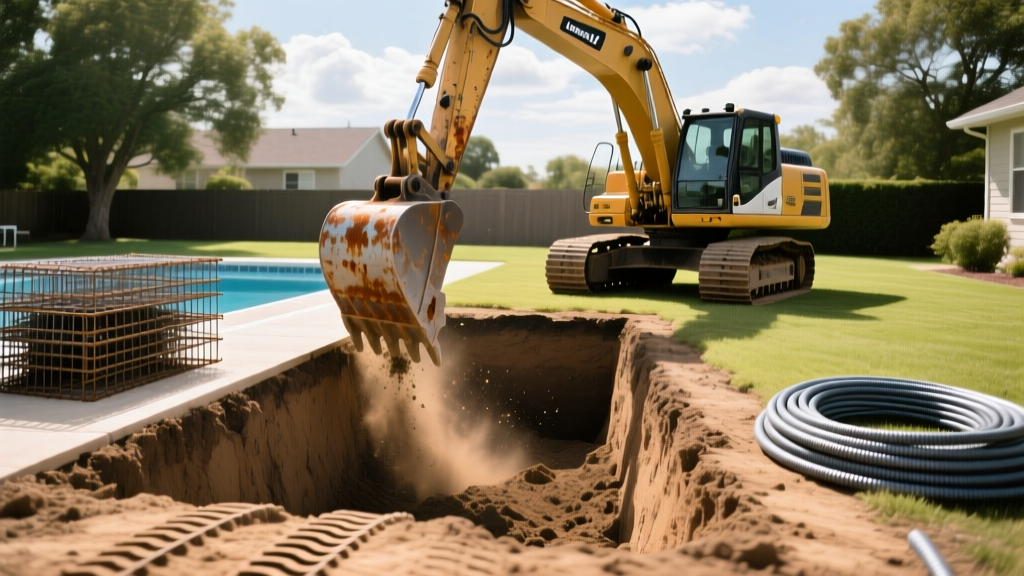
The most common cause of budget overruns in pool construction is subsurface conditions. Before signing a contract, allocate $1,500 to $2,500 for a geotechnical soil report. This upfront cost can save you tens of thousands in change orders.
- Standard Excavation (Dirt/Sand): $1,500 – $3,500. Standard trackhoe operations with easy soil removal.
- Expansive Clay: Requires over-excavation and backfilling with crushed stone to prevent soil swelling from cracking the pool shell. Adds $3,000 – $6,000.
- Bedrock / Ledge: If the excavator hits solid rock, blasting or mechanical hammering is required. Rock removal adds $5,000 to $15,000+ to the project, depending on the volume and local blasting ordinances.
- High Water Table: Building in coastal or low-lying areas often requires a wellpoint dewatering system to keep the hole dry during construction, plus the mandatory installation of a hydrostatic relief valve in the pool floor to prevent structural failure when the pool is drained. Adds $2,000 – $5,000.
Permits, Setbacks, and Code Compliance
Local municipalities enforce strict zoning and safety codes. Expect to pay $300 to $1,500 in building and electrical permits. Additionally, the Pool & Hot Tub Alliance (PHTA) and local adopters of the International Swimming Pool and Spa Code (ISPSC) mandate specific barrier requirements. You will likely need to install a 4-foot minimum fence with self-closing, self-latching gates, which costs $1,500 to $4,000 if your existing yard fencing does not meet code.
Mechanical, Plumbing, and Energy Standards
The mechanical pad is the heart of your pool. Outdated equipment will result in massive utility bills and premature failure. In 2026, the Department of Energy (DOE) strictly enforces energy conservation standards for pool pumps, effectively mandating variable speed technology for most residential installations.
Essential Equipment Specifications
| Component | Recommended Specification | Estimated Installed Cost |
|---|---|---|
| Pump | Variable Speed (e.g., Pentair IntelliFlo3 VSF) | $1,800 – $2,400 |
| Sanitation | Salt Chlorine Generator (e.g., Hayward AquaRite) | $1,500 – $2,200 |
| Heater | 140k BTU Titanium Heat Pump | $3,500 – $5,000 |
| Automation | Smart Panel with Wi-Fi & Smart Relays | $2,000 – $3,500 |
Plumbing Best Practices: Insist on rigid Schedule 40 PVC piping with a minimum diameter of 2 inches for all main drain and skimmer lines. Many budget builders use 1.5-inch pipe to save on materials, but this increases friction head loss, forcing the pump to work harder and consume more electricity. All underground plumbing must be pressure-tested to 40 PSI before the concrete deck is poured.
Safety Mandates: VGB Act and ASTM Standards
Federal law requires all public and residential pools to comply with the Virginia Graeme Baker (VGB) Pool and Spa Act. This mandates the installation of anti-entrapment drain covers that meet ASME/ANSI A112.19.8 standards. Ensure your builder uses dual main drains plumbed in series, spaced at least 3 feet apart, to completely eliminate suction entrapment risks.
For homes with young children, an automatic safety cover meeting ASTM F1346 standards is a highly recommended upgrade. While it adds $8,000 to $12,000 to the initial build, it prevents unauthorized access, retains up to 90% of the pool's heat, and drastically reduces water evaporation and chemical off-gassing.
Long-Term Operational Realities
Understanding how much it costs to build an inground pool is only half the equation; operational costs dictate the true lifetime value. According to Bankrate's housing analysis, homeowners should budget between $1,500 and $3,500 annually for routine maintenance, chemicals, water, and electricity.
Running a single-speed 2.0 HP pump costs roughly $1,200 per year in electricity. Upgrading to a variable speed pump running at low RPMs for filtration drops that annual cost to $200 – $300. The premium for the variable speed pump pays for itself in energy savings within 18 to 24 months.
Insurance and Property Tax Implications
Adding an inground pool will trigger a reassessment of your property in many counties, potentially increasing your annual property taxes by $500 to $1,500. Furthermore, you must notify your homeowner's insurance provider. Expect your annual premium to increase by $100 to $300, and insurers will almost universally require an umbrella liability policy (typically $1M to $2M in coverage) to protect against premises liability claims.
Ultimately, a successful pool build relies on vetting the contractor's structural engineering practices, not just their aesthetic portfolio. Demand detailed line-item bids that specify rebar sizes, PVC diameters, equipment model numbers, and exact soil backfill materials to ensure your investment survives the decades.
Written by
James ThorntonJames Thornton is a construction industry veteran with 25 years of hands-on experience in wood framing, lumber grading, and residential building codes. He started as a framing carpenter in rural Oregon, earned his ICC Residential Building Inspector certification, and eventually became a senior plan reviewer for the City of Portland Bureau of Development Services. James holds a B.S. in Wood Science & Technology from Oregon State University and is a certified lumber grader through the West Coast Lumber Inspection Bureau (WCLIB). He has inspected over 3,000 residential construction sites and authored the city's internal guide on advanced framing techniques (2x6 at 24" O.C.). James lives in Bend, OR, where he builds custom timber-frame cabins and competes in lumberjack sports.
More from James Thornton
View all
Insulation
Best Home Insulation Materials: Complete 2026 Guide
Compare top home insulation materials for 2026. Find R-values, installed costs per square foot, and best uses for fiberglass, spray foam, and mineral wool.
Aug 4, 2026

Sustainable Building
Certify Your Green Building Material for LEED and WELL
Step-by-step guide to certifying a green building material for LEED v5 and WELL v2. Master EPDs, HPDs, and VOC limits for 2026 project specifications.
Aug 4, 2026

Stone & Masonry
Veneer Stacked Stone Panels: Interior Design & Style Showcase
Discover how veneer stacked stone panels transform interiors. Explore modern design profiles, material pairings, and technical installation specs.
Aug 4, 2026