How Much Does a Rocket Cost to Build? 2026 Complete Cost Guide
Discover how much a rocket costs to build in 2026. We break down material, propulsion, labor, and launch pad construction costs for orbital vehicles.

The Ultimate Aerospace Construction Breakdown
When evaluating how much does a rocket cost to build, estimators must separate research and development (R&D) amortization from the marginal hardware and ground infrastructure costs. Building an aerospace vehicle is the pinnacle of structural engineering, requiring extreme tolerances, exotic metallurgy, and specialized integration facilities. In 2026, the shift toward reusable architectures and advanced manufacturing techniques like friction stir welding and 3D-printed superalloys has fundamentally altered the cost baseline for both commercial and state-sponsored launch providers.
According to data analyzed by the Center for Strategic and International Studies (CSIS) Aerospace Security Project, the marginal cost to manufacture a modern medium-lift orbital vehicle has dropped significantly over the last decade, primarily due to vertical integration and reusable tooling. However, the ground construction and testing infrastructure required to support these vehicles remains a massive capital expenditure.
Cost Tiers: From Amateur to Heavy Orbital Class
Rocket construction costs scale non-linearly with payload capacity and target altitude. The table below outlines the baseline hardware and supporting infrastructure costs across four primary construction tiers in 2026.
| Vehicle Class | Target Altitude | Primary Propulsion | Hardware Cost (Marginal) | Ground Infrastructure Cost |
|---|---|---|---|---|
| High-Power Amateur | <10 km | Solid / Hybrid | $2,000 - $15,000 | $500 - $2,000 |
| Sounding / Suborbital | 100+ km (Karman Line) | Solid / Liquid Hybrid | $250,000 - $2.5M | $1M - $5M |
| Light Orbital (e.g., Electron-class) | Low Earth Orbit (LEO) | Liquid (LOX/RP-1) | $7M - $15M | $15M - $30M |
| Heavy Orbital (e.g., Falcon 9-class) | LEO / GTO | Liquid (LOX/RP-1 / Methane) | $15M - $65M | $50M - $150M+ |
Material Costs: Aerospace Alloys and Composites
The airframe and propellant tanks account for roughly 15% to 25% of the total vehicle hardware cost. Material selection dictates not only the raw material price but also the machining and welding labor required.
- Aluminum-Lithium (Al-Li 2195): The traditional standard for cryogenic tanks (used in the Space Launch System and Orion). Raw material costs hover around $120 to $160 per kilogram. It requires highly controlled friction stir welding and expensive non-destructive testing (NDT) to prevent micro-cracking.
- Carbon Fiber Reinforced Polymer (CFRP): Used extensively in light orbital vehicles for upper stages and fairings. Aerospace-grade prepreg carbon fiber costs $200 to $400 per kilogram, plus the cost of autoclave curing cycles, which can add $10,000+ per bake depending on the part volume.
- 304L / 301 Stainless Steel: Popularized by modern heavy-lift reusable architectures. While the raw material is remarkably cheap ($4 to $8 per kilogram), the sheer mass of the vehicle increases transportation and handling costs. Furthermore, stainless steel requires advanced TIG or laser welding techniques to maintain structural integrity under cryogenic and high-heat conditions.
- Inconel 718 and Copper Alloys (GRCop-42): Reserved almost exclusively for combustion chambers, nozzles, and turbopumps. Inconel 718 costs upwards of $100 per kilogram, but the 5-axis CNC machining and electron beam melting (EBM) 3D printing processes drive the final cost of a single engine bell to $250,000 or more.
Propulsion Systems: The Budget Anchor
The propulsion system is the most expensive single subsystem on any orbital vehicle, typically consuming 40% to 60% of the total manufacturing budget. Building a liquid rocket engine requires precision machining of turbopumps that spin at 30,000+ RPM while handling cryogenic oxidizers.
Engine Manufacturing Costs
A modern gas-generator cycle engine (producing 150,000 to 250,000 lbf of thrust) costs between $1.5 million and $3 million to manufacture in low-rate initial production. Transitioning to a full-flow staged combustion cycle (utilizing both fuel-rich and oxidizer-rich preburners) increases the part count and metallurgical complexity, pushing the per-engine cost to $5 million to $12 million during early production runs. As production scales and additive manufacturing replaces traditional cast-and-weld assemblies, these costs can be reduced by up to 40%.
Rocket propulsion technology is strictly regulated under the International Traffic in Arms Regulations (ITAR) in the United States. Compliance requires specialized legal counsel, secure facility construction (SCIFs), and rigorous supply chain auditing. Budget an additional $250,000 to $500,000 annually purely for ITAR compliance infrastructure and personnel when establishing a new propulsion manufacturing facility.
Labor, Integration, and Cleanroom Construction
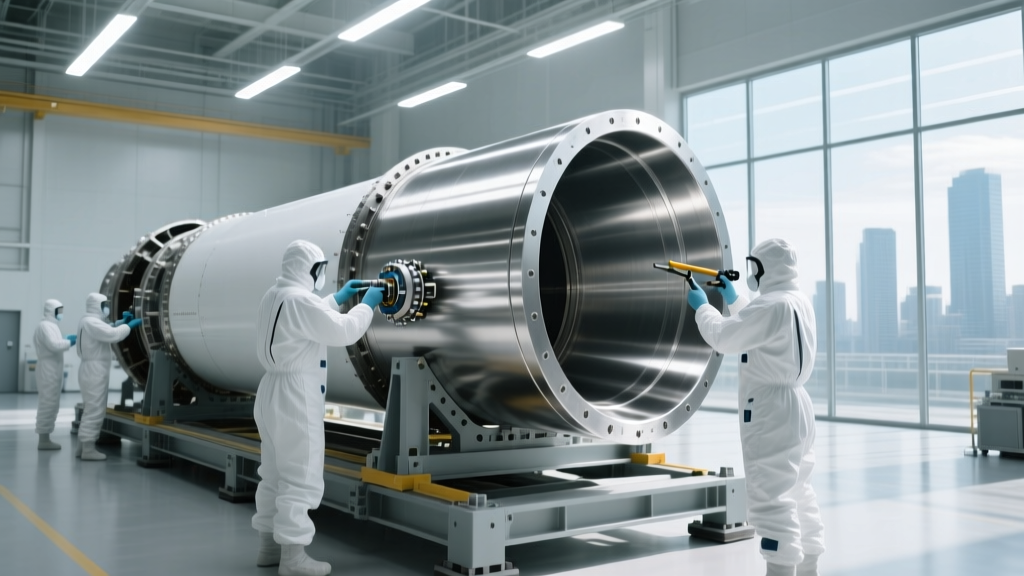
Aerospace assembly cannot be performed in standard warehouses. Vehicle integration requires ISO Class 7 or Class 8 cleanrooms to prevent particulate contamination in avionics bays and fluid lines. Constructing a 10,000-square-foot aerospace cleanroom costs between $150 and $300 per square foot, heavily dependent on HVAC filtration requirements and positive pressure systems.
Labor rates for specialized aerospace personnel are a major cost driver:
- Aerospace TIG Welders (AWS D17.1 Certified): $85 to $150 per hour. Welding thin-gauge Al-Li or stainless steel tank domes requires X-ray certified welders with years of specialized experience.
- Avionics Integration Technicians: $70 to $120 per hour. Responsible for routing shielded harnesses and testing redundant flight computers.
- Propulsion Test Engineers: $120,000 to $180,000+ annual salary. Required on-site during all static fire and hot-fire testing campaigns.
Ground Infrastructure and Launch Pad Construction
Building the rocket is only half the equation; building the launch infrastructure is a massive civil and mechanical engineering project. The Federal Aviation Administration (FAA) Office of Commercial Space Transportation mandates strict environmental and safety guidelines for launch site construction, which heavily influence site preparation costs.
The Flame Trench and Deluge System
An orbital-class launch pad requires a massive flame trench to deflect exhaust away from the vehicle. This involves excavating up to 20,000 cubic yards of earth and pouring deep-pile foundations using Type V sulfate-resistant Portland cement to withstand chemical attack from exhaust byproducts. The trench walls must be lined with high-alumina refractory concrete (such as RESCOCAST 17) or castable ceramics capable of withstanding 3,000°F (1,650°C) thermal shock.
To protect the pad and the vehicle from acoustic energy, a sound suppression deluge system is required. This involves constructing reinforced concrete water towers or subterranean cisterns holding 300,000 to 500,000 gallons of water, paired with high-pressure pump stations capable of dumping 90,000 gallons per minute onto the pad during ignition.
Propellant Storage and Transfer
Storing Liquid Oxygen (LOX) and refined kerosene (RP-1) or Liquid Methane (LCH4) requires specialized cryogenic storage tanks. A 50,000-gallon vacuum-jacketed LOX storage tank costs between $1.2 million and $2.5 million, including the specialized foundation and vaporizer systems. Transfer lines must be constructed from vacuum-insulated stainless steel piping, with automated pneumatic valves rated for cryogenic shock.
Testing and Quality Assurance Overhead
Before a rocket reaches the pad, it undergoes brutal qualification testing. Budgeting for testing infrastructure and consumables is critical:
- Vibration and Acoustic Testing: Shaker tables large enough for orbital fairings cost $5M+ to install. Outsourcing to third-party test facilities costs $15,000 to $30,000 per day.
- Hydrostatic Proof Testing: Tanks are pressurized with water to 1.25x or 1.5x their flight pressure. This requires heavy-duty test stands and high-pressure fluid pumps.
- Static Fire Campaigns: Firing the assembled first stage on a test stand consumes thousands of gallons of propellant per test. A single full-duration static fire can cost $500,000 to $1.5 million in propellant, facility wear-and-tear, and labor.
For a comprehensive look into the historical and current data on launch vehicle economics and infrastructure requirements, the NASA Technical Reports Server (NTRS) provides extensive engineering documentation on facility design and propulsion testing methodologies.
Summary: Estimating the Final Invoice
Answering "how much does a rocket cost to build" requires a holistic view of the entire launch ecosystem. While the physical orbital vehicle may cost between $15 million and $65 million in raw materials and direct labor, the supporting cleanrooms, test stands, and launch pad civil works can easily double or triple the initial capital expenditure. For construction estimators and aerospace project managers, success lies in optimizing the balance between exotic materials, manufacturing scalability, and robust ground infrastructure.
Written by
David NakamuraDavid Nakamura is a licensed architect (AIA) and construction technology writer focused on sustainable building methods, mass timber engineering, and high-performance building envelopes. He holds a Master of Architecture from the University of Washington and is a certified Passive House Consultant (CPHC). David spent eight years at the Seattle firm Mithun, where he led the design of three LEED Platinum projects, before founding his own practice specializing in net-zero residential design. He serves on the editorial advisory board of GreenBuilder Magazine and has authored peer-reviewed papers on cross-laminated timber (CLT) connections for the Journal of Structural Engineering. In his spare time, David teaches woodworking at Pratt Fine Arts Center and kayaks the Puget Sound.
More from David Nakamura
View all
Construction Cost
Labor Cost to Build a Deck Per Sq Ft: 2026 Installation Guide
Discover the exact labor cost to build a deck per sq ft in 2026. This installation guide breaks down contractor rates, complexity factors, and hidden fees.
Aug 4, 2026

Construction Cost
How Much Does It Cost to Build a 3 Bedroom House? Financing Guide
Learn exactly how much it costs to build a 3 bedroom house and explore 2026 financing options, construction loan types, and budget frameworks for your build.
Aug 4, 2026

Construction Cost
Cost to Build a Tennis Court: 2026 Guide
How much does it cost to build a tennis court in 2026? Breakdowns for asphalt, concrete, and synthetic surfaces plus fencing and lighting.
Jul 30, 2026