Cost to Build a Miniature Golf Course: 2026 Budget Guide
Plan your budget with our 2026 guide on the cost to build a miniature golf course. Breakdowns for site prep, concrete, synthetic turf, and obstacles.

The Financial Baseline: Commercial vs. High-End Residential
Estimating the cost to build a miniature golf course requires separating backyard DIY projects from commercial family entertainment centers (FECs). A residential backyard course relies on pre-fabricated kits and basic landscaping, whereas a commercial 18-hole facility demands engineered drainage, commercial-grade synthetic turf, and custom-fabricated fiberglass obstacles. In 2026, material costs for specialized polymers and reinforced concrete have stabilized, but labor and permitting fees continue to dictate the upper limits of your budget.
| Project Scale | Cost Per Hole | Total 18-Hole Estimate | Primary Materials |
|---|---|---|---|
| Backyard / DIY | $500 - $2,500 | $9,000 - $45,000 | Interlocking plastic tiles, basic astroturf, wooden borders |
| Mid-Tier Commercial | $15,000 - $22,000 | $270,000 - $396,000 | Poured concrete, 50oz turf, standard fiberglass obstacles |
| Premium Custom FEC | $25,000 - $40,000+ | $450,000 - $720,000+ | Shotcrete hardscaping, 70oz turf, animatronics, LED theming |
Phase 1: Earthwork, Drainage, and Hardscaping
The most common cause of miniature golf course failure is inadequate subsurface drainage. Water pooling on the playing surface ruins the turf backing and creates unplayable lies. Budgeting for site preparation must account for soil testing, grading, and a robust drainage network.
Concrete and Base Specifications
Commercial courses utilize a 4-inch to 6-inch thick concrete pad as the foundational substrate. According to guidelines referenced by the American Concrete Institute (ACI), exterior flatwork exposed to freeze-thaw cycles requires air-entrained concrete with a minimum compressive strength of 4,000 PSI. For miniature golf, the mix design should incorporate a 3/8-inch aggregate and fiber-mesh reinforcement to prevent micro-cracking that can telegraph through the synthetic turf.
- Forming and Sloping: The concrete pad must be formed with a 1% to 2% positive slope toward perimeter trench drains. Flat surfaces will trap water beneath the turf.
- Perimeter Hardscaping: Budget an additional $12 to $18 per linear foot for stamped or broom-finished concrete borders. These borders act as retaining walls for the turf infill and provide ADA-accessible pathways between holes.
- Sub-base Drainage: Install 4-inch perforated PVC piping wrapped in non-woven geotextile fabric beneath the concrete base, tying into municipal storm drains or dry wells.
Phase 2: Synthetic Turf and Playing Surface
The putting surface is the core product you are selling. Standard landscaping artificial grass is entirely unsuitable for miniature golf; it lacks the density to support a rolling golf ball and will cause the ball to bounce or deviate. You must specify turf engineered specifically for putting greens.
Required Turf Specifications for Commercial Greens
- Yarn Material: 100% Polyethylene (texturized or nylon-blend for high-traffic tee boxes).
- Pile Height: 0.375 inches to 0.5 inches (shorter pile ensures true ball roll).
- Face Weight: Minimum 60 oz/yd² (premium courses use 70 oz/yd² to 80 oz/yd² for maximum density).
- Infill: 12-20 mesh rounded silica sand. Never use angular sand or crumb rubber, which will alter the ball's trajectory. Apply at a rate of 1.5 to 2.0 lbs per square foot.
For comprehensive manufacturing and testing standards, refer to the Synthetic Turf Council (STC) guidelines on sports-specific surfacing.
When calculating turf costs, factor in a 10% to 15% waste allowance for cutting around curves, obstacles, and drainage grates. Professional installation, which includes power-brooming the infill to stand the yarn fibers upright, typically adds $4.50 to $7.00 per square foot to the material cost.
Phase 3: Obstacles, Theming, and Electrical
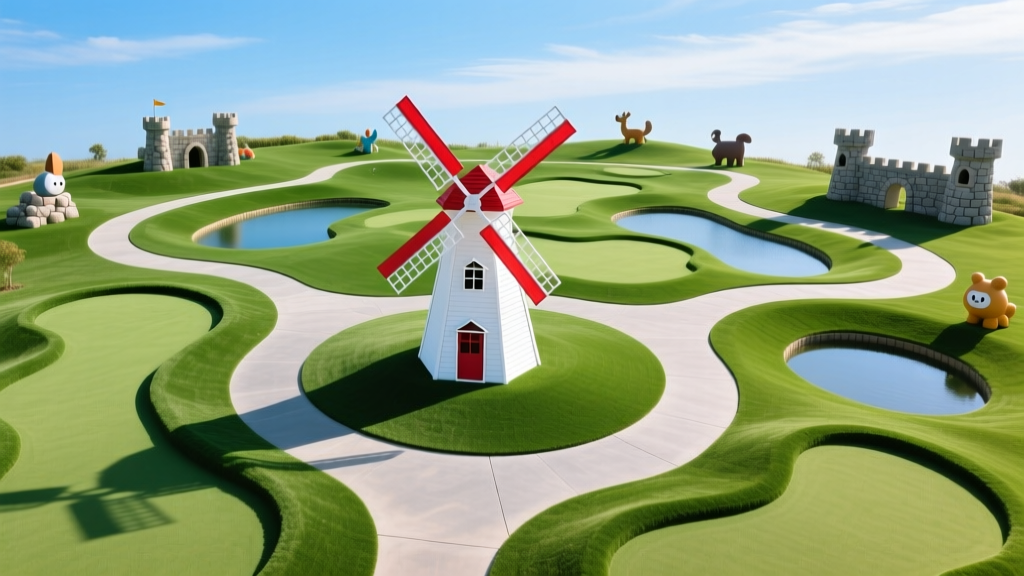
Obstacles transform a basic putting green into a miniature golf course. The cost variance in this phase is massive, depending on whether you choose static props or kinetic, animatronic features.
| Obstacle Type | Average Cost Per Unit | Maintenance Profile |
|---|---|---|
| Static Fiberglass (e.g., Windmill, Lighthouse) | $3,500 - $8,000 | Low: Occasional UV-clear coat reapplication |
| Structural Steel / Rope Climbing | $10,000 - $18,000 | Medium: Annual rust inspections and tensioning |
| Kinetic / Animatronic (e.g., Moving Pirates) | $25,000 - $60,000+ | High: Requires specialized HVAC and monthly mechanical servicing |
| Custom Rockwork (GFRC - Glass Fiber Reinforced Concrete) | $150 - $300 per sq ft | Low: Highly durable, requires occasional acrylic sealing |
Lighting and Low-Voltage Electrical
Nighttime play can increase a commercial course's revenue by up to 40%. Budgeting for lighting requires trenching for underground PVC conduit before the concrete is poured. Specify IP67-rated, low-voltage LED strip lighting for obstacle perimeters and 120V LED floodlights mounted on 16-foot galvanized poles for general course illumination. Expect to allocate $18,000 to $35,000 for a fully illuminated 18-hole electrical grid, including commercial panel upgrades.
Phase 4: Soft Costs and Permitting
Construction materials are only part of the financial equation. The International Association of Amusement Parks and Attractions (IAAPA) frequently highlights that soft costs can derail FEC budgets if not properly forecasted. You must budget for the following pre-construction and administrative expenses:
- Architectural and Engineering (A&E) Fees: 8% to 12% of total hard construction costs. This includes stamped civil engineering plans for stormwater management and ADA compliance routing.
- Zoning and Conditional Use Permits: Miniature golf courses are often classified as outdoor amusement facilities. Depending on your municipality, securing a conditional use permit (CUP) can cost between $2,500 and $15,000 and take 3 to 6 months.
- Impact Fees and Utility Hookups: Water and sewer tap fees for the concession stand and restrooms can range from $10,000 to $40,000 depending on local municipal rates.
- Landscaping Buffers: Many zoning boards require dense vegetative buffers (e.g., 6-foot tall arborvitae) to shield neighboring residential properties from noise and LED light pollution. Budget $25 to $45 per linear foot for mature privacy plantings.
Budget Allocation Framework: The 18-Hole Commercial Build
To maintain financial control during the build, allocate your capital according to this proven percentage framework. This prevents over-investing in visible elements (like animatronics) while starving the invisible infrastructure (like drainage).
- Site Prep, Grading & Drainage: 15%
- Concrete Hardscaping & Borders: 25%
- Synthetic Turf & Infill Installation: 20%
- Obstacles, Theming & GFRC Rockwork: 25%
- Electrical, Lighting & Audio: 8%
- Soft Costs, Permits & Contingency: 7%
Estimator's Warning: Never reduce your concrete base thickness to afford a more expensive fiberglass obstacle. A 3-inch concrete pad will inevitably crack under thermal expansion and soil settling, causing the synthetic turf above it to ripple and create unplayable 'dead zones' on the green. The substrate is permanent; the obstacles can be upgraded in year three once cash flow is established.
Accurately forecasting the cost to build a miniature golf course requires treating the project as a specialized commercial landscape build rather than a simple recreational installation. By strictly adhering to 4,000 PSI concrete standards, specifying 60+ oz polyethylene turf, and properly funding subsurface drainage, you ensure the facility generates revenue for decades without requiring catastrophic structural renovations.
Written by
Elena RodriguezElena Rodriguez is a civil engineer and technical writer specializing in concrete technology, masonry systems, and ASTM/ACI compliance. She earned her B.S. in Civil Engineering from Texas A&M University and spent a decade at a materials testing laboratory, performing over 2,000 concrete compressive strength tests and masonry prism evaluations. Elena is an ACI-certified Field Testing Technician (Grade I) and a member of ASTM Committee C12 on Natural Building Stone. She currently consults on forensic engineering cases involving concrete failures and moisture intrusion. Based in San Antonio, TX, Elena is a proud member of the Society of Women Engineers (SWE) and coaches her daughter's FIRST Robotics team.
More from Elena Rodriguez
View all
Walls & Panels
Cost Analysis: Light Gauge Steel Framing Advantages and Disadvantages
Evaluate light gauge steel framing advantages and disadvantages through a strict cost analysis lens, comparing material, labor, and lifecycle expenses.
Aug 4, 2026

Walls & Panels
Gypsum Board Types: Exact Specifications, Thickness & Dimensions
Compare standard, Type X, and moisture-resistant gypsum board types. Get exact specifications, thicknesses, dimensions, and ASTM standards for your project.
Aug 4, 2026

Fire Resistance
Best Fire-Resistant Outdoor Decking Materials: 2026 Buyer Guide
Discover the best fire-resistant outdoor decking materials for 2026. Compare Class A PVC, aluminum, and hardwood options for WUI compliance and safety.
Aug 4, 2026