Smart Strategies to Lower the Cost to Build a Baseball Field
Discover actionable strategies to reduce the cost to build a baseball field. Learn budget-friendly grading, turf, and lighting choices for modern projects.

Baseline Metrics: The True Cost to Build a Baseball Field
Estimating the cost to build a baseball field requires moving beyond generic averages. A facility designed for Little League differs vastly in engineering, material requirements, and regulatory compliance compared to a high school or collegiate diamond. Before applying money-saving strategies, you must understand the baseline capital expenditure for your specific tier of play.
| Facility Tier | Baseline Dimensions | Estimated Cost Range | Primary Cost Drivers |
|---|---|---|---|
| Youth / Little League | 60-foot bases, 200-225 ft outfield | $60,000 - $150,000 | Basic grading, chain-link fencing, natural grass |
| High School | 90-foot bases, 325-350 ft outfield | $250,000 - $600,000 | Laser grading, engineered drainage, LED lighting |
| Collegiate / Pro | 90-foot bases, 330-400 ft outfield | $1,000,000 - $3,000,000+ | Synthetic turf, advanced sub-surface drainage, stadium amenities |
To actively reduce the cost to build a baseball field without compromising player safety or playability, project managers must target the three highest expense categories: earthwork, infield material selection, and electrical infrastructure.
Phase 1: Earthwork and Grading Strategies
Site preparation and grading typically consume 30% to 40% of the total construction budget. The most common budget-killer is the import and export of soil. Hauling away unsuitable native clay and importing engineered topsoil can cost between $15 and $35 per cubic yard.
The 'Cut and Fill' Balance
To minimize hauling fees, mandate a cut-and-fill balance in your grading plan. By utilizing 3D GPS-guided bulldozers, contractors can scrape high spots and fill low spots using the site's existing soil. If your native soil has a percolation rate slower than 0.5 inches per hour, you will need to amend it rather than replace it. Tilling in 3 to 4 inches of coarse sand and organic compost into the top 6 inches of native clay improves drainage at a fraction of the cost of importing a full sand-based rootzone profile.
Do not skip laser grading to save $3,000 to $5,000 upfront. Manual grading inevitably leaves micro-depressions that pool water, leading to $15,000+ in turf replacement and re-grading costs within the first two years. Laser grading to a 0.5% to 1% slope ensures immediate surface drainage, protecting your turf investment.
Phase 2: Infield Material Selection and Sourcing
The skinned area (infield dirt) requires highly specific engineering to maintain proper moisture retention, cleat traction, and ball bounce. Using standard topsoil or masonry sand will result in an unplayable surface that turns to concrete when dry and mud when wet.
Comparing Engineered Infield Mixes
According to guidelines published by the American Sports Builders Association (ASBA), an engineered infield mix should consist of roughly 55-65% sand, 20-30% silt, and 15-20% clay. Here is how the top commercial options compare in cost and performance:
- DuraEdge ProSlide: A premium, engineered mix heavily favored by professional groundskeepers. It offers exceptional moisture management but costs between $90 and $120 per ton delivered.
- Turface MVP: A calcined clay soil conditioner. While not a complete infield mix on its own, blending Turface MVP ($65-$85 per ton) into a local, less-expensive native loam can mimic the performance of premium mixes at a 40% lower overall cost.
- Local Dirt & Sand Blends: For youth fields on a strict budget, sourcing a local 60/40 sand-to-clay blend from a regional quarry ($20-$35 per ton) and top-dressing with 2 tons of calcined clay provides a highly playable surface without the cross-country freight costs of branded mixes.
'Freight costs often exceed the material costs for engineered infield dirt. Sourcing a base blend within a 50-mile radius and amending it locally is the single most effective way to lower the cost to build a baseball field's skinned areas.' - Senior Sports Turf Manager
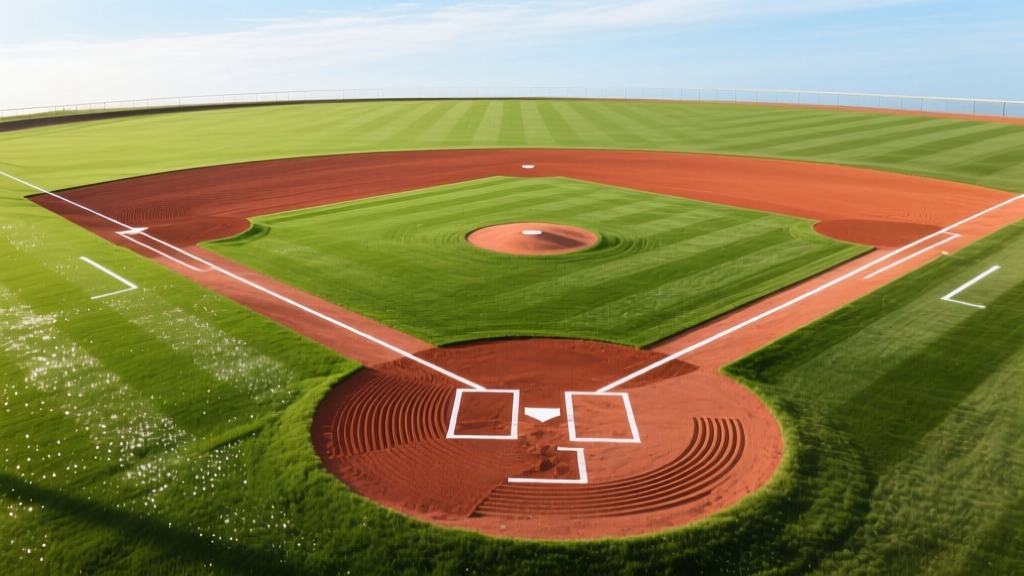
Phase 3: Outfield Turf – Seed vs. Sod vs. Synthetic
The outfield represents the largest square footage of the project. Your choice of turf establishment directly impacts both immediate capital expenditure and long-term maintenance.
| Turf Method | Initial Cost (Per Sq. Ft.) | Time to Playability | Best Use Case |
|---|---|---|---|
| Hydroseed / Drill Seed | $0.15 - $0.35 | 12 - 18 Months | Phased builds, municipal parks with delayed opening dates |
| Big-Roll Sod | $0.85 - $1.50 | 3 - 4 Weeks | High schools, rapid-turnaround community projects |
| Synthetic Turf | $8.00 - $14.00 | Immediate | Multi-use facilities, high-rainfall climates, collegiate |
The Money-Saving Strategy: If your timeline allows for a 12-to-18-month grow-in period, drill-seeding a blend of Kentucky Bluegrass and Perennial Ryegrass (in northern climates) or Bermuda grass (in southern climates) saves tens of thousands of dollars compared to sod. To protect the seed and accelerate germination, use a bonded fiber matrix (BFM) mulch rather than traditional straw, which introduces weed seeds and requires costly removal later.
Phase 4: Lighting and Fencing Economics
Lighting and fencing are often treated as afterthoughts, but they represent massive opportunities for lifecycle cost reduction.
LED vs. Metal Halide Lighting
While traditional 1500W Metal Halide fixtures have a lower upfront purchase price, modern 500W LED sports fixtures (such as those from Musco or Ephesus) reduce energy consumption by 60% and eliminate the $400-per-bulb replacement cycle required every 3,000 hours. When calculating the cost to build a baseball field, always factor in the 10-year total cost of ownership. Many municipalities now offer commercial energy rebates that cover 20% to 30% of LED installation costs, effectively making the upfront price competitive with outdated metal halide systems.
Fencing Specifications
Do not over-engineer the perimeter fencing, but never under-engineer the backstop.
Perimeter Fencing: Use standard 2 3/8-inch Outside Diameter (OD) galvanized steel posts with 11-gauge chain link fabric.
Backstop: Upgrade to 2 7/8-inch OD posts and 6-gauge chain link fabric with a vinyl padding sleeve. The backstop takes the direct impact of foul tips and wild pitches; using 11-gauge wire here will result in sagging and structural failure within five years.
The Phased Construction Framework
When capital is constrained, attempting to build the entire facility at once leads to value-engineering that compromises critical infrastructure. Instead, utilize a phased construction approach. This allows organizations to secure initial funding, build the core asset, and generate revenue or secure grants for subsequent phases.
- Phase 1: Subgrade and Drainage (Year 1)
Clear the site, balance the soil, install the main collector pipes, and laser-grade the sub-base. This is the most disruptive phase and must be done correctly from day one. - Phase 2: Infield and Skinned Areas (Year 1)
Install the engineered infield mix, pitcher's mound, and home plate. These areas require precise elevation tolerances that are difficult to retrofit later. - Phase 3: Outfield Turf and Fencing (Year 1-2)
Seed or sod the outfield and erect the perimeter chain-link fencing to secure the site. - Phase 4: Lighting and Amenities (Year 2-3)
Install light poles, dugouts, and bleachers once additional fundraising or municipal budgets are replenished.
Long-Term Maintenance Forecasting
A cheap build often results in an expensive maintenance burden. According to the Sports Field Management Association, a poorly drained natural grass field can cost upwards of $25,000 annually in aeration, topdressing, and turf repair. By investing an extra $15,000 upfront in a herringbone subsurface drainage system (using 4-inch perforated PVC pipes wrapped in filter fabric and buried in gravel trenches), you reduce annual turf rehabilitation costs by up to 70%. Always evaluate the cost to build a baseball field through the lens of a 10-year maintenance horizon, ensuring that today's material savings do not become tomorrow's operational liabilities.
Written by
Sarah WhitfieldSarah Whitfield is a chartered quantity surveyor (MRICS) and construction cost analyst with 15 years of experience in material pricing, procurement strategy, and project budgeting. She earned her degree in Construction Management from the University of Reading (UK) and has worked on projects ranging from $2M custom homes to $180M mixed-use developments across North America and Europe. Sarah currently leads cost estimating for BuildMat Insight, maintaining a proprietary database of 4,000+ material price points updated quarterly. She is a frequent contributor to RSMeans cost data panels and has presented at the International Cost Engineering Council (ICEC) congress. Based in Denver, CO, Sarah is an avid trail runner and volunteer mentor for Women in Construction.
More from Sarah Whitfield
View all
Wood & Lumber
What Are the Different Types of Wood? A Builder's Guide
Compare structural softwoods, finish hardwoods, and engineered lumber. Analyze Janka ratings, MOE values, and 2026 pricing for construction.
Aug 4, 2026

Walls & Panels
Steel Framing vs Wood Framing: Corrosion and Moisture Defense
Compare steel framing vs wood framing for moisture resistance. Learn about galvanized coatings, condensation risks, and corrosion protection strategies.
Jul 21, 2026

Stone & Masonry
How to Cut Stone Veneer: Wet Saw vs Grinder Comparison
Compare the best tools for cutting stone veneer. We review wet saws, angle grinders, and chop saws to help you achieve clean, chip-free cuts.
Jul 21, 2026