How Much Does a Mobile App Cost to Build for Construction Firms?
Discover how much does a mobile app cost to build in 2026. Complete cost guide for construction apps, covering offline sync, tech stacks, and MVP budgets.
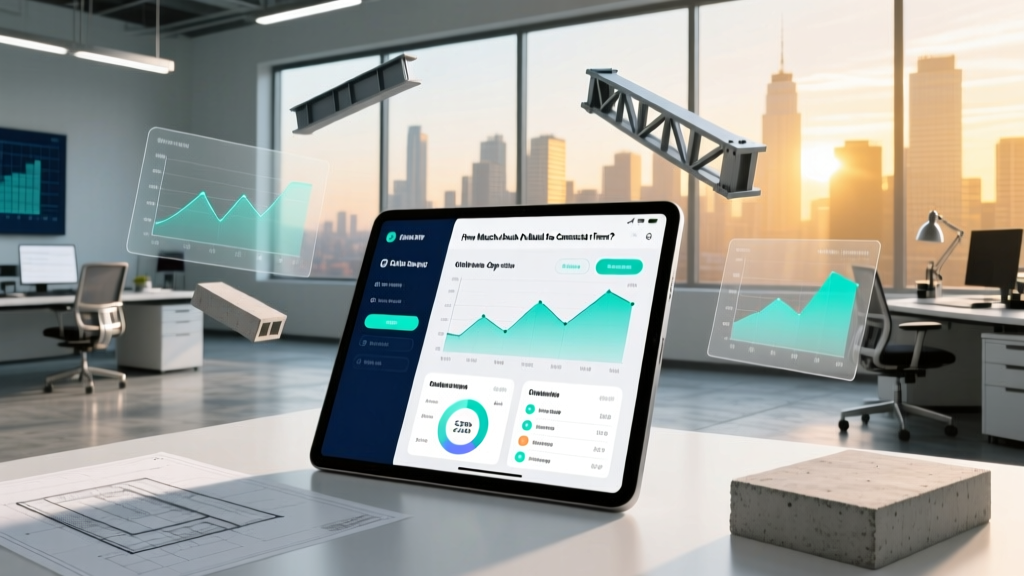
How Much Does a Mobile App Cost to Build for Construction Firms?
When general contractors and specialty trades ask how much does a mobile app cost to build, the answer hinges entirely on field conditions. Unlike consumer apps that rely on constant 5G connectivity, construction apps must function in concrete basements, remote grading sites, and steel-framed high-rises where cellular signals fail. In 2026, building a custom mobile application for construction management, field estimating, or daily reporting typically ranges from $45,000 for a basic Minimum Viable Product (MVP) to over $350,000 for an enterprise-grade, offline-first platform with BIM integration.
2026 Executive Cost Summary
- Basic MVP (Online-only, standard forms): $35,000 – $65,000
- Mid-Market (Offline sync, photo markup, GPS): $90,000 – $175,000
- Enterprise (AR overlays, heavy BIM, multi-tenant): $250,000 – $450,000+
- Annual Maintenance: 15% – 20% of initial development cost
The Complexity Matrix: Where Your Budget Actually Goes
The primary cost driver is not the user interface; it is the data architecture. Construction workflows involve massive file sizes (architectural drawing sets), complex relational data (RFIs linked to submittals and daily logs), and strict compliance requirements. Below is a breakdown of what different budget tiers deliver in the current market.
| App Tier | Core Features Included | Timeline | Estimated Cost |
|---|---|---|---|
| Tier 1: MVP | Digital daily logs, basic GPS tracking, online-only form submissions, cloud photo uploads. | 3 – 4 Months | $35k – $65k |
| Tier 2: Core Field | Offline-first database, PDF blueprint viewing, photo annotation, basic ERP integration (e.g., Sage, QuickBooks). | 5 – 8 Months | $90k – $175k |
| Tier 3: Enterprise | AR field overlay, BIM model rendering, CRDT conflict resolution, Procore/CMiC API integration, multi-language support. | 10 – 14 Months | $250k – $450k+ |
Hidden Cost Drivers Specific to Construction Apps
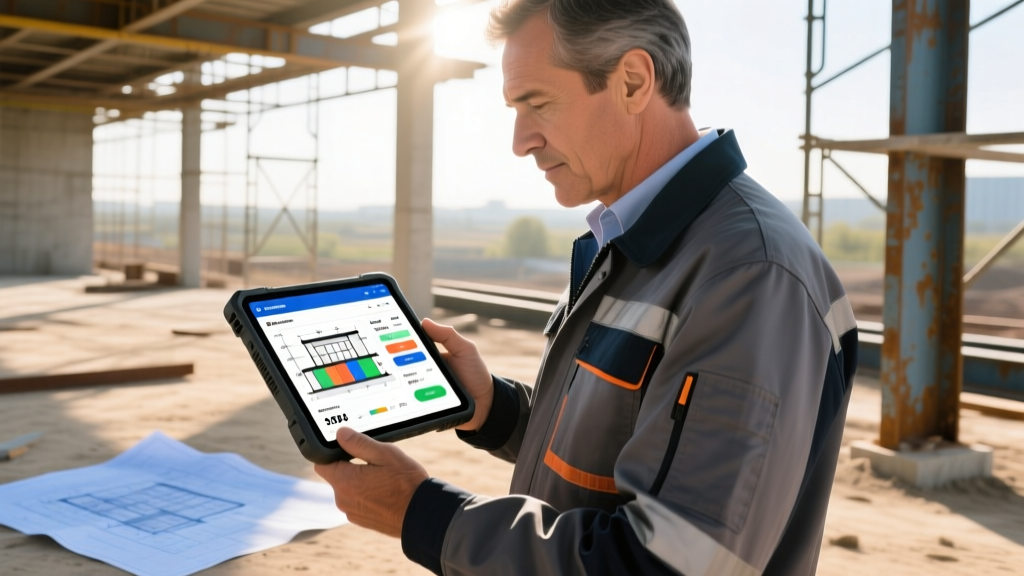
Standard app development agencies often underquote construction projects because they fail to account for the physical realities of job sites. If you are scoping an app for field crews, you must budget for these three technical hurdles:
1. Offline-First Architecture (The Budget Multiplier)
A standard consumer app fetches data via REST APIs in real-time. On a remote earthwork site or inside a commercial basement, this architecture fails. Building an 'offline-first' app requires a local database (such as WatermelonDB or Realm) that stores data on the device and syncs when connectivity returns. Implementing Conflict-free Replicated Data Types (CRDTs) to resolve data conflicts when two foremen edit the same punch list offline adds roughly 30% to 40% to your backend development hours.
2. Heavy File & Blueprint Rendering
Architectural drawing sets routinely exceed 100MB. Native mobile PDF viewers will crash or stutter when attempting to render these files. To provide a smooth pinch-to-zoom experience, developers must implement tile-based rendering engines or integrate specialized SDKs like PSPDFKit. Licensing commercial PDF SDKs can add $5,000 to $15,000 in annual fees to your operating budget.
3. High-Volume Image Processing
Field crews take hundreds of high-resolution progress photos daily. Uploading 12MP images over spotty 4G networks causes timeouts and app crashes. Your app must include background queueing, local image compression (converting HEIC to optimized WebP), and chunked uploading to cloud storage. This requires robust backend infrastructure, typically utilizing AWS Amplify and S3 buckets, which shifts costs from upfront development to ongoing cloud hosting fees.
Tech Stack Economics: Cross-Platform vs. Native
The technology stack you choose dictates both your initial build cost and your long-term maintenance. For 90% of construction applications, cross-platform development is the most financially sound decision.
- Flutter (Google): Uses the Skia graphics engine, making it superior for custom UI elements like drawing tools, markup layers, and custom measuring tools on blueprints. Highly recommended for complex field apps. Cost impact: Moderate.
- React Native (Meta): Ideal if your firm already utilizes a React-based web dashboard. It allows for significant code sharing between your web estimating portal and the mobile field app. Cost impact: Lowest (if web team exists).
- Native (Swift/Kotlin): Requires building two separate codebases. Only justified if your app requires deep hardware integration, such as LiDAR scanning for concrete volume estimation or heavy Augmented Reality (AR) overlays for MEP coordination. Cost impact: High (effectively doubles frontend costs).
Team Location and Hourly Rate Realities
Where your development team is located drastically alters the final invoice. While US-based agencies offer seamless communication and deep familiarity with American construction compliance (OSHA, Davis-Bacon), nearshore and offshore teams provide significant arbitrage.
US & Canada
$150 – $250 / hr
Best for: Enterprise ERPs, strict HIPAA/SOC2 compliance, complex AR.
Latin America
$60 – $95 / hr
Best for: Mid-market apps, real-time collaboration, overlapping US time zones.
Eastern Europe
$55 – $90 / hr
Best for: Heavy backend architecture, offline-sync logic, algorithm development.
App Store Fees, Compliance, and Ongoing Maintenance
The initial build is only the capital expenditure (CapEx). Operating the app requires ongoing operational expenditure (OpEx). You must budget for app store deployment, third-party API subscriptions, and OS update maintenance.
Store Deployment & Licensing
To distribute your app to field crews, you must navigate the Apple Developer Program ($99/year) and the Google Play Console ($25 one-time fee). However, for enterprise construction firms with over 100 employees, relying on public app stores is inefficient. Most firms utilize Apple Business Manager or Mobile Device Management (MDM) solutions like Jamf or VMware Workspace ONE to push private, custom apps directly to company-owned ruggedized tablets (e.g., Panasonic Toughbooks or Samsung Galaxy XCover).
The 20% Maintenance Rule
Mobile operating systems update annually. When Apple releases iOS 19 or Google releases Android 16, deprecated APIs will break your app's camera access, GPS tracking, or local storage permissions. Industry standard dictates allocating 15% to 20% of your initial development cost annually for maintenance, bug fixes, and security patching. For a $150,000 app, expect to pay $22,500 to $30,000 per year in retainer fees to your development partner.
Strategic Scoping: How to Protect Your Budget
To prevent scope creep, enforce a strict 'Field-Only' rule during the MVP phase. Your mobile app should exclusively handle data capture (photos, signatures, GPS, voice-to-text notes) and offline viewing. Leave complex data manipulation, multi-tier approval workflows, and heavy estimating calculations to the web-based desktop dashboard. By restricting the mobile app to a 'data collection and viewing' node, you can reduce your initial development costs by up to 40% while still delivering immense value to your field superintendents and project managers.
Written by
Marcus ChenMarcus Chen is a licensed structural engineer (PE) and building materials analyst with over 12 years of experience across residential, commercial, and industrial construction. He holds a Master of Science in Civil Engineering from UC Berkeley and spent six years at Thornton Tomasetti before transitioning to independent consulting and technical writing. Marcus specializes in material selection for seismic-prone regions, concrete reinforcement strategies, and lifecycle cost analysis. His work has been cited by the American Concrete Institute (ACI) and the Structural Engineers Association of California (SEAOC). When he is not on a job site or at his desk, you will find him hiking the Sierra Nevada or restoring a 1920s craftsman bungalow in Oakland, CA.
More from Marcus Chen
View all
Construction Cost
How Much Did the Eiffel Tower Cost to Build?
How much did the Eiffel Tower cost to build in 1889? We adjust for inflation and compare its budget to modern skyscraper construction.
Aug 4, 2026

Fire Resistance
What Is a Fire Resistant Material? Testing & Certification Guide
Discover what is a fire resistant material through ASTM and UL testing. Learn how fire ratings, certifications, and assemblies work in construction.
Aug 4, 2026

Construction Cost
How Much Did the Burj Khalifa Cost to Build?
How much did the Burj Khalifa cost to build? We break down the $1.5B project and extract 5 money-saving strategies for your next build.
Jul 30, 2026