How Much Is a Cord of Wood? 2026 Costs for Masonry & Heating
Discover how much a cord of wood costs in 2026. Compare hardwood and softwood pricing for cordwood masonry construction and masonry heater fuel.
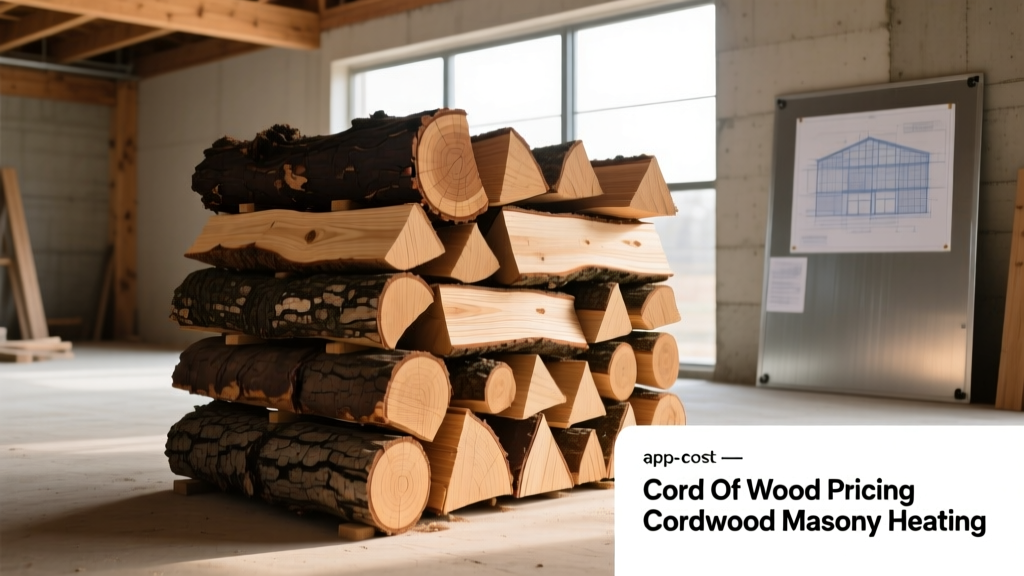
The Anatomy of a Cord: Full, Face, and Rick Measurements
When estimating material costs for off-grid builds, masonry heater installations, or alternative structural methods, understanding exactly how much is a cord of wood is the baseline for accurate budgeting. The term 'cord' is a legally defined unit of measure for stacked firewood and timber, but market terminology often obscures the actual volume you are purchasing. A standard full cord measures 4 feet high, 4 feet wide, and 8 feet long, yielding exactly 128 cubic feet of stacked volume. Because of the air gaps between irregular logs, a full cord typically contains between 70 and 90 cubic feet of solid wood mass.
Contractors and homeowners frequently encounter the face cord (often called a 'rick' in the Midwest). A face cord is 4 feet high and 8 feet long, but the logs are cut to 16-inch lengths (one-third the depth of a full cord), yielding roughly 42.6 cubic feet of stacked volume. When a supplier quotes a price without specifying 'full' or 'face,' they are almost always quoting a face cord. Always verify the log length before signing a procurement contract.
Material Taxonomy: Hardwood vs. Softwood Selection
The biological taxonomy of the wood species dictates its structural viability, thermal mass, and combustion profile. Selecting the wrong species for your specific application will result in catastrophic shrinkage in masonry walls or inefficient, creosote-heavy burns in high-mass heaters.
Heating Applications (Masonry Heaters & Wood Stoves)
For high-efficiency masonry heaters and EPA-certified wood stoves, dense hardwoods are mandatory. Species like White Oak, Hickory, and Sugar Maple possess tightly packed cellular structures that yield high British Thermal Unit (BTU) outputs per cord. According to the U.S. Department of Energy, properly seasoned hardwood is essential for achieving the high combustion temperatures required to minimize particulate emissions and maximize heat transfer into thermal mass benches and flues.
Structural Applications (Cordwood Masonry)
Cordwood masonry—a building technique where short logs are laid transversely within a mortar matrix to form structural, insulated walls—requires an entirely different taxonomy. Softwoods like Eastern White Cedar, Tamarack (Larch), and White Pine are the industry standard. Softwoods possess higher inherent R-values (insulation) and, crucially, exhibit uniform radial shrinkage. If you build a cordwood wall using dense Oak, the logs will shrink at a different rate than the mortar, causing massive structural voids and air infiltration.
2026 Species Comparison & Cost Matrix
Market rates fluctuate based on regional forestry yields and transportation costs. The following matrix outlines 2026 average pricing for a full cord (128 cubic feet), alongside critical performance metrics.
| Species | Taxonomy | 2026 Avg Cost (Full Cord) | BTU (Millions/Cord) | Primary Use Case |
|---|---|---|---|---|
| Hickory | Hardwood | $550 - $700 | 28.0 | Masonry Heaters |
| White Oak | Hardwood | $450 - $600 | 25.7 | Wood Stoves / Heating |
| Sugar Maple | Hardwood | $450 - $550 | 24.0 | Wood Stoves / Heating |
| White Pine | Softwood | $300 - $400 | 15.9 | Cordwood Masonry |
| Eastern White Cedar | Softwood | $350 - $500 | 13.5 | Cordwood Masonry |
Estimating Cordwood Masonry Volumes for Construction
If you are acting as an owner-builder or estimating a custom cabin project utilizing cordwood masonry, you must calculate the exact volume of logs required to prevent mid-build shortages. The U.S. Energy Information Administration (EIA) tracks biomass material volumes, but construction-specific estimating requires accounting for mortar displacement and cutting waste.
Follow this step-by-step framework to calculate your cord requirements:
- Calculate Gross Wall Area: Multiply the total exterior wall length by the wall height. (e.g., A 20x30 cabin with 9-foot walls = 100 linear feet x 9 ft = 900 sq ft).
- Subtract Openings: Deduct the square footage of all doors and windows. (e.g., 150 sq ft of windows/doors leaves 750 sq ft of net wall area).
- Determine Wall Thickness Volume: Multiply the net wall area by the wall thickness in feet. A standard 16-inch thick wall is 1.33 feet. (750 sq ft x 1.33 ft = 997.5 cubic feet of total wall volume).
- Account for Mortar Displacement: The mortar matrix (typically a mix of 9 parts soaked sawdust, 3 parts sand, 3 parts lime, and 1 part Portland cement) occupies roughly 20% of the wall volume. Subtract 20% to find the wood volume. (997.5 x 0.80 = 798 cubic feet of wood).
- Convert to Cords and Add Waste: Divide the wood volume by 128 (the cubic feet in a full cord). 798 / 128 = 6.23 cords. Add a 15% waste factor for off-cuts, split logs, and damaged pieces. Final procurement target: 7.2 full cords.
Procurement, Curing, and Moisture Content Standards
The quoted price of a cord of wood is heavily dependent on its moisture content (MC). Green (unseasoned) wood is the cheapest option but is unusable for immediate heating and structurally dangerous for immediate masonry enclosure. For masonry heaters, wood must be seasoned to an MC of 15% to 20%. Burning wood with an MC above 25% wastes massive amounts of thermal energy boiling off water, leading to rapid creosote accumulation in the flue and potential chimney fires.
For cordwood masonry, the logs must be dead-dry before being laid in mortar. If you enclose green wood in a cementitious matrix, the log will shrink radially as it dries over the first two years, pulling away from the mortar and leaving a 1/4-inch gap around every single log end. To verify moisture content, do not rely on visual checks. Use a commercial-grade pinless moisture meter, such as the Wagner MMC220 or Lignomat E-12, testing the inner core of a freshly split sample log. If you must purchase green wood to save on upfront costs (often 30% cheaper than kiln-dried), you must factor in the cost of stickering, tarping, and storing the wood for 12 to 18 months before your construction or heating season begins.
Accurate cost estimating for wood-based projects requires looking beyond the sticker price per cord. Factor in the logistical costs of delivery, the labor of restacking, the time-value of seasoning, and the specific biological traits of the species to ensure your masonry or heating system performs to engineering standards.