How Much Does a Monster Truck Cost to Build? 2026 Scope Calculator
Calculate exactly how much a monster truck costs to build in 2026. Compare grassroots, semi-pro, and pro scope budgets, parts, and hidden expenses.

The Size & Scope Calculator: Defining Your Build Tier
Building a 10,000-pound, 1,500-horsepower machine capable of crushing cars and launching 30 feet into the air requires precise engineering and a highly structured budget. When evaluating how much a monster truck costs to build, there is no single price tag. The final invoice depends entirely on the operational scope: local exhibition, regional semi-pro competition, or professional stadium touring.
As of 2026, material costs for 4130 chromoly tubing, custom billet machining, and advanced composite body panels have shifted. This size and scope calculator breaks down the capital requirements across three distinct build tiers, providing exact component pricing and engineering specifications to help you allocate your fabrication budget accurately.
Tier 1: Grassroots & Local Exhibition ($45,000 – $85,000)
The grassroots scope targets local fairgrounds, independent mud bogs, and regional truck pulls. At this level, the goal is durability and crowd-pleasing wheelies rather than stadium-level freestyle acrobatics.
- Chassis: Mild steel or basic 4130 chromoly tube frame. Often built in-house by local fabricators rather than specialized motorsports shops. ($12,000 - $18,000)
- Powerplant: Naturally aspirated or mildly supercharged 540 cubic inch Big Block Chevy (BBC) running on race gas or E85. Produces 800–1,000 horsepower. ($15,000 - $25,000)
- Drivetrain: Modified military Rockwell 2.5-ton axles with standard spools and heavy-duty U-joints. Power is routed through a modified Turbo 400 transmission with a Lenco-style planetary overdrive. ($10,000 - $15,000)
- Body & Tires: Standard fiberglass replica bodies (e.g., 1950s pickup style) and used 66-inch Terra tires with basic paddle cutting. ($8,000 - $12,000)
Limitation: Grassroots trucks lack the suspension travel and nitrogen-charged shock valving required to absorb the impact of 20-foot jumps. Landing flat at high speeds will bend mild steel chassis components and shatter fiberglass bodies.
Tier 2: Regional Semi-Pro Circuit ($140,000 – $240,000)
Semi-pro trucks compete in sanctioned regional events and serve as support acts for larger tours. The engineering focus shifts toward weight reduction, suspension articulation, and driver safety.
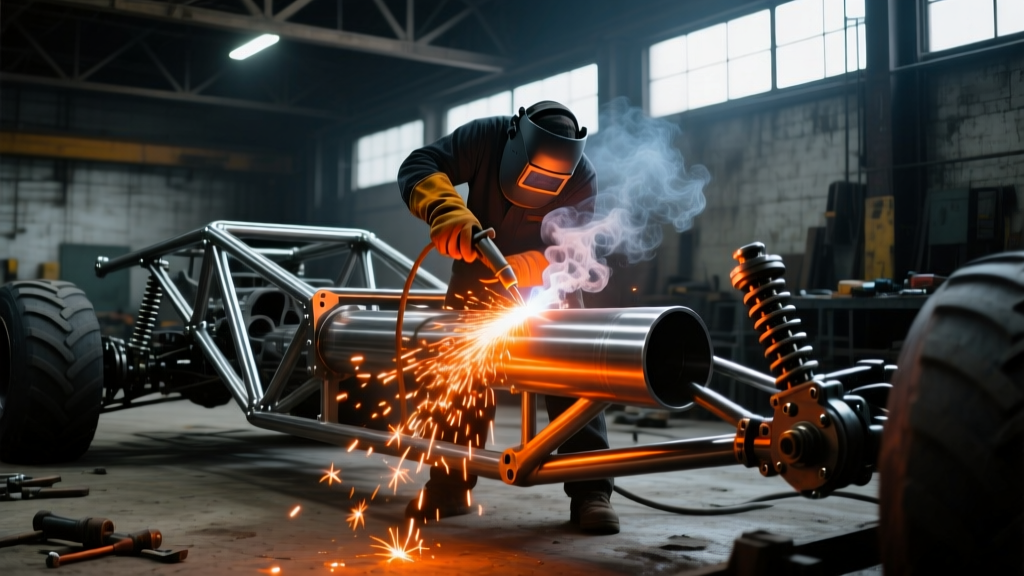
- Chassis: Fully certified 4130 chromoly space frame, TIG-welded with integrated 4-link suspension geometry and removable front/rear clips for easy transport. ($30,000 - $45,000)
- Powerplant: Blown 572 cubic inch Hemi or Merlin block with an 8-71 supercharger and mechanical fuel injection, tuned for methanol. Output exceeds 1,500 horsepower. ($45,000 - $65,000)
- Suspension: Custom 4-link setup with dual nitrogen-charged bypass shocks per wheel (8 total). This allows for 30+ inches of vertical wheel travel and adjustable compression/rebound valving. ($18,000 - $25,000)
- Body: High-grade fiberglass with carbon fiber reinforcement in high-stress mounting zones. ($15,000 - $22,000)
Tier 3: Professional Arena & Stadium Tour ($320,000 – $550,000+)
Professional trucks competing on circuits like Monster Jam or elite USHRA sanctioned events are aerospace-grade machines. Every ounce is scrutinized, and safety systems are heavily redundant.
- Chassis & Safety: Ultra-lightweight chromoly chassis with integrated data acquisition sensors, FIA-style impact attenuators, and a multi-point harness system paired with a HANS device and custom-molded racing seat. ($55,000 - $80,000)
- Drivetrain: Custom planetary drop boxes and transfer cases machined by specialists like SCS Gearbox. These components manage the massive torque spike when the 66-inch tires hit the dirt after a freestyle jump. ($35,000 - $50,000)
- Body Panels: Azdel composite or full carbon fiber. Azdel is a thermoplastic composite that bends and absorbs impact rather than shattering into dangerous, razor-sharp shards upon crash impact. ($35,000 - $60,000 for molds and shells)
- Tires & Wheels: Brand new 66-inch Terra tires, custom-cut with specialized tread patterns for indoor dirt tracks, mounted on custom billet aluminum beadlock wheels with integrated tire-pressure monitoring. ($20,000+ for a full set with spares)
Component Cost Matrix: Where the Budget Actually Goes
Use this matrix to calculate your baseline parts list. Labor and fabrication hours are not included in these component costs; expect to add 30-50% for professional assembly and machining.
| Component Category | Grassroots Scope | Semi-Pro Scope | Professional Scope |
|---|---|---|---|
| Engine & Fuel System | $15,000 - $25,000 | $45,000 - $65,000 | $75,000 - $110,000 |
| Chassis & Roll Cage | $12,000 - $18,000 | $30,000 - $45,000 | $55,000 - $80,000 |
| Drivetrain (Trans/Axles) | $10,000 - $15,000 | $25,000 - $35,000 | $45,000 - $70,000 |
| Suspension & Steering | $5,000 - $8,000 | $18,000 - $25,000 | $35,000 - $50,000 |
| Body & Paint | $8,000 - $12,000 | $15,000 - $22,000 | $40,000 - $75,000 |
| Tires & Wheels (Set of 4) | $6,000 (Used) | $14,000 | $22,000+ |
| Estimated Parts Total | $56k - $78k | $147k - $206k | $272k - $407k |
Drivetrain & Suspension: The Engineering Bottleneck
The most common point of failure—and the largest hidden cost—in monster truck construction is the drivetrain. Standard automotive components will instantly disintegrate under the rotational mass of 66-inch tires and 1,500 horsepower.
Axle and Hub Configurations
Entry-level builds often rely on surplus military Rockwell axles. While robust, they are incredibly heavy, adding unsprung weight that ruins suspension response. Professional builds utilize custom planetary hub axles. These feature internal gear reduction at the wheel hub, allowing the axle shafts to be smaller and lighter while still multiplying torque. A single set of custom planetary hubs and chromoly axle shafts can exceed $25,000, but they are mandatory for competitive freestyle performance.
Four-Wheel Steering Geometry
Professional trucks utilize independent hydraulic steering for both the front and rear axles. This requires dual hydraulic pumps, custom-valved steering boxes, and heavy-duty tie rods machined from solid billet steel. The rear steering is often linked to a secondary joystick or pedal in the cab, allowing the driver to 'crab' the truck sideways during tight arena turns or correct mid-air attitude during jumps.
Hidden Operational Costs: Beyond the Build
The build scope calculator only gets the truck on the trailer. Operating a monster truck requires a massive logistical and financial overhead that bankrupts underfunded teams.
- The Hauler: You need a Class 8 semi-tractor and a 48-foot enclosed toy hauler trailer with a reinforced rear ramp, living quarters, and a pit workbench. Budget $120,000 to $250,000 for a reliable used rig.
- Fuel Consumption: A blown 572 engine running on methanol consumes roughly 2 to 3 gallons per minute at wide-open throttle. A standard 15-minute freestyle routine plus burnouts will burn 30+ gallons of methanol. At current racing fuel prices, budget $400+ per event just for track fuel.
- Breakage Inventory: You will break parts. Professional teams travel with a 'rolling spare' inventory that includes two complete spare engines, four spare axle shafts, a dozen U-joints, and spare shock shafts. This inventory alone can cost $50,000.
- Pit Crew & Logistics: Stadium events require a minimum two-person pit crew for tire washing, fueling, and mid-round repairs. Factor in hotels, per diems, and commercial trucking insurance.
Final Verdict: Sizing Your Scope
If your goal is to run local exhibition shows and mud bogs, a carefully sourced grassroots build can be completed for under $85,000, provided you have in-house welding and machining skills. However, if you intend to compete on a professional stadium tour, the barrier to entry is steep. A competitive, safe, and reliable professional monster truck requires a minimum capital outlay of $350,000 for the truck, plus an additional $150,000 for the transport rig and first-year operational reserves.
Expert Estimator Tip: Do not compromise on the roll cage and safety harness budget to afford a larger supercharger. Sanctioning bodies like the USHRA mandate strict tech inspections; a truck with an out-of-spec cage will be barred from the dirt, rendering your engine investment useless until the chassis is recertified.
Written by
James ThorntonJames Thornton is a construction industry veteran with 25 years of hands-on experience in wood framing, lumber grading, and residential building codes. He started as a framing carpenter in rural Oregon, earned his ICC Residential Building Inspector certification, and eventually became a senior plan reviewer for the City of Portland Bureau of Development Services. James holds a B.S. in Wood Science & Technology from Oregon State University and is a certified lumber grader through the West Coast Lumber Inspection Bureau (WCLIB). He has inspected over 3,000 residential construction sites and authored the city's internal guide on advanced framing techniques (2x6 at 24" O.C.). James lives in Bend, OR, where he builds custom timber-frame cabins and competes in lumberjack sports.
More from James Thornton
View all
Insulation
Best Home Insulation Materials: Complete 2026 Guide
Compare top home insulation materials for 2026. Find R-values, installed costs per square foot, and best uses for fiberglass, spray foam, and mineral wool.
Aug 4, 2026

Sustainable Building
Certify Your Green Building Material for LEED and WELL
Step-by-step guide to certifying a green building material for LEED v5 and WELL v2. Master EPDs, HPDs, and VOC limits for 2026 project specifications.
Aug 4, 2026

Stone & Masonry
Veneer Stacked Stone Panels: Interior Design & Style Showcase
Discover how veneer stacked stone panels transform interiors. Explore modern design profiles, material pairings, and technical installation specs.
Aug 4, 2026