Cost to Build a Pickleball Court: 2026 Pricing Guide
Discover the true cost to build a pickleball court in 2026. Detailed pricing for concrete, asphalt, surfacing, fencing, and lighting for any budget.

The True Cost to Build a Pickleball Court: 2026 Pricing Matrix
The explosion of pickleball has transitioned from a neighborhood trend to a permanent fixture in residential and commercial real estate. However, the cost to build a pickleball court varies wildly based on site conditions, base materials, and finishing specifications. In 2026, a standard outdoor court build ranges from $28,000 for a basic residential asphalt setup to over $65,000 for a tournament-grade post-tensioned concrete facility.
• Basic Residential (Asphalt): $28,000 - $38,000
• Commercial Club (Concrete): $45,000 - $55,000
• Tournament Grade (Post-Tensioned + Cushion): $55,000 - $68,000
• Indoor Court Build-out: $85,000+
Court Dimensions and Site Preparation
Before calculating material costs, you must establish the footprint. According to USA Pickleball guidelines, the actual playing area is 20 feet by 44 feet. However, you cannot pour a slab exactly to those dimensions. The minimum recommended pad size is 30 feet by 60 feet (1,800 square feet) to allow for player runoff. For tournament play, the pad must be expanded to 34 feet by 64 feet (2,176 square feet).
Site preparation is the most common area where budgets fracture. Clearing, grading, and compacting the sub-base typically costs between $2.50 and $4.50 per square foot. If your site requires extensive tree root removal, retaining walls, or importing fill dirt to achieve the mandatory 1% slope (a 1-inch drop per 10 feet for drainage), expect site prep costs to double.
Base Construction: Asphalt vs. Post-Tensioned Concrete
The structural base dictates the lifespan of your court. While standard concrete and asphalt are common, post-tensioned concrete has become the industry standard for commercial facilities in 2026 due to its resistance to freeze-thaw cracking.
| Base Material | Cost per Sq. Ft. | Lifespan | Pros & Cons |
|---|---|---|---|
| Type S Asphalt | $4.00 - $6.00 | 10-15 Years | Lower upfront cost; prone to structural cracking and birdbaths (depressions) over time. |
| Standard Concrete | $6.00 - $8.00 | 15-20 Years | Rigid surface; control joints required which can cause ball bounce irregularities. |
| Post-Tensioned Concrete | $8.50 - $12.00 | 25+ Years | Steel cables compress the slab (33,000 PSI), virtually eliminating structural cracks. Premium choice. |
Surfacing Systems: Acrylic vs. Cushioned
You cannot play directly on raw asphalt or concrete. The surface requires an acrylic color coating system to provide UV protection, texture for ball grip, and player traction. Brands like SportMaster and Plexipave dominate the 2026 market.
Standard 5-Coat Acrylic System ($2.50 - $3.50 / sq. ft.)
- Resurfacer: Fills minor voids and creates a bonding layer.
- Color Coats (x2): Provides the primary aesthetic and UV resistance.
- Textured Color Coats (x2): Incorporates graded silica sand to dictate the speed of the court (Pace Rating).
Premium 8-Coat Cushioned System ($4.50 - $6.50 / sq. ft.)
For commercial clubs or older players concerned with joint impact, a cushioned system adds three layers of rubber granule-filled acrylic. This reduces leg fatigue and provides a slightly slower, more forgiving ball bounce. According to HomeAdvisor, adding a cushioned layer increases total project costs by roughly $4,000 to $6,000 per court, but drastically improves the facility's appeal to high-paying club members.
Fencing, Lighting, and Net Systems
Perimeter infrastructure is non-negotiable for dedicated courts. A standard tennis court fence is often insufficient for pickleball due to the smaller ball size and different wind dynamics.
- Fencing (10ft high): $35 - $50 per linear foot. A 30x60 court requires roughly 180 linear feet, totaling $6,300 - $9,000.
- LED Sports Lighting: $6,000 - $14,000 per court. Requires 5000K color temperature LEDs delivering 30-50 foot-candles of illumination. Ensure fixtures are Dark Sky compliant to avoid neighborhood light pollution complaints.
- Nets and Posts: $400 - $800. Use heavy-duty steel posts with a center strap to maintain the exact 34-inch center height mandated by official rules.
Hidden Costs and Site Preparation Edge Cases
Contractors often exclude critical site-specific variables from initial bids. Watch out for these budget-killers:
- Utility Trenching: Running dedicated 200-amp electrical service for LED lighting can add $3,000 to $8,000 if the main panel is far from the court site.
- Acoustic Mitigation: The distinct 'pop' of a pickleball can reach 70 decibels. If building near residential property lines, you may be legally required to install acoustic fencing or sound-dampening barriers, adding $10,000+ to the project.
- Sub-Base Stabilization: If soil tests reveal expansive clay, you will need to excavate deeper and import a crushed aggregate base, increasing earthwork costs by 30% to 50%.
'Never compromise on the 1% slope for drainage. A perfectly flat court will develop birdbaths that trap water, degrading the acrylic surface and causing algae growth within a single season.'
Decision Framework: Which Build Tier Fits Your Budget?
Tier 1: Residential / HOA Recreational ($28k - $38k)
Best for: Private backyards, small HOAs, and rural properties.
Specs: Standard asphalt base, 5-coat acrylic surfacing, 8-foot galvanized chain link fencing, no dedicated sports lighting (rely on ambient or portable lights).
Tier 2: Commercial / Club Tournament ($45k - $65k)
Best for: Country clubs, municipal parks, and dedicated pickleball franchises.
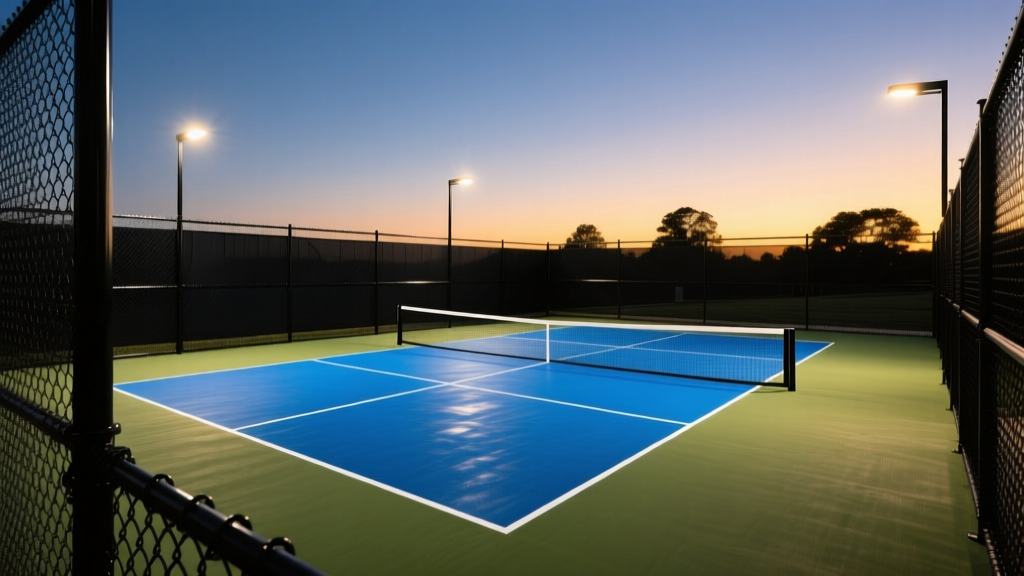
Specs: Post-tensioned concrete base, 8-coat cushioned acrylic system, 10-foot black vinyl-coated fencing, 5000K LED stadium lighting, and integrated bench seating.
FAQ: Pickleball Court Construction
Can I just paint lines on an existing tennis court?
Yes, but it is a temporary compromise. Blended lines (painting pickleball lines in a different color over tennis lines) cost about $800 to $1,200. However, tennis courts are crowned (sloped from the center) for drainage, which causes the pickleball to roll unpredictably toward the sidelines. Dedicated, flat-sloped courts are always preferred for serious play.
How long does the construction process take?
Expect a timeline of 6 to 10 weeks from groundbreaking to first serve. Asphalt requires a 14-to-21-day curing period before acrylic coatings can be applied, whereas concrete requires 28 days of curing. Applying surfacing over an uncured base will trap moisture, leading to immediate bubbling and delamination.
Is an indoor court more expensive?
Significantly so. Converting an existing warehouse or building a new indoor facility involves HVAC considerations, specialized sports flooring (like poured polyurethane or interlocking tiles), and high-bay lighting. Indoor court build-outs rarely drop below $85,000 per court when factoring in the structural envelope and climate control.
Written by
Elena RodriguezElena Rodriguez is a civil engineer and technical writer specializing in concrete technology, masonry systems, and ASTM/ACI compliance. She earned her B.S. in Civil Engineering from Texas A&M University and spent a decade at a materials testing laboratory, performing over 2,000 concrete compressive strength tests and masonry prism evaluations. Elena is an ACI-certified Field Testing Technician (Grade I) and a member of ASTM Committee C12 on Natural Building Stone. She currently consults on forensic engineering cases involving concrete failures and moisture intrusion. Based in San Antonio, TX, Elena is a proud member of the Society of Women Engineers (SWE) and coaches her daughter's FIRST Robotics team.
More from Elena Rodriguez
View all
Walls & Panels
Cost Analysis: Light Gauge Steel Framing Advantages and Disadvantages
Evaluate light gauge steel framing advantages and disadvantages through a strict cost analysis lens, comparing material, labor, and lifecycle expenses.
Aug 4, 2026

Walls & Panels
Gypsum Board Types: Exact Specifications, Thickness & Dimensions
Compare standard, Type X, and moisture-resistant gypsum board types. Get exact specifications, thicknesses, dimensions, and ASTM standards for your project.
Aug 4, 2026

Fire Resistance
Best Fire-Resistant Outdoor Decking Materials: 2026 Buyer Guide
Discover the best fire-resistant outdoor decking materials for 2026. Compare Class A PVC, aluminum, and hardwood options for WUI compliance and safety.
Aug 4, 2026