Regional Cost to Build a Raised Garden Bed Breakdown
Discover the regional cost to build a raised garden bed across the US. Compare material prices, labor rates, and soil expenses by climate zone.

The Baseline: National Average Costs for a Standard 4x8 Bed
Calculating the exact cost to build a raised garden bed requires moving beyond national averages and examining local material availability, climate-driven durability requirements, and regional soil logistics. The industry standard for a residential raised bed is 4 feet wide by 8 feet long, with a depth of 11 inches (the height of two standard stacked lumber boards). This footprint yields approximately 29.3 cubic feet, or 1.08 cubic yards, of required soil volume.
Nationally, the baseline material cost for a standard 4x8 untreated cedar bed ranges from $130 to $180, while composite and galvanized steel alternatives push material costs between $200 and $450. However, these figures fluctuate wildly based on your zip code. A builder in the Pacific Northwest enjoys abundant, locally milled cedar, whereas a homeowner in the Deep South must factor in the cost of termite-resistant metals or specialized pressure-treated lumber.
• National Average Total Cost (DIY): $210 - $480
• National Average Total Cost (Pro Installed): $650 - $1,400
• Soil & Fill Requirements: 1.1 Cubic Yards
• Estimated Build Time: 2 to 4 hours (DIY)
Regional Price Matrix: How Geography Dictates Your Budget
According to landscaping data analyzed by Forbes Home Improvement, regional supply chains and local climate hazards are the primary drivers of cost variance. The table below breaks down the expected material and soil delivery costs across major U.S. climate zones for a standard 4x8 footprint.
| Region | Primary Cost Driver | Avg Material Cost | Bulk Soil Delivery | Labor Premium |
|---|---|---|---|---|
| Pacific Northwest | Abundant Cedar, High Rainfall | $120 - $160 | $45 - $70 | +15% |
| Northeast | Freeze-Thaw, Composite Demand | $180 - $350 | $60 - $90 | +25% |
| Deep South / Gulf | Formosan Termites, Rot | $200 - $400 | $35 - $55 | +10% |
| Midwest | Temperature Swings, Masonry | $110 - $250 | $40 - $65 | +20% |
| Mountain West | UV Degradation, Arid Soil | $190 - $380 | $55 - $85 | +30% |
Material Selection by Climate Zone: Avoiding Premature Failure
Choosing the wrong material for your specific region is the most common cause of budget overruns, as it leads to premature structural failure and replacement costs. The University of Minnesota Extension emphasizes that material longevity is directly tied to local moisture and pest pressures.
The Pacific Northwest & Northeast: Moisture and Rot Resistance
In regions with high annual precipitation, untreated pine will rot within 2 to 3 years. Western Red Cedar is the gold standard here, naturally resisting fungal decay. However, in the Northeast, where cedar must be shipped from the West Coast or Canada, material costs jump by 30% to 40%. To offset this, many Northeastern builders are pivoting to composite lumber (like Trex or TimberTech). While composite boards cost $45 to $65 per linear foot compared to cedar's $12 to $18, they offer a 25+ year lifespan with zero moisture degradation, making the long-term cost per year highly competitive.
The Deep South & Gulf Coast: Termite Pressure and Heat
The presence of aggressive subterranean and Formosan termites makes traditional wood a liability in the South. Even cedar is susceptible to termite tunneling over time. The most cost-effective and durable solution in this region is corrugated galvanized steel or Zn-Al-Mg coated metal beds (such as those from Vego Garden). A 4x8 modular metal bed kit costs between $180 and $250. Metal reflects intense Southern UV rays better than dark composite, keeping root zones cooler during July and August heatwaves. If using wood, builders must opt for UC4A-rated ground-contact pressure-treated lumber, which costs roughly $90 to $120 for a 4x8 frame, though it requires a heavy-duty polyethylene liner to prevent copper azole leaching into acidic Southern soils.
The Midwest & Mountain West: Freeze-Thaw Cycles
The Midwest experiences severe freeze-thaw cycles that can bow and crack rigid materials. Standard 1-inch thick lumber often warps under the lateral pressure of freezing, water-logged soil. Builders in these zones should use 2-inch thick oak or hemlock boards, or pivot to masonry. Stacked interlocking concrete retaining wall blocks or standard cinder blocks cost only $2.50 to $4.00 per unit, bringing the total structural cost for a 4x8 bed down to $80 to $120. The trade-off is labor; moving and leveling hundreds of pounds of masonry requires significant physical effort or professional installation.
The Hidden Variable: Soil and Fill Logistics
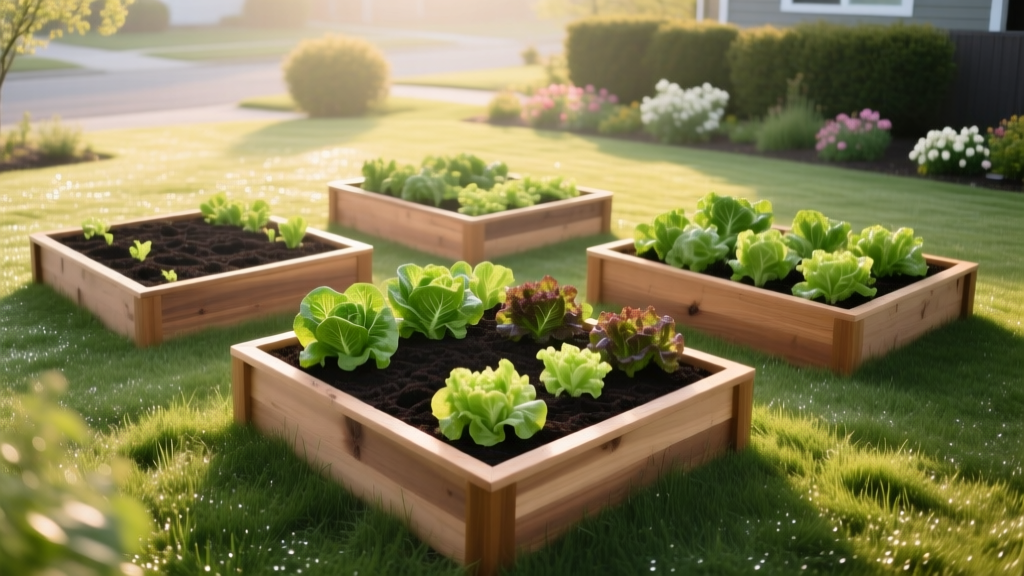
The structural frame is only half the equation. Filling a 4x8x11 bed requires 1.08 cubic yards of soil. According to The Old Farmer's Almanac, the ideal raised bed medium is a porous, nutrient-dense blend, not heavy native topsoil which will compact and suffocate roots.
Bulk Delivery vs. Bagged Soil:
If you have driveway access, ordering a custom bulk blend (50% compost, 50% topsoil) from a local landscape supplier costs $35 to $60 per cubic yard. However, delivery fees range from $50 to $120 depending on your distance from the yard. For urban lots or fenced backyards where dump trucks cannot access the build site, you must rely on bagged soil. A 1.5 cubic foot bag of premium raised bed mix costs $6 to $9. You will need 20 bags to fill a 4x8 bed, pushing the soil cost to $120 - $180, entirely negating any savings from building a cheap wooden frame.
The Peat Moss vs. Coco Coir Price Shift
Traditional 'Mel's Mix' (1/3 peat moss, 1/3 vermiculite, 1/3 compost) has been the standard for decades. However, due to environmental harvesting restrictions in Canada and Northern Europe, peat moss prices have surged. In 2026, regional suppliers in the Northeast and Midwest are heavily substituting peat with compressed coconut coir bricks. A 5kg brick of coir expands to roughly 2.5 cubic feet and costs $12 to $18, offering superior moisture retention in arid Western states while remaining cost-competitive with peat in the East.
Labor Rates: Professional Installation vs. DIY
If you lack the tools or physical capability to assemble the bed and move a ton of soil, professional landscaping crews can handle the installation. Labor rates vary drastically by regional cost-of-living indices.
- Southeast & Midwest: $65 to $95 per hour. Total installed cost for one 4x8 bed (including materials and soil): $550 to $850.
- Northeast & Pacific Northwest: $90 to $140 per hour. Total installed cost: $750 to $1,150.
- California & Mountain West: $110 to $175 per hour. Total installed cost: $900 to $1,400+.
Contractors rarely mobilize for a single bed. Most require a minimum project fee (often $500 to $800) to cover transit and equipment. The most cost-effective approach is to bundle the installation of 3 to 4 beds into a single project, which drops the per-unit labor cost by up to 40%.
Strategic Sourcing to Beat Regional Markups
To minimize the cost to build a raised garden bed, bypass big-box home improvement stores for your primary materials. Big-box retailers price lumber based on national averages, meaning a builder in Oregon pays the same markup on cedar as a builder in Florida, despite the vast differences in local milling costs. Instead, source materials from local sawmills, agricultural supply cooperatives, or specialized landscaping yards. For metal beds, ordering directly from manufacturers during late-winter preseason sales (January and February) often yields 15% to 20% discounts before the spring gardening rush triggers price hikes and shipping delays.
Frequently Asked Questions
Is it cheaper to build or buy a pre-fabricated raised garden bed?
For standard rectangular dimensions (4x8), building your own from raw lumber is generally 30% to 50% cheaper than buying a pre-fabricated kit. However, for modular metal beds or complex composite designs with interlocking corner joints, pre-fabricated kits are often cheaper because manufacturers buy extruded metals and molded corners at scale, a cost advantage individual DIYers cannot replicate.
Do I need to line the bottom of my raised bed?
If building over concrete, compacted clay, or in areas with aggressive invasive weeds (like Bermuda grass), a lining is mandatory. Use a heavy-duty, permeable geotextile fabric (costing $0.50 to $0.80 per square foot). Never use solid plastic sheeting, as it destroys drainage and will cause root rot and anaerobic soil conditions.
How deep should a raised bed be for different crops?
An 11-inch depth is sufficient for shallow-rooted crops like lettuce, radishes, and herbs. However, if you plan to grow deep-rooted crops like carrots, parsnips, or indeterminate tomatoes, you must build the bed to a minimum depth of 18 to 24 inches. Note that doubling the depth of a 4x8 bed doubles the material cost and requires nearly 2.2 cubic yards of soil, significantly increasing your total budget.
Written by
Priya KapoorPriya Kapoor is a real estate market analyst and construction economics researcher with expertise in housing affordability, development feasibility, and infrastructure investment. She holds a Master of Regional Planning from Cornell University and previously worked as a senior analyst at CBRE's Investment Properties group, where she modeled returns for $4B in mixed-use development pipelines. Priya now runs an independent research practice advising developers, municipalities, and REITs on construction cost forecasting and market timing. She publishes the quarterly "BuildMat Market Pulse" report tracking material price indices across 12 commodity categories. Based in Austin, TX, Priya serves on the board of Habitat for Humanity Austin and is a marathon runner.
More from Priya Kapoor
View all
Construction Cost
Cost to Build a 1600 Sq Ft Home in 2026: Full Breakdown
Accurate 2026 cost to build a 1600 sq ft home—material, labor, and regional pricing breakdowns included. Plan your budget with real-time estimates.
Aug 11, 2026

Wood & Lumber
Name the Types of Wood for Pressure Treatment and Preservation
Learn how to name the types of wood best suited for pressure treatment. Compare species treatability, chemical retention levels, and 2026 preservation costs.
Aug 4, 2026

Stone & Masonry
Stone Veneer Suppliers Lindenhurst: 2026 Cost Analysis
Analyze 2026 stone veneer costs in Lindenhurst, NY. Compare local supplier pricing, delivery fees, and Suffolk County installation labor rates.
Aug 4, 2026