Cost to Build a Wine Cellar: Detailed Pricing Breakdown
Discover the true cost to build a wine cellar. Get a detailed pricing breakdown for cooling units, insulation, racking, and framing in this expert guide.

Building a climate-controlled wine cellar requires strict adherence to building science, not just interior design. The cost to build a wine cellar typically ranges from $300 to $650 per square foot, translating to $15,000 to $32,500 for a standard 50-square-foot space, and $30,000 to $65,000 for a 100-square-foot room. These figures account for the specialized insulation, vapor barriers, commercial-grade cooling systems, and custom millwork required to maintain the strict 55°F (12.8°C) and 60% relative humidity environment necessary for proper wine preservation.
Baseline Cost to Build a Wine Cellar by Size
Estimating your budget begins with the physical footprint of the space. Below is the average cost breakdown for fully finished, climate-controlled residential wine cellars based on 2026 contractor rates.
| Cellar Size (Sq Ft) | Estimated Bottle Capacity | Average Cost Range | Cost Per Sq Ft |
|---|---|---|---|
| 25 - 50 | 250 - 500 | $10,000 - $25,000 | $400 - $500 |
| 50 - 100 | 500 - 1,500 | $25,000 - $55,000 | $450 - $550 |
| 100 - 200 | 1,500 - 3,000 | $50,000 - $110,000 | $500 - $550 |
| 200+ | 3,000+ | $120,000+ | $600+ |
Component Breakdown: Where the Budget Goes
A common mistake in wine cellar estimating is over-allocating budget to visible racking while underfunding the mechanical and building envelope systems. A properly balanced budget for a custom cellar follows this distribution:
- Climate Control & Electrical: 20% - 30%
- Insulation, Vapor Barrier & Framing: 15% - 20%
- Custom Racking & Millwork: 35% - 45%
- Exterior-Grade Door & Glass: 10% - 15%
- Specialty Lighting & Finishes: 5% - 10%
Climate Control Systems: The Heart of the Cellar
Standard HVAC systems cannot achieve the 55°F temperature or manage the high humidity levels required for wine storage. You must install a purpose-built wine cooling unit. The cost varies drastically based on the configuration and the heat load of the room.
1. Through-the-Wall Units
These self-contained units mount directly through an exterior wall or an interior wall venting into an adjacent, climate-controlled room. They are the most economical but generate the most noise inside the cellar.
- Top Models: WhisperKOOL SC PRO 3000, KoolR KZ
- Cost: $1,800 - $2,800 (Unit only)
- Best For: Small cellars (under 650 cubic feet) with an adjacent mechanical room or exterior wall.
2. Split Systems
Split systems separate the evaporator (inside the cellar) from the condenser (outside or in an attic/garage). This eliminates compressor noise inside the cellar and allows for precise ducting.
- Top Models: CellarPro 1800XT, Wine Guardian D025
- Cost: $3,500 - $6,500 (Unit plus line set installation)
- Best For: Medium to large cellars, interior rooms without exterior wall access, and high-end residential builds.
3. Fully Ducted Systems
The entire cooling unit is hidden in a remote mechanical space, with supply and return air ducted into the cellar through ceiling grilles.
- Cost: $5,500 - $9,000+
- Best For: Luxury estates where zero mechanical noise and invisible equipment are mandatory.
Insulation and Vapor Barrier Engineering
According to the U.S. Department of Energy, proper thermal resistance is critical for specialized climate rooms. A wine cellar is essentially a walk-in refrigerator situated inside a warm house. Without adequate insulation and a vapor barrier, condensation will form inside the walls, leading to black mold and structural rot.
Required R-Values
Interior walls separating the cellar from conditioned space require a minimum of R-19. Exterior walls and ceilings require R-30. While fiberglass batts are common in standard construction, they are highly susceptible to moisture trapping. The North American Insulation Manufacturers Association (NAIMA) notes that insulation performance degrades significantly when damp. Therefore, closed-cell spray foam ($1.50 to $3.00 per board foot) is the industry standard for wine cellars, as it provides high R-value per inch and acts as a secondary moisture barrier.
The 6-Mil Vapor Barrier
If you are not using closed-cell spray foam, you must install a continuous 6-mil polyethylene vapor barrier. This barrier must be wrapped around the entire room (floor, walls, ceiling) and sealed at every seam with acoustic sealant. Crucially, the vapor barrier must be installed on the warm side of the insulation (the exterior of the cellar walls) to prevent warm, moist household air from penetrating the cold wall cavity and condensing.
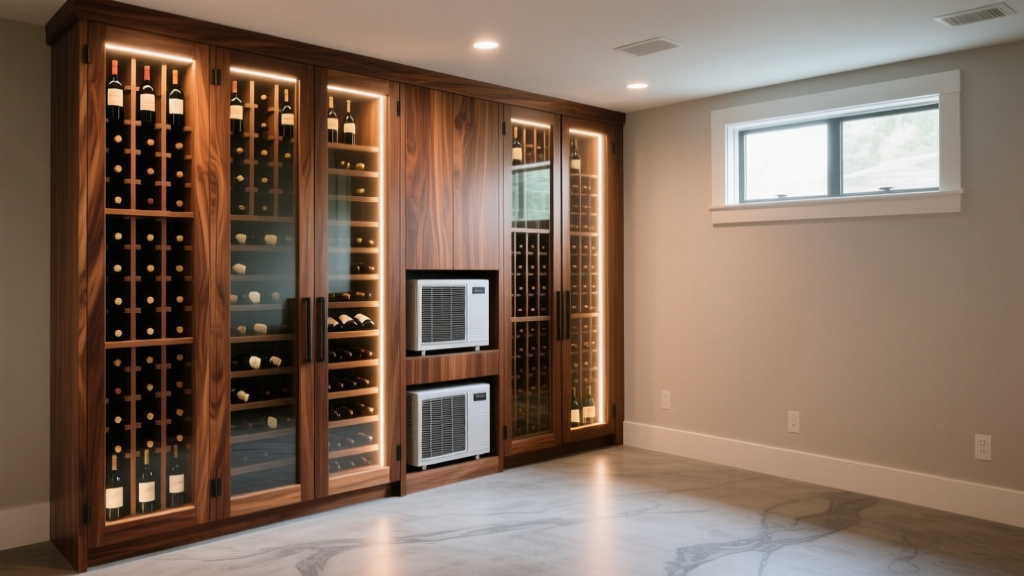
Racking Materials and Configuration Costs
Wine racking is the most visually prominent and highly variable cost in the build. Material selection dictates both the aesthetic and the price per bottle stored.
| Material | Characteristics | Cost Per Bottle (Installed) |
|---|---|---|
| All-Heart Redwood | Naturally resistant to moisture and rot. Premium aesthetic. Does not require staining. | $12 - $22 |
| Sapele Mahogany | Dense, dark wood. Excellent structural integrity. Takes stain beautifully. | $15 - $28 |
| Rustic Pine | Budget-friendly. Must be sealed properly to prevent mold in high humidity. | $6 - $10 |
| Powder-Coated Metal | Modern, minimalist aesthetic. High strength-to-weight ratio. Zero moisture risk. | $18 - $35 |
| Acrylic/Glass | Ultra-modern, floating bottle illusion. Requires precise custom fabrication. | $30 - $50+ |
For long-term aging, Decanter Magazine recommends keeping bottles horizontal to ensure the cork remains in constant contact with the wine, preventing it from drying out and allowing oxygen ingress. Ensure your racking design accommodates standard Bordeaux bottles (3 inches in diameter) as well as larger formats like Magnums and Champagnes if your collection requires it.
The Exterior-Grade Door Requirement
Installing a standard interior bedroom door on a wine cellar is a catastrophic estimating error. Interior doors lack the thermal breaks and weatherstripping required to contain the cold air. When cold air escapes the cellar, it meets the warm ambient air of the home, creating immediate condensation on the door and floor.
Required Specifications:
- Core: Solid core or exterior-grade fiberglass/steel.
- Weatherstripping: Full perimeter compression seals and an automatic door bottom sweep.
- Threshold: Raised threshold to accommodate the bottom sweep seal.
- Glazing: If using glass, it must be dual-pane, tempered, and ideally feature a UV-blocking low-E coating.
Cost: A pre-hung, exterior-grade wood door with custom weatherstripping ranges from $1,800 to $3,500. A custom frameless dual-pane glass door with stainless steel pivot hinges ranges from $4,500 to $8,500.
Specialty Lighting and Electrical
Ultraviolet (UV) light degrades wine by breaking down organic compounds, leading to 'light strike' and premature aging. Furthermore, heat-emitting bulbs will force your cooling unit to work overtime.
The Rule: Only use LED lighting. Avoid incandescent, halogen, or fluorescent fixtures entirely. Recessed LED puck lights, low-voltage LED tape lighting hidden behind racking reveals, and fiber-optic ceiling lights are the standard. Budget $800 to $2,500 for a professional low-voltage lighting layout, including dimmers and transformers located outside the cellar to keep heat out of the envelope.
Hidden Costs and Common Estimating Mistakes
- Electrical Upgrades: Split cooling systems require dedicated 20-amp circuits. If your panel is full, a sub-panel upgrade can add $1,500 - $3,000.
- Condensate Drain Lines: Cooling units produce condensation. If gravity drainage is not possible, you must install a condensate pump and run a drain line to a nearby sink or floor drain ($400 - $800).
- Flooring: Carpet is strictly prohibited (it harbors mold). Use slate, sealed stone, porcelain tile, or engineered hardwood. Budget $12 - $25 per square foot for moisture-tolerant flooring installation.
Expert FAQ on Wine Cellar Budgeting
Can I convert an existing closet into a wine cellar to save money?
Yes, but the cost to build a wine cellar in a closet still requires rebuilding the envelope. You must strip the drywall, add insulation, install a vapor barrier, and re-drywall. A 20-square-foot closet conversion typically costs $8,000 to $12,000, primarily driven by the fixed costs of the cooling unit and custom door, which do not scale down linearly with room size.
Do I need a dedicated humidifier if I have a cooling unit?
Most residential wine cooling units only cool and dehumidify; they do not add moisture. If your home's ambient winter humidity drops below 50%, the cooling unit will pull the cellar humidity down to 30%, which will dry out corks. In dry climates or during winter, budget an additional $600 to $1,200 for an integrated humidification module that ties into the cooling system's thermostat.
What is the ongoing maintenance cost of a wine cellar?
Expect to spend $150 to $300 annually. This includes replacing the HVAC air filters every 3 months, cleaning the condenser coils annually to maintain efficiency, and replacing the UV water purification lamp if your system includes an integrated drain line treatment module.
Written by
Sarah WhitfieldSarah Whitfield is a chartered quantity surveyor (MRICS) and construction cost analyst with 15 years of experience in material pricing, procurement strategy, and project budgeting. She earned her degree in Construction Management from the University of Reading (UK) and has worked on projects ranging from $2M custom homes to $180M mixed-use developments across North America and Europe. Sarah currently leads cost estimating for BuildMat Insight, maintaining a proprietary database of 4,000+ material price points updated quarterly. She is a frequent contributor to RSMeans cost data panels and has presented at the International Cost Engineering Council (ICEC) congress. Based in Denver, CO, Sarah is an avid trail runner and volunteer mentor for Women in Construction.
More from Sarah Whitfield
View all
Wood & Lumber
What Are the Different Types of Wood? A Builder's Guide
Compare structural softwoods, finish hardwoods, and engineered lumber. Analyze Janka ratings, MOE values, and 2026 pricing for construction.
Aug 4, 2026

Walls & Panels
Steel Framing vs Wood Framing: Corrosion and Moisture Defense
Compare steel framing vs wood framing for moisture resistance. Learn about galvanized coatings, condensation risks, and corrosion protection strategies.
Jul 21, 2026

Stone & Masonry
How to Cut Stone Veneer: Wet Saw vs Grinder Comparison
Compare the best tools for cutting stone veneer. We review wet saws, angle grinders, and chop saws to help you achieve clean, chip-free cuts.
Jul 21, 2026