How Much Does It Cost to Build a Restaurant Building? Financing Guide
Discover how much it costs to build a restaurant building and explore SBA loans, capital stacks, and construction financing strategies for 2026.
Ground-Up vs. Shell Build-Out: Defining Your Baseline
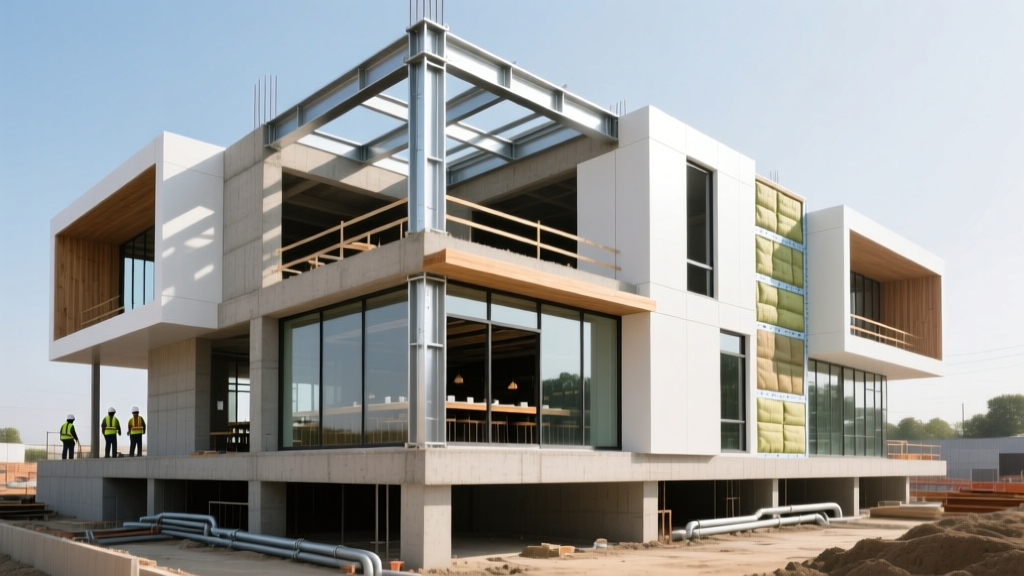
Determining exactly how much it costs to build a restaurant building requires separating the real estate development (ground-up construction) from the tenant improvement (TI) build-out. If you are purchasing raw land and constructing a standalone structure, you are absorbing both the shell costs and the specialized interior fit-out. Conversely, leasing a gray shell in a commercial plaza shifts the interior build-out costs to the tenant while the landlord finances the structure.
For operators pursuing ground-up construction to build equity in their own real estate, the capital requirements are substantial. Commercial construction loans for hospitality properties carry distinct underwriting criteria compared to standard retail or office spaces due to the heavy mechanical, electrical, and plumbing (MEP) requirements inherent in food service.
2026 Construction Cost Matrix by Concept
Costs vary drastically based on the service model. Quick Service Restaurants (QSR) prioritize drive-thru logistics and high-throughput kitchen lines, while fine dining concepts demand premium architectural finishes, extensive HVAC zoning, and complex acoustic treatments. The following table outlines current ground-up construction costs (excluding land acquisition).
| Restaurant Concept | Avg Cost / Sq Ft (Ground-Up) | Typical Footprint | Estimated Construction Cost |
|---|---|---|---|
| Quick Service (QSR) | $250 - $350 | 2,500 - 3,000 sq ft | $625,000 - $1,050,000 |
| Fast Casual | $350 - $500 | 3,000 - 4,500 sq ft | $1,050,000 - $2,250,000 |
| Casual Dining / Bar | $450 - $650 | 4,500 - 6,000 sq ft | $2,025,000 - $3,900,000 |
| Fine Dining | $650 - $950+ | 5,000 - 8,000 sq ft | $3,250,000 - $7,600,000+ |
The Capital Stack: Restaurant Construction Financing Options
Securing capital for a restaurant building rarely involves a single loan. Most operators utilize a 'capital stack' combining real estate debt, equipment financing, and owner equity. Below is a breakdown of the primary financing vehicles used for restaurant construction.
SBA 504 Loan Program (Real Estate Focus)
The SBA 504 Loan Program is the premier vehicle for financing the physical building and land. It provides long-term, fixed-rate financing for major fixed assets. The structure typically involves a first mortgage from a conventional lender (50%), a second mortgage from a Certified Development Company (CDC) backed by the SBA (40%), and a borrower equity injection (10%).
SBA 7(a) Loan Program (Versatile / Working Capital)
While the SBA 7(a) program can be used for real estate, it is more commonly utilized to finance the FF&E (Furniture, Fixtures, and Equipment), working capital, and soft costs. The maximum loan amount is $5 million. Rates are variable and tied to the Prime Rate, making it less ideal for the 20-25 year amortization of the building shell, but excellent for 10-year equipment and build-out amortization.
Conventional Commercial Construction Loans
Offered by regional and national banks, these are short-term (12-24 month) interest-only loans that convert to a permanent commercial mortgage upon project completion. They require rigorous appraisal, higher DSCR (Debt Service Coverage Ratio) thresholds, and typically demand 20% to 30% down. They offer faster closing times than SBA products but carry higher interest rate risk.
The 'Special Purpose' Trap: Why Restaurant Equity Requirements Are Higher
One of the most common pitfalls in restaurant financing is misclassifying the property type. Under SBA and conventional underwriting guidelines, a restaurant is classified as a Special Purpose Property. Because the interior build-out (grease traps, walk-in coolers, Type 1 exhaust hoods, bar plumbing) cannot be easily repurposed for general retail or office use without massive capital expenditure, lenders view the collateral as high-risk.
Critical SBA Rule: For special purpose properties, the SBA 504 program mandates a minimum borrower equity injection of 15%, not the standard 10%. If you are building a $3,000,000 fast-casual restaurant, you must bring $450,000 in liquid cash to the closing table, excluding the funds needed for FF&E and operating reserves.
Hard Costs, Soft Costs, and FF&E Allocation
Lenders scrutinize how your budget is allocated. A common mistake is presenting a lump-sum construction contract without breaking out the FF&E. Lenders will not finance commercial kitchen equipment on a 25-year real estate note; equipment must be financed on a 5-to-7-year schedule matching its MACRS depreciation life.
Where Budgets Bleed: The Top 3 Restaurant Cost Overruns
- Type 1 Commercial Exhaust Hoods: Required for any equipment producing grease-laden vapors (fryers, griddles, charbroilers). These systems cost between $1,500 and $2,500 per linear foot, plus the cost of roof curbs, make-up air units, and fire suppression integration. Upgrading from a 10-foot to a 12-foot hood mid-design can add $15,000+ to the MEP budget.
- Grease Interceptors and Plumbing: Municipal codes strictly regulate FOG (Fats, Oils, and Grease) discharge. Installing an in-ground exterior grease interceptor capable of handling high-flow commercial dishwashers and multi-compartment sinks costs $8,000 to $18,000. Failing to account for core-drilling concrete slabs for trench drains routinely causes $10,000+ change orders.
- Electrical Upgrades (3-Phase Power): Commercial kitchens require 200-amp to 400-amp 3-phase electrical panels. If the local utility must upgrade the transformer or run new service from the street to your pad site, the operator is often billed for the infrastructure upgrade, which can range from $15,000 to $45,000.
Lender Underwriting: Proving Viability
To secure a construction loan, the National Restaurant Association notes that operators must demonstrate deep industry experience and robust financial projections. Lenders will evaluate:
- Global DSCR: Lenders require a Debt Service Coverage Ratio of at least 1.25x to 1.35x. This means your projected net operating income (NOI) must exceed your total debt payments by 25-35%.
- Post-Closing Liquidity: You must prove you have 6 to 12 months of operating expenses and debt service in cash reserves after the down payment and construction costs are paid.
- Management Track Record: First-time restaurant operators are frequently denied commercial construction loans unless they partner with a veteran operator or secure a franchisor-backed guarantee.
Step-by-Step Capital Stack Assembly
Follow this sequence to structure your financing and avoid mid-construction capital calls:
- Secure the Land: Use cash or a seller-financed note to acquire the pad site. Land equity counts toward your SBA down payment requirement.
- Finalize Architectural & MEP Plans: Lenders will not issue a term sheet without stamped, permit-ready drawings. Budget $40,000 - $80,000 for soft costs (architect, MEP engineer, expeditor).
- Obtain the SBA 504 Term Sheet: Lock in the real estate financing for the shell and site work.
- Structure the FF&E Lease: Partner with a specialized hospitality equipment leasing company to finance the $250,000+ kitchen package, preserving your cash for working capital.
- Fund the Contingency: Establish a 15% hard-cost contingency fund. Restaurant builds are notorious for municipal health department change-orders during framing.
Written by
Marcus ChenMarcus Chen is a licensed structural engineer (PE) and building materials analyst with over 12 years of experience across residential, commercial, and industrial construction. He holds a Master of Science in Civil Engineering from UC Berkeley and spent six years at Thornton Tomasetti before transitioning to independent consulting and technical writing. Marcus specializes in material selection for seismic-prone regions, concrete reinforcement strategies, and lifecycle cost analysis. His work has been cited by the American Concrete Institute (ACI) and the Structural Engineers Association of California (SEAOC). When he is not on a job site or at his desk, you will find him hiking the Sierra Nevada or restoring a 1920s craftsman bungalow in Oakland, CA.
More from Marcus Chen
View all
Construction Cost
How Much Did the Eiffel Tower Cost to Build?
How much did the Eiffel Tower cost to build in 1889? We adjust for inflation and compare its budget to modern skyscraper construction.
Aug 4, 2026

Fire Resistance
What Is a Fire Resistant Material? Testing & Certification Guide
Discover what is a fire resistant material through ASTM and UL testing. Learn how fire ratings, certifications, and assemblies work in construction.
Aug 4, 2026

Construction Cost
How Much Did the Burj Khalifa Cost to Build?
How much did the Burj Khalifa cost to build? We break down the $1.5B project and extract 5 money-saving strategies for your next build.
Jul 30, 2026