How Much Would It Cost to Build a Retaining Wall? A Financing Guide
Discover how much it costs to build a retaining wall, from segmental blocks to natural stone, and explore financing strategies to fund your project.
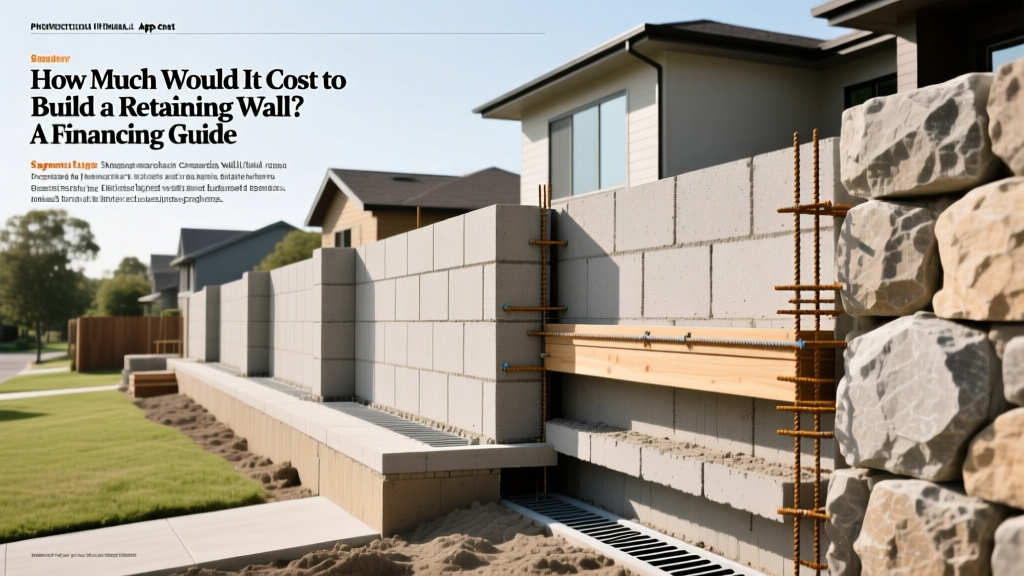
The True Price Tag: Breaking Down Retaining Wall Costs
When homeowners ask how much would it cost to build a retaining wall, they often receive linear-foot estimates that obscure the real math. Professional hardscape contractors calculate pricing based on the square footage of the exposed face (height multiplied by length). A 50-foot long wall that is 2 feet high (100 sq. ft. of face) costs vastly less than a 50-foot long wall that is 6 feet high (300 sq. ft. of face). This is due to the exponential increase in geogrid reinforcement, drainage aggregate, and engineering required for taller structures.
Below is a realistic 2026 cost matrix based on national hardscape averages. These prices include materials, labor, excavation, and basic drainage, but exclude complex site access issues or extreme soil remediation.
| Material Type | Cost per Sq. Ft. of Face | Max Unreinforced Height | Lifespan |
|---|---|---|---|
| Treated Timber (6x6) | $15 - $25 | 4 feet | 15 - 20 years |
| Gabion Baskets (Wire + Stone) | $20 - $35 | 10 feet (stepped) | 50+ years |
| Poured Concrete (Formed) | $25 - $45 | Varies (Engineered) | 50+ years |
| Segmental Concrete Block (e.g., Allan Block, Versa-Lok) | $30 - $55 | 4 feet (unreinforced) | 75+ years |
| Natural Stone (Mortared/Veneer over CMU) | $45 - $85+ | Varies (Engineered) | 100+ years |

Financing Your Retaining Wall: Matching Capital to the Project
A 150-square-foot segmental retaining wall at $40 per square foot will cost roughly $6,000. However, a 400-square-foot engineered wall with tiered steps and lighting can easily exceed $25,000. How you finance the project should depend on the total capital required and your current equity position.
1. Home Equity Line of Credit (HELOC)
For projects exceeding $15,000, a HELOC is often the most cost-effective route. According to the Consumer Financial Protection Bureau, HELOCs allow you to draw only what you need during the draw period (usually 10 years), paying interest only on the drawn amount. This is ideal for phased retaining wall projects where excavation happens in month one, but block laying and finishing occur in month two. The interest may also be tax-deductible if the wall is considered a substantial improvement to your property (consult a tax professional).
2. Point-of-Sale Contractor Financing
Many large landscaping firms partner with lenders like GreenSky or Synchrony to offer "0% APR for 12-18 months" financing. This is highly effective for walls in the $5,000 to $12,000 range if you have the cash flow to pay off the principal before the promotional period ends. Warning: These loans typically feature deferred interest. If you carry a balance of $10,000 and miss the 18-month payoff deadline by a single day, you will be retroactively charged 15% to 29% APR on the entire original amount from day one.
3. Unsecured Personal Loans
For homeowners with little equity or those who need immediate funding to prevent soil erosion before a rainy season, unsecured personal loans offer fast capital (often within 48 hours). However, APRs in the current market range from 8% to 24%. This should be reserved for emergency stabilization walls under $10,000, not cosmetic garden terracing.
Hidden Costs That Derail Landscaping Budgets
When calculating how much it would cost to build a retaining wall, homeowners frequently budget only for the visible materials. The structural components hidden behind the wall are where budgets truly balloon.
- Geotechnical Engineering Stamps: The International Residential Code (IRC) mandates that retaining walls over 4 feet in height (measured from the bottom of the footing to the top of the wall) must be designed by a licensed engineer. Engineering plans typically cost between $800 and $2,000, plus $300 for a soil boring test.
- Geogrid Reinforcement: For walls over 3 feet, layers of synthetic geogrid (e.g., Mirafi or Tensar) must be embedded into the soil behind the wall and tied into the block courses. Add $2.50 to $4.00 per square foot of face for geogrid materials and the extra labor to compact the soil in 8-inch lifts.
- Drainage Aggregate: Water pressure (hydrostatic load) is the number one cause of retaining wall failure. You must backfill the wall with #57 clear stone (washed, angular gravel) and install a perforated PVC drain pipe at the base. Budget an additional $1,500 to $3,000 for aggregate delivery and placement on mid-sized walls.
- Soil Hauling and Disposal: Excavating a 50-foot trench for a 4-foot wall generates roughly 75 cubic yards of dirt. At $50 to $85 per cubic yard for hauling and dump fees, soil removal alone can add $3,750 to your invoice.
Phased Construction: A Cash-Flow Strategy for Tall Walls
If you need to retain 10 feet of soil but only have $12,000 in cash, do not attempt to build a single 10-foot timber wall to save money. It will inevitably fail, and the resulting landslide will cost tens of thousands in property damage. Instead, use a phased terracing strategy.
Build a 5-foot reinforced segmental wall now at the base of the slope. Leave the upper 5 feet as a stabilized, sloped grade planted with deep-rooting erosion control vegetation (like creeping juniper or crown vetch). In year two or three, when your savings or HELOC draw allows, build the second 5-foot wall set back at least twice the height of the lower wall (a 10-foot setback). This breaks a $35,000 engineered project into two manageable $12,000-$15,000 phases, keeping you compliant with structural safety standards while managing cash flow.
Strategic Decision Framework: Which Wall and Loan Match Your Budget?
Use this matrix to align your budget, material choice, and financing strategy before contacting a contractor.
Tier 1: Budget Under $8,000
Material: Treated Timber or Gabion Baskets.
Height: Under 4 feet (No engineering required).
Financing: Cash savings or 0% introductory APR credit card paid off within 12 months.
Tier 2: Budget $10,000 - $25,000
Material: Segmental Concrete Block (Allan Block, Keystone).
Height: 4 to 6 feet (Requires geogrid and engineering).
Financing: HELOC draw or Point-of-Sale contractor financing (strictly managed to avoid deferred interest).
Written by
Sarah WhitfieldSarah Whitfield is a chartered quantity surveyor (MRICS) and construction cost analyst with 15 years of experience in material pricing, procurement strategy, and project budgeting. She earned her degree in Construction Management from the University of Reading (UK) and has worked on projects ranging from $2M custom homes to $180M mixed-use developments across North America and Europe. Sarah currently leads cost estimating for BuildMat Insight, maintaining a proprietary database of 4,000+ material price points updated quarterly. She is a frequent contributor to RSMeans cost data panels and has presented at the International Cost Engineering Council (ICEC) congress. Based in Denver, CO, Sarah is an avid trail runner and volunteer mentor for Women in Construction.
More from Sarah Whitfield
View all
Wood & Lumber
What Are the Different Types of Wood? A Builder's Guide
Compare structural softwoods, finish hardwoods, and engineered lumber. Analyze Janka ratings, MOE values, and 2026 pricing for construction.
Aug 4, 2026

Walls & Panels
Steel Framing vs Wood Framing: Corrosion and Moisture Defense
Compare steel framing vs wood framing for moisture resistance. Learn about galvanized coatings, condensation risks, and corrosion protection strategies.
Jul 21, 2026

Stone & Masonry
How to Cut Stone Veneer: Wet Saw vs Grinder Comparison
Compare the best tools for cutting stone veneer. We review wet saws, angle grinders, and chop saws to help you achieve clean, chip-free cuts.
Jul 21, 2026