How Much Does It Cost to Build a Roller Coaster? Budget Guide
Discover how much it costs to build a roller coaster. Learn terrain, secondary market, and control strategies to save millions on amusement construction.

The True Cost Breakdown: How Much Does It Cost to Build a Roller Coaster?
When developers and park operators ask how much does it cost to build a roller coaster, the answer spans a massive spectrum based on scale, materials, and site conditions. In 2026, a basic kiddie circuit starts around $1.5 million, while a record-breaking giga-coaster can easily exceed $35 million. However, the raw hardware and track fabrication represent only a fraction of the total capital expenditure. Foundation engineering, ride control systems, theming, and regulatory compliance drastically alter the final ledger.
For regional parks and emerging theme park developers, capital efficiency is paramount. By strategically manipulating terrain, leveraging the secondary market, and value-engineering the programmable logic controllers (PLCs), operators can shave 15% to 30% off standard manufacturer quotes without compromising rider safety or throughput.
| Coaster Classification | Typical Height / Drop | Track Length | Estimated 2026 Cost Range | Primary Cost Driver |
|---|---|---|---|---|
| Kiddie / Family Flat | 15 ft - 40 ft | 200 ft - 800 ft | $1.5M - $4M | Theming and queue integration |
| Family Steel / Wooden | 50 ft - 90 ft | 1,500 ft - 3,000 ft | $6M - $14M | Track milling and support steel |
| Thrill / Mega Steel | 150 ft - 220 ft | 4,000 ft - 6,000 ft | $18M - $28M | Deep foundations and heavy steel |
| Giga / Hyper Coaster | 300 ft+ | 6,500 ft+ | $30M - $45M+ | Custom train engineering and wind-load structural analysis |
Strategy 1: Terrain Utilization Over Steel Erection
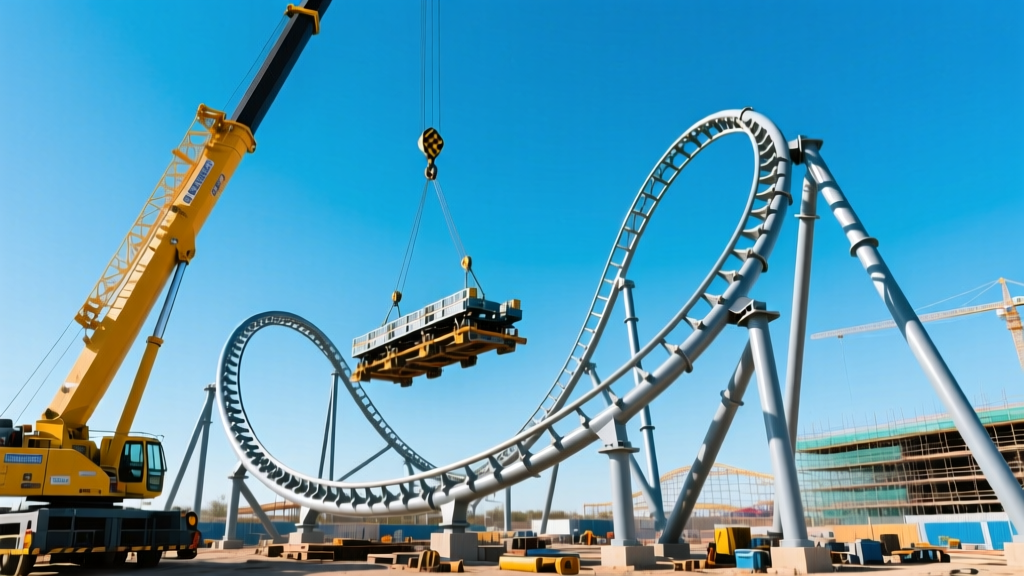
The most effective way to reduce the cost of a large-scale roller coaster is to let the earth do the work of the steel. Structural steel prices for amusement applications in 2026 hover between $1,300 and $1,600 per ton installed. A standard mega-coaster requires upwards of 1,200 tons of support columns and cross-bracing. If a park is situated on hilly topography, designers can utilize a "terrain coaster" layout.
The Math Behind Terrain Savings
By routing the track into natural ravines, over existing ridges, and through natural valleys, engineers can drastically reduce the required height of the support columns. Dropping the average support column height from 60 feet to 20 feet across a 4,000-foot layout can eliminate over 400 tons of structural steel. At $1,500 per ton, this saves $600,000 in material costs alone, not including the reduced crane rental time and accelerated erection schedule. Earthmoving and grading typically cost between $15 and $25 per cubic yard, making strategic cut-and-fill operations significantly cheaper than vertical steel erection.
Expert Insight: When designing terrain coasters, ensure the natural soil composition can handle the dynamic lateral loads of the track. A geotechnical survey costing $15,000 upfront can prevent $500,000 in retaining wall failures later.
Strategy 2: Navigating the Secondary Coaster Market
Not every park needs a factory-fresh ride. The secondary market for relocated and refurbished roller coasters is highly active, tracked extensively by databases like the Roller Coaster DataBase (RCDB). Purchasing a decommissioned ride from a closing park or a manufacturer's holding yard can reduce hardware costs by 40% to 60%.
Refurbishment Realities: NDT and Track Milling
Buying used requires rigorous validation. The primary expense in relocating a coaster is Non-Destructive Testing (NDT) and track refurbishment. Every weld on the track spines and support columns must undergo magnetic particle inspection or ultrasonic testing to identify fatigue micro-cracks. Expect to pay $15,000 to $30,000 for comprehensive NDT on a mid-sized family coaster. Additionally, the running rails often require CNC milling to remove wear grooves and restore the precise tubular profile, costing roughly $1,500 per linear meter. Even with these refurbishment costs, a relocated Vekoma or Schwarzkopf model remains vastly cheaper than commissioning a new build.
Strategy 3: Value-Engineering the Ride Control System
The brain of a roller coaster is its block zone control system, which prevents train collisions by dividing the track into isolated sections. Modern coasters rely on safety-rated Programmable Logic Controllers (PLCs). While manufacturers often default to top-tier, fully redundant architectures for every ride, regional parks can optimize these systems based on actual throughput needs.
- Proximity Switches vs. Linear Encoders: Standard inductive proximity switches for block zone detection cost roughly $150 each and are highly reliable. Upgrading to continuous linear encoders for exact train positioning adds $100,000+ to the control budget and is only necessary for complex, multi-launch LSM (Linear Synchronous Motor) coasters.
- Braking Systems: Traditional friction fin brakes require pneumatic compressors, air lines, and regular pad replacements. Transitioning to passive magnetic eddy-current brakes eliminates the need for pneumatic infrastructure and reduces annual maintenance costs by up to $40,000, paying for the initial hardware premium within three years.
- PLC Selection: Utilizing a standard Siemens S7-1500F safety PLC setup rather than a fully proprietary, manufacturer-locked black-box system allows parks to use local, certified integrators for future modifications and troubleshooting, slashing long-term service contract fees.
Strategy 4: Phased Theming and Envelope Design
Theming and immersive environments can easily double the base cost of a roller coaster. A bare-steel track sitting in an open field costs a fraction of one wrapped in a $10 million artificial mountain facade. The most financially sound strategy for new parks is phased envelope design.
Navigating ASTM F24 Compliance and Inspection Costs
Safety and regulatory compliance are non-negotiable, but understanding the exact standards prevents over-engineering and unnecessary consulting fees. In the United States, amusement ride design and operation are governed by the ASTM F24 Committee on Amusement Rides and Devices. Specifically, ASTM F2291 dictates design requirements, while ASTM F770 covers operation and maintenance.
To optimize compliance costs, park operators should mandate that the manufacturer provides a complete, pre-certified F2291 design package reviewed by a licensed Professional Engineer (PE) in the state of installation. If the manufacturer provides raw CAD files and expects the local park to hire a third-party PE to validate the dynamic load calculations, engineering fees can balloon by $150,000 to $250,000. Always negotiate the delivery of a fully stamped, state-ready engineering dossier as part of the initial purchase agreement.
Foundation Geotechnical Optimization
ASTM standards require foundations to withstand extreme dynamic wind and seismic loads. The default engineering solution is often deep drilled shafts (caissons) socketed into bedrock. However, if a thorough geotechnical boring reveals stable, heavily over-consolidated clay at a shallow depth, engineers can utilize large spread footings instead. Drilled shafts require massive rotary rigs and cost upwards of $250 per linear foot. Spread footings only require standard excavators and concrete formwork, potentially saving $500,000 on a large layout. Always invest in a dense grid of soil borings ($5,000 - $8,000 per hole) along the exact track footprint to give structural engineers the data they need to confidently specify cheaper foundation types.
Final Considerations for Park Developers
Answering the question of how much does it cost to build a roller coaster requires looking far beyond the manufacturer's brochure. By embracing natural topography, rigorously vetting secondary market hardware, optimizing block-zone pneumatics, and phasing immersive elements, developers can deliver world-class thrill experiences while maintaining strict fiduciary responsibility. For ongoing industry benchmarks and operational safety guidelines, operators should maintain active engagement with the International Association of Amusement Parks and Attractions (IAAPA) to ensure their cost-saving measures never compromise the stringent safety expectations of the modern amusement industry.
Written by
Elena RodriguezElena Rodriguez is a civil engineer and technical writer specializing in concrete technology, masonry systems, and ASTM/ACI compliance. She earned her B.S. in Civil Engineering from Texas A&M University and spent a decade at a materials testing laboratory, performing over 2,000 concrete compressive strength tests and masonry prism evaluations. Elena is an ACI-certified Field Testing Technician (Grade I) and a member of ASTM Committee C12 on Natural Building Stone. She currently consults on forensic engineering cases involving concrete failures and moisture intrusion. Based in San Antonio, TX, Elena is a proud member of the Society of Women Engineers (SWE) and coaches her daughter's FIRST Robotics team.
More from Elena Rodriguez
View all
Walls & Panels
Cost Analysis: Light Gauge Steel Framing Advantages and Disadvantages
Evaluate light gauge steel framing advantages and disadvantages through a strict cost analysis lens, comparing material, labor, and lifecycle expenses.
Aug 4, 2026

Walls & Panels
Gypsum Board Types: Exact Specifications, Thickness & Dimensions
Compare standard, Type X, and moisture-resistant gypsum board types. Get exact specifications, thicknesses, dimensions, and ASTM standards for your project.
Aug 4, 2026

Fire Resistance
Best Fire-Resistant Outdoor Decking Materials: 2026 Buyer Guide
Discover the best fire-resistant outdoor decking materials for 2026. Compare Class A PVC, aluminum, and hardwood options for WUI compliance and safety.
Aug 4, 2026