The True Cost to Build a Sauna: 2026 Pricing Guide
Discover the true cost to build a sauna in 2026. Break down custom vs. prefab pricing, wood material costs, heater sizing, and hidden electrical expenses.

Building a residential sauna is a high-ROI home improvement project that blends wellness benefits with structural complexity. Unlike standard room additions, saunas require specialized thermal dynamics, specific wood species, and heavy-duty electrical infrastructure. The cost to build a sauna typically ranges from $4,500 for a basic prefabricated infrared unit to over $18,000 for a custom stick-built traditional Finnish sauna. This guide deconstructs the exact material, labor, and mechanical costs required to budget accurately for a 2026 sauna construction project.
The Baseline: Custom Stick-Built vs. Prefab Kits
The first major cost bifurcation in sauna construction is choosing between a prefabricated kit and a custom stick-built enclosure. Your choice dictates the baseline budget and the level of architectural integration possible.
Quick Cost Snapshot (2026 Estimates)
- Prefab Infrared Sauna (2-Person): $2,800 – $5,500 (Plug-and-play 120V)
- Prefab Traditional Finnish Kit (4x6 ft): $4,500 – $8,500 (Requires 240V)
- Custom Stick-Built Traditional (6x8 ft): $11,000 – $18,500 ($230 – $385 per sq. ft.)
- Outdoor Barrel Sauna (Cedar, 6ft): $6,000 – $9,500 (Includes wood-burning or electric stove)
Prefab kits offer predictable pricing and rapid assembly, often utilizing tongue-and-groove panels that lock together. However, they are restricted to standard dimensions and often use thinner 1-inch framing. Custom stick-built saunas allow for exact dimensional tailoring, integration into existing bathroom layouts, and the use of premium 2x4 framing with high-R-value insulation, which drastically improves heat retention and long-term energy efficiency.
Material Matrix: Selecting Your Sauna Wood
The interior shell of a sauna must withstand extreme temperature fluctuations (up to 195°F) and high humidity without warping, splintering, or off-gassing toxic resins. Softwoods are mandatory due to their low thermal conductivity, meaning they won't burn the skin upon contact. According to the USDA Forest Service, Western Red Cedar is the premier choice due to its natural decay resistance and dimensional stability, but alternatives exist for varying budgets.
| Wood Species | Cost per Linear Foot (1x4 T&G) | Durability & Resin | Best Application |
|---|---|---|---|
| Western Red Cedar (Clear) | $9.50 – $14.00 | Exceptional; low resin, natural oils | Premium custom interiors |
| Western Red Cedar (Knotty) | $6.00 – $8.50 | Good; knots may weep resin over time | Budget-conscious traditional builds |
| Nordic Spruce / Hemlock | $4.50 – $7.00 | Moderate; requires kiln-drying to prevent sap bleed | Prefab kits, painted exteriors |
| Thermally Modified Aspen | $11.00 – $16.00 | Superior; heat-treated to eliminate all resins and allergens | Hypoallergenic environments, modern aesthetics |
Estimating Tip: Always order 15% more tongue-and-groove (T&G) siding than your calculated square footage to account for miter cuts, grading defects, and waste. For a standard 6x8 foot sauna (roughly 250 sq. ft. of wall and ceiling surface), expect to spend between $1,800 and $3,200 solely on interior cedar cladding.
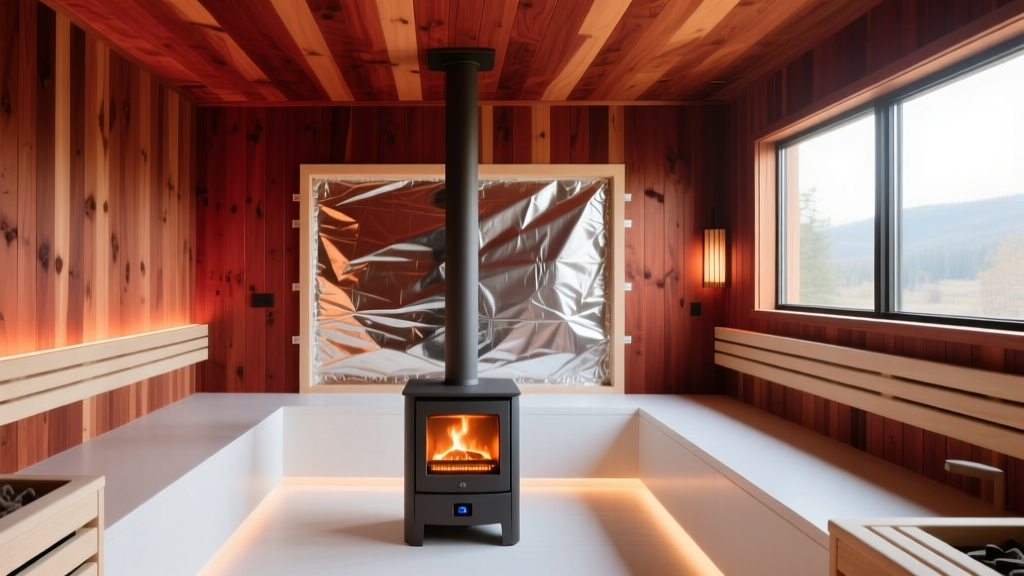
The Heating Engine & Electrical Rough-In
The heater is the heart of the sauna and represents a significant portion of the mechanical budget. Sizing a traditional electric sauna heater follows the strict 50-Cubic-Foot Rule: you need approximately 1 kW of power for every 50 cubic feet of insulated sauna space. A standard 6x8 foot sauna with an 8-foot ceiling yields 384 cubic feet, requiring an 8 kW heater.
Heater Type Cost Comparison
- Electric Wall-Mounted (e.g., Harvia or TyloHelo 8kW): $900 – $1,600. Requires a dedicated 40-amp, 240V circuit.
- Electric Floor-Standing / Pillar (e.g., Harvia Cilindro): $1,400 – $2,500. Holds more rocks for softer, more consistent steam (löyly).
- Wood-Burning Stove: $1,200 – $3,000. Requires a Class A insulated chimney system, non-combustible floor pad, and strict adherence to NFPA 211 clearance standards for combustibles.
- Carbon Infrared Panels: $600 – $1,200 (for a full room set). Operates on standard 120V but does not produce traditional steam.
Critical Hidden Costs: Insulation and Vapor Barriers
The most common failure in DIY and budget-contracted sauna builds is improper thermal and moisture management. A sauna is essentially a high-heat, high-humidity box; without the right barriers, moisture will migrate into the wall cavity, causing mold and structural rot.
Expert Insight: Never use standard polyethylene plastic sheeting as a vapor barrier in a sauna. According to guidelines referenced by the U.S. Department of Energy, vapor barriers must be matched to the climate and application. In saunas, temperatures routinely exceed 180°F, which will cause standard plastic to degrade, melt, and off-gas volatile organic compounds (VOCs). You must use a specialized aluminum foil vapor barrier (kraft-backed or scrim-reinforced), which reflects radiant heat back into the room and withstands extreme temperatures without degrading.
- Insulation (R-11 to R-13 Fiberglass Batts): $0.60 – $1.10 per sq. ft. Fits standard 2x4 framing.
- Aluminum Foil Vapor Barrier: $0.75 – $1.50 per sq. ft. Seams must be taped with specialized aluminum foil tape (not standard duct tape).
- Furring Strips (1x2 or 1x3): $1.50 per linear foot. Installed vertically over the foil to create a 3/4-inch air gap behind the cedar T&G, preventing moisture trapping against the wood.
Ventilation and Flooring: The Overlooked Details
Proper airflow is non-negotiable for oxygen replenishment and heat distribution. A correctly ventilated sauna requires two vents: 1. Intake Vent: Positioned low on the wall, directly beneath or behind the heater, to draw in cool air that is immediately heated and pushed upward. 2. Exhaust Vent: Positioned on the opposite wall, roughly 6 inches below the ceiling, to draw out stale, cool air without losing the primary heat bank at the ceiling level. Budget $150 to $300 for adjustable wooden or aluminum vent covers and the carpentry labor to frame them into the wall cavity.
For flooring, never use carpet, standard vinyl, or untreated hardwood. The floor must be waterproof and easily cleanable. The most cost-effective and durable approach is a tiled concrete slab or a cement backer board subfloor covered in slip-resistant porcelain tile ($12 – $25 per sq. ft. installed). Over the tile, removable cedar duckboards ($4 – $8 per sq. ft.) are placed for barefoot comfort and easy removal for floor cleaning.
Step-by-Step Cost Allocation Breakdown
When evaluating contractor bids or planning a DIY budget, use this percentage breakdown to ensure no category is being underfunded or overcharged. Based on a $15,000 custom 6x8 traditional electric sauna build:
- Framing, Insulation & Vapor Barrier: 15% ($2,250)
- Interior Wood Cladding (Cedar T&G) & Benches: 30% ($4,500)
- Sauna Heater, Controls & Rocks: 12% ($1,800)
- Electrical Rough-In & Finish Wiring: 18% ($2,700)
- Door, Glass, Ventilation & Hardware: 10% ($1,500)
- Flooring & Waterproofing: 8% ($1,200)
- Permits, Miscellaneous & Contingency: 7% ($1,050)
3 Estimating Mistakes That Blow Up Sauna Budgets
1. Underestimating Glass Costs: Full-glass sauna doors or expansive tempered glass front walls are highly popular in modern designs. However, custom-sized, double-paned tempered glass (required to prevent shattering under thermal stress and reduce heat loss) costs $1,200 to $2,500 per panel. Standard pre-hung single-pane tempered cedar-framed doors cost significantly less ($400 – $800).
2. Ignoring Ceiling Height Restrictions: Sauna ceilings should never exceed 8 feet (7 feet is optimal). Heat rises, and a vaulted or 10-foot ceiling will trap the thermal energy above the bathers' heads, forcing the heater to run continuously and fail to reach target temperatures. If you are building in a room with high ceilings, budget for the extra framing and cedar required to drop the sauna ceiling to 7 or 8 feet.
3. Forgetting the Dedicated GFCI Requirement: Modern electrical codes often require Ground Fault Circuit Interrupter (GFCI) protection for sauna circuits, especially if located near a bathroom or wet area. Standard 40A double-pole GFCI breakers are significantly more expensive than standard breakers ($120 – $180 vs. $15). Ensure your electrical estimate specifies the correct code-compliant breaker type to avoid failed inspections.
Written by
James ThorntonJames Thornton is a construction industry veteran with 25 years of hands-on experience in wood framing, lumber grading, and residential building codes. He started as a framing carpenter in rural Oregon, earned his ICC Residential Building Inspector certification, and eventually became a senior plan reviewer for the City of Portland Bureau of Development Services. James holds a B.S. in Wood Science & Technology from Oregon State University and is a certified lumber grader through the West Coast Lumber Inspection Bureau (WCLIB). He has inspected over 3,000 residential construction sites and authored the city's internal guide on advanced framing techniques (2x6 at 24" O.C.). James lives in Bend, OR, where he builds custom timber-frame cabins and competes in lumberjack sports.
More from James Thornton
View all
Insulation
Best Home Insulation Materials: Complete 2026 Guide
Compare top home insulation materials for 2026. Find R-values, installed costs per square foot, and best uses for fiberglass, spray foam, and mineral wool.
Aug 4, 2026

Sustainable Building
Certify Your Green Building Material for LEED and WELL
Step-by-step guide to certifying a green building material for LEED v5 and WELL v2. Master EPDs, HPDs, and VOC limits for 2026 project specifications.
Aug 4, 2026

Stone & Masonry
Veneer Stacked Stone Panels: Interior Design & Style Showcase
Discover how veneer stacked stone panels transform interiors. Explore modern design profiles, material pairings, and technical installation specs.
Aug 4, 2026