How Much Does It Cost to Build a Skyscraper? Global Cost Comparison
Discover how much it costs to build a skyscraper. Compare global construction costs per square foot, structural material expenses, and hidden high-rise fees.
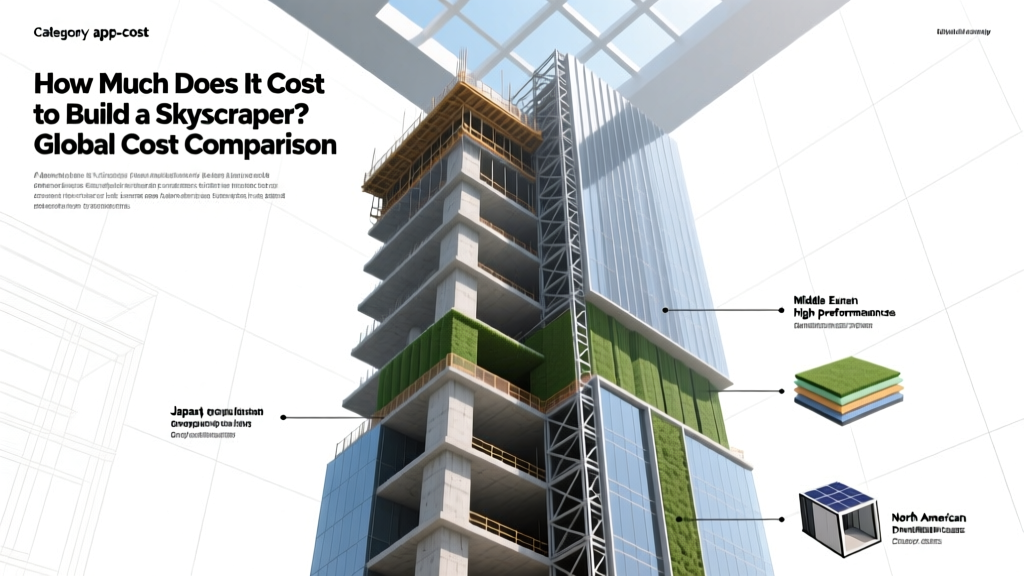
The True Cost of Piercing the Skyline
When developers and municipal planners ask how much does it cost to build a skyscraper, the answer requires dissecting a complex matrix of structural engineering, regional labor indices, and vertical logistics. A standard 40-to-50-story commercial high-rise typically costs between $150 million and $500 million, translating to a baseline of $1,500 to $3,500 per square foot. However, once a building crosses the 300-meter threshold into 'supertall' territory, costs scale exponentially, frequently exceeding $1.5 billion due to extreme wind-loading requirements and specialized vertical transport systems.
According to data tracked by The Skyscraper Center (CTBUH), the global average cost for supertall structures hovers around $3,200 per square foot, but regional disparities can swing this figure by over 60%. Below, we break down the exact cost drivers, structural system comparisons, and the hidden engineering expenses that dictate high-rise budgets.
Skyscraper Cost Comparison by Structural System
The skeletal framework accounts for 15% to 25% of total hard construction costs. The choice between steel, concrete, or composite systems is rarely just about material price; it is dictated by local supply chains, seismic requirements, and the building's target height.
| Structural System | Avg. Cost per Sq. Ft. | Ideal Height Range | Key Advantages & Limitations |
|---|---|---|---|
| Structural Steel Frame | $120 - $180 (Frame Only) | 10 - 40 Stories | Faster erection, high strength-to-weight ratio. Vulnerable to fire (requires expensive intumescent coatings) and price volatility in global steel markets. |
| Reinforced Concrete Core | $90 - $140 (Frame Only) | 20 - 60 Stories | Superior fire resistance and acoustic damping. Slower construction cycle due to concrete curing times; requires high-strength mixes (10,000+ psi) for lower floors. |
| Composite (Steel + Concrete Core) | $150 - $220 (Frame Only) | 50 - 100+ Stories | Industry standard for supertalls. Concrete core resists wind shear; steel outriggers distribute gravity loads. Highest upfront cost but optimizes usable floor plate. |
The 'Height Premium': Why Floor 80 Costs More Than Floor 10
A common miscalculation in high-rise estimating is applying a uniform cost-per-square-foot across all elevations. In reality, skyscrapers suffer from a 'height premium'—the phenomenon where upper floors cost significantly more to build than lower ones.
Height Premium Cost Multipliers
- Floors 1–20: Base cost multiplier (1.0x). Standard concrete pumping, conventional crane reach.
- Floors 21–40: 1.15x multiplier. Requires secondary water pumping stations, high-pressure concrete mixes, and specialized tower crane climbing ties.
- Floors 41–60: 1.35x multiplier. Wind bracing requirements increase steel tonnage by 20%. Elevator shafts consume more rentable floor area, driving up the effective cost per leasable square foot.
- Floors 60+: 1.60x+ multiplier. Requires tuned mass dampers, ultra-high-strength concrete (14,000 psi), and sky-lobby elevator transfer zones.
Logistics alone inflate upper-floor costs. Pumping concrete to 1,000 feet requires specialized high-pressure trailer pumps and retarder admixtures to prevent the mix from setting in the lines during the hours-long ascent. Furthermore, as documented in the Turner & Townsend International Construction Market Survey, labor productivity drops by up to 30% on extreme high-rise floors due to wind delays, restricted material staging areas, and extended vertical commute times for workers.
Regional Cost Variations: Global High-Rise Markets
Geography dictates material availability, union labor rates, and regulatory overhead. Here is how the cost to build a 50-story commercial skyscraper compares across major global hubs:
North America (New York, San Francisco, Toronto)
Average Cost: $2,800 – $4,500+ per sq. ft.
North American markets are heavily constrained by union labor rates, stringent seismic and wind codes, and dense urban logistics. In Manhattan, the lack of laydown space means materials must be delivered 'just-in-time' and hoisted immediately, requiring meticulous scheduling and inflating crane rental costs.
Middle East (Dubai, Riyadh)
Average Cost: $2,000 – $3,200 per sq. ft.
While labor costs are lower, the Middle East requires massive investments in HVAC systems capable of handling extreme desert heat, alongside specialized facade coatings to resist sand abrasion and solar gain. Deep foundation costs also spike in areas with high water tables and loose sandy soils, requiring extensive friction piling.
East Asia (Shanghai, Shenzhen, Seoul)
Average Cost: $1,200 – $2,200 per sq. ft.
East Asia benefits from highly optimized, localized supply chains for steel and glass, alongside rapid-deployment construction methodologies. State-backed infrastructure and 24/7 construction permits allow for significantly compressed build schedules, reducing carrying costs and financing overhead.
Hidden Costs That Break High-Rise Budgets
General contractors often account for the concrete and steel, but the specialized systems unique to skyscrapers are where budgets frequently experience cost overruns.
⚠️ Warning: The Facade Engineering Trap
For buildings over 40 stories, traditional stick-built curtain walls are impossible to install safely due to wind shear and the lack of scaffolding anchor points. Developers must use unitized curtain wall systems—factory-assembled glass and mullion panels hoisted and locked into place. While stick-built systems cost $40–$70 per sq. ft., unitized systems range from $90 to $160 per sq. ft. installed. Furthermore, wind tunnel testing to validate the facade's pressure resistance adds $150,000 to $350,000 to the pre-construction soft costs.
Vertical Transport and Elevator Zoning
A 60-story building cannot rely on a single bank of elevators; the shaft space required would consume the entire ground floor. Engineers must implement 'sky lobbies' and zoned elevator banks. High-speed traction elevators (capable of 10+ meters per second) cost between $250,000 and $500,000 per cab. Implementing destination-dispatch software and carbon-fiber hoisting ropes (like Kone's UltraRope) to reduce cable weight in supertalls can push the total vertical transport budget past $25 million for a single tower.
Tuned Mass Dampers (TMD)
To prevent motion sickness for occupants on upper floors during high-wind events, supertalls require a Tuned Mass Damper. This is typically a massive steel or concrete pendulum suspended near the roof. The 660-ton steel sphere in Taipei 101 cost roughly $4 million, but modern active liquid dampers or multi-axis electromagnetic TMDs in newer builds can range from $5 million to $15 million, requiring dedicated structural reinforcement just to support the damper's dead load.
"The transition from a 40-story high-rise to an 80-story supertall is not a linear doubling of costs. The geometric increase in wind forces, the necessity for sky-lobbies, and the exponential loss of net-rentable area to structural cores and elevator shafts mean the final 40 stories can cost up to three times as much per square foot as the first 40."
— Senior Structural Engineer, High-Rise Division
Real-World Case Studies
To contextualize these estimating metrics, consider two recent benchmark projects:
- Central Park Tower (New York City): Standing at 1,550 feet, this mixed-use supertall cost approximately $3 billion to construct. The extreme height, combined with New York's logistical constraints and luxury interior fit-outs, pushed the blended cost well over $3,500 per square foot.
- Salesforce Tower (San Francisco): At 1,070 feet, this commercial office tower cost roughly $1.1 billion. The project required a massive deep-foundation overhaul, sinking 42 load-bearing piles down to 300 feet to anchor the building into bedrock, a direct response to the region's stringent seismic codes.
Frequently Asked Questions
How long does it take to build a 50-story skyscraper?
From groundbreaking to certificate of occupancy, a standard 50-story commercial tower takes 36 to 48 months. The core and shell typically rise at a rate of one floor every 4 to 7 days, but interior MEP (mechanical, electrical, plumbing) fit-outs and facade sealing often extend the final year of the schedule.
What is the most expensive part of building a skyscraper?
While the structural frame is highly visible, the most expensive individual components are often the MEP systems and the exterior facade. HVAC systems capable of managing the stack effect and solar heat gain in a glass tower, combined with unitized curtain walls, routinely consume 35% to 45% of the total hard construction budget.
Written by
Marcus ChenMarcus Chen is a licensed structural engineer (PE) and building materials analyst with over 12 years of experience across residential, commercial, and industrial construction. He holds a Master of Science in Civil Engineering from UC Berkeley and spent six years at Thornton Tomasetti before transitioning to independent consulting and technical writing. Marcus specializes in material selection for seismic-prone regions, concrete reinforcement strategies, and lifecycle cost analysis. His work has been cited by the American Concrete Institute (ACI) and the Structural Engineers Association of California (SEAOC). When he is not on a job site or at his desk, you will find him hiking the Sierra Nevada or restoring a 1920s craftsman bungalow in Oakland, CA.
More from Marcus Chen
View all
Construction Cost
How Much Did the Eiffel Tower Cost to Build?
How much did the Eiffel Tower cost to build in 1889? We adjust for inflation and compare its budget to modern skyscraper construction.
Aug 4, 2026

Fire Resistance
What Is a Fire Resistant Material? Testing & Certification Guide
Discover what is a fire resistant material through ASTM and UL testing. Learn how fire ratings, certifications, and assemblies work in construction.
Aug 4, 2026

Construction Cost
How Much Did the Burj Khalifa Cost to Build?
How much did the Burj Khalifa cost to build? We break down the $1.5B project and extract 5 money-saving strategies for your next build.
Jul 30, 2026