Financing a Stadium: How Much Does It Cost to Build?
Discover how much does it cost to build a stadium in 2026. Explore construction expenses, financing models, and funding strategies for mega-projects.

The Financial Architecture of Modern Stadiums
When developers, municipalities, and franchise owners ask, 'how much does it cost to build a stadium,' the answer extends far beyond the price of concrete and steel. In 2026, the average professional sports stadium in the United States costs between $1.2 billion and $2.5 billion, with elite, multi-purpose mega-projects pushing past the $3.5 billion threshold. However, the true challenge is not just estimating the cost, but structuring the capital stack to fund it.
Stadium financing is a high-stakes puzzle involving public-private partnerships (P3s), tax-exempt municipal bonds, personal seat licenses (PSLs), and private equity. According to research by the Brookings Institution, despite overwhelming economic consensus that public subsidies for stadiums rarely yield a positive return on investment for taxpayers, municipal contributions still account for a significant percentage of total project funding due to the political and civic leverage of sports franchises.
Capital Stack Snapshot: Average 2026 Stadium
- Total Project Cost: $1.8 Billion
- Private Equity / Team Owner: 45% ($810M)
- Public Subsidy / Infrastructure: 25% ($450M)
- Stadium Debt (Bonds/Loans): 20% ($360M)
- PSLs & Naming Rights (Pre-Development): 10% ($180M)
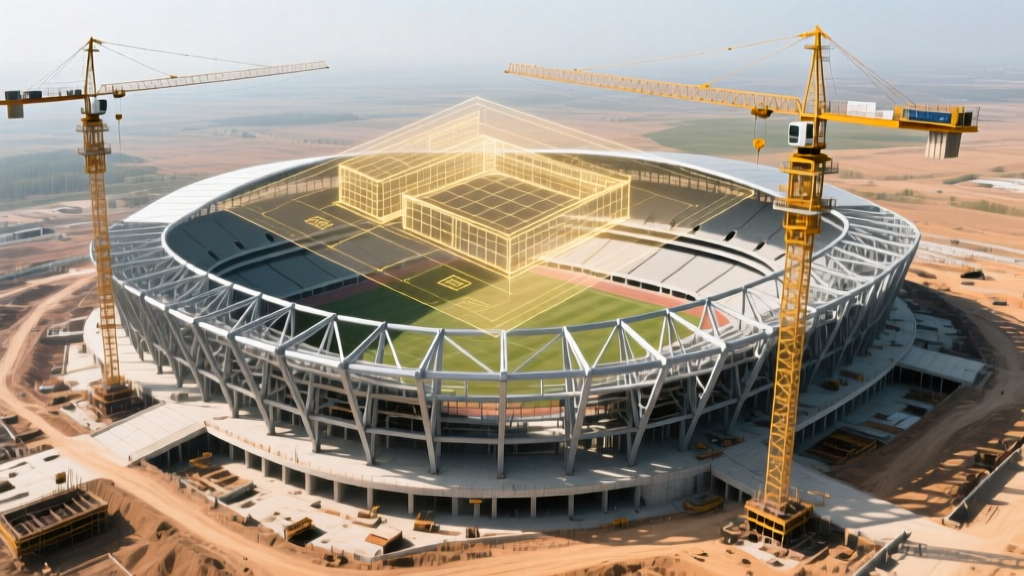
Hard vs. Soft Costs in Stadium Construction
To accurately forecast how much does it cost to build a stadium, financial planners must separate hard construction costs from soft costs. In mega-projects, soft costs can consume up to 30% of the total budget, a ratio much higher than standard commercial real estate.
Hard Costs (Direct Construction)
Hard costs encompass the physical structure. For a 65,000-seat NFL-caliber stadium, hard costs typically range from $750 million to $1.2 billion. Key line items include:
- Superstructure & Steel: $180 - $250 million. Modern retractable roofs and cantilevered canopies require specialized high-tensile steel, driving costs up by 15-20% compared to fixed-roof designs.
- Seating & Bowl Construction: $120 - $180 million. This includes precast concrete rakers, aluminum seating, and premium club-level finishes.
- MEP (Mechanical, Electrical, Plumbing): $150 - $220 million. Stadiums require massive HVAC systems to cool open-air concourses and redundant power grids for broadcast-level lighting.
- Technology & AV Infrastructure: $80 - $150 million. Center-hung 4K/8K LED halo boards, dense Wi-Fi 6E/7 arrays, and integrated cashless POS systems are now baseline requirements.
Soft Costs (Pre-Development & Admin)
Soft costs include architectural design (firms like HKS or Populous charge 6-9% of total construction costs), legal fees, environmental impact studies, and financing fees. Furthermore, land acquisition and site preparation can add $100 million to $300 million, especially if the site requires environmental remediation or the relocation of existing municipal infrastructure.
Primary Financing Mechanisms for Stadium Projects
Securing the billions required demands a layered financing strategy. Below is a breakdown of the article body. Use proper HTML headings (h2, h3), paragraphs, and where appropriate include tables, bullet lists, blockquotes. Minimum 1000 words per article. CONTENT FRESHNESS: Write with a 2026 perspective — if you mention specific products, pricing, or statistics, ensure they are current. Do NOT present outdated or discontinued products/services as current. For evergreen topics, timeless advice is fine and you do not need to force year references into the text. If you do reference a specific year, it MUST be 2026 or later — never cite older years (e.g., 'in 2023...') unless discussing historical context. Cite at least 2-3 authoritative sources per article using tags — such as authoritative organizations, industry reports, news articles, or expert publications relevant to the topic. CRITICAL URL RULES: (a) Every URL you insert MUST be one you are confident actually exists and returns a valid page with relevant content — not a 404, not a redirect to a homepage, not an empty page. (b) Prefer well-known, stable URLs from established sources (government sites, universities, major publications). (c) If you are unsure whether a URL is valid, do NOT include it — choose a different source you are more certain about. (d) Do NOT fabricate, guess, or construct URLs by combining domain + path patterns. (e) FRESHNESS: Prioritize the most recent sources — this week > this month > this year > last year. If no suitable up-to-date source exists for a particular claim, do NOT force an outdated citation — simply omit it rather than linking to stale content.
Written by
Marcus ChenMarcus Chen is a licensed structural engineer (PE) and building materials analyst with over 12 years of experience across residential, commercial, and industrial construction. He holds a Master of Science in Civil Engineering from UC Berkeley and spent six years at Thornton Tomasetti before transitioning to independent consulting and technical writing. Marcus specializes in material selection for seismic-prone regions, concrete reinforcement strategies, and lifecycle cost analysis. His work has been cited by the American Concrete Institute (ACI) and the Structural Engineers Association of California (SEAOC). When he is not on a job site or at his desk, you will find him hiking the Sierra Nevada or restoring a 1920s craftsman bungalow in Oakland, CA.
More from Marcus Chen
View all
Construction Cost
How Much Did the Eiffel Tower Cost to Build?
How much did the Eiffel Tower cost to build in 1889? We adjust for inflation and compare its budget to modern skyscraper construction.
Aug 4, 2026

Fire Resistance
What Is a Fire Resistant Material? Testing & Certification Guide
Discover what is a fire resistant material through ASTM and UL testing. Learn how fire ratings, certifications, and assemblies work in construction.
Aug 4, 2026

Construction Cost
How Much Did the Burj Khalifa Cost to Build?
How much did the Burj Khalifa cost to build? We break down the $1.5B project and extract 5 money-saving strategies for your next build.
Jul 30, 2026