How Much Does It Cost to Build a Tennis Court? Budget Breakdown
Discover exactly how much it costs to build a tennis court. Get detailed budget breakdowns for asphalt, concrete, clay, site prep, and lighting.

Baseline Construction Costs by Surface Type
When planning a residential or commercial tennis facility, the base construction and surfacing dictate the largest portion of your capital expenditure. A standard tournament-sized playing area measures 60 feet by 120 feet (7,200 square feet), but the total fenced enclosure should ideally be 70 feet by 130 feet (9,100 square feet) to accommodate proper runoff and player safety.
According to the American Sports Builders Association (ASBA), the choice of base material fundamentally alters both the upfront budget and the 20-year lifecycle cost. Below is the current cost matrix for a standard 9,100 sq. ft. residential court, excluding extreme site-work anomalies.
| Base & Surface System | Estimated Cost Range | Cost per Sq. Ft. | Expected Lifespan (Base) |
|---|---|---|---|
| Asphalt Base + Acrylic Coating | $45,000 – $75,000 | $4.95 – $8.25 | 15 – 20 Years |
| Standard Concrete + Acrylic | $55,000 – $85,000 | $6.05 – $9.35 | 25 – 30 Years |
| Post-Tensioned Concrete + Acrylic | $75,000 – $110,000 | $8.25 – $12.10 | 40+ Years |
| Har-Tru (Fast-Dry Clay) | $60,000 – $95,000 | $6.60 – $10.45 | Indefinite (with upkeep) |
| Modular Polypropylene Tile | $35,000 – $60,000 | $3.85 – $6.60 | 15 – 20 Years |
Site Preparation: The Hidden Budget Variables
The most frequent cause of budget overruns in court construction is subsurface site preparation. A tennis court is essentially a massive, flat roof; if water cannot shed off it, the base will fail. The ASBA mandates a minimum slope of 0.83% (1 inch drop per 10 feet) and a maximum of 1% for proper drainage.
Never skip the geotechnical soil report ($1,500 – $3,500). Expansive clays or high water tables require structural mitigation. If your soil report reveals poor load-bearing capacity, you will need to over-excavate and import engineered fill, which can add $8,000 to $15,000 to your earthwork budget.
Earthwork and Grading Costs
- Clearing and Grubbing: $2,000 – $6,000 depending on tree density and root removal.
- Cut and Fill Earthwork: $4,500 – $12,000. Balancing cut and fill on-site saves massive trucking fees.
- Laser Grading: $3,000 – $5,000. Essential for achieving the strict 1% planar tolerance required for asphalt or concrete pours.
- Subsurface Drainage: $2,500 – $6,000. Includes trenching, gravel bedding, and installing 4-inch perforated PVC French drains along the perimeter.
Surfacing Systems and Coating Specifications
Once the structural base is cured (asphalt requires 14 to 28 days of curing to off-gas volatile oils; concrete requires 28 days), the surfacing system is applied. Do not use standard driveway sealcoat on a tennis court. You must specify 100% acrylic, non-abrasive resurfacing systems like Plexipave or DecoTurf.
The 5-Layer Acrylic System
A professional-grade acrylic application involves multiple distinct layers, each serving a specific mechanical purpose:
- Resurfacer (1-2 coats): Fills minor voids and provides a textured grip for subsequent layers. Contains fine silica sand.
- Cushion Layer (Optional, 3-5 coats): Adds shock absorption. Increases the budget by $6,000 – $10,000 but significantly reduces player joint fatigue and achieves ITF (International Tennis Federation) Category 2 or 3 pace ratings.
- Texture Coats (2 coats): Dictates the speed of the court. More sand equals a slower, higher-bouncing court; less sand yields a faster, lower-bouncing surface.
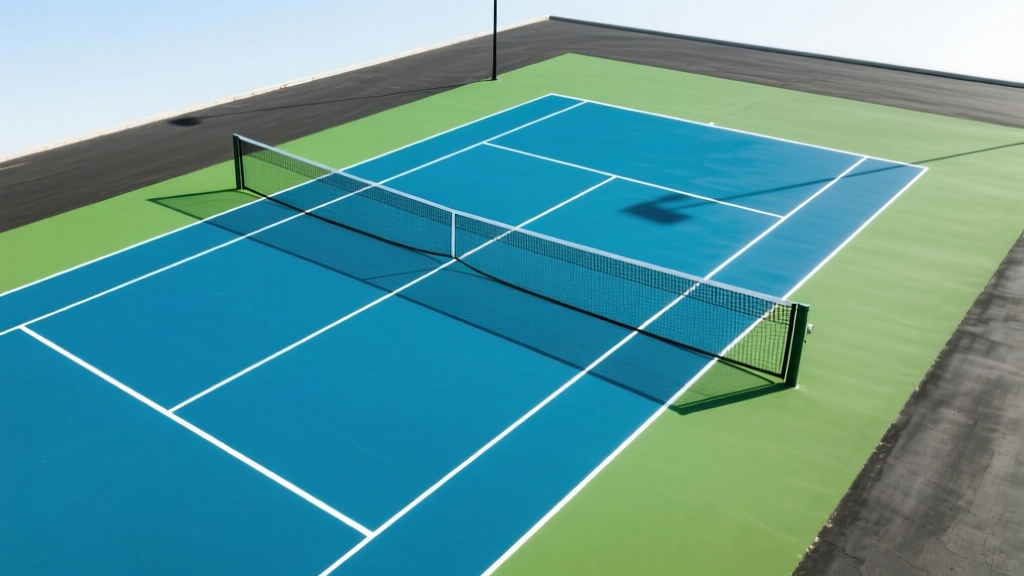
- Finish Coats (2 coats): Provides the UV-stable color (typically US Open Blue and Green).
- Line Striping: $800 – $1,200 using specialized white acrylic line paint to prevent bleeding.
Fencing, Lighting, and Perimeter Infrastructure
A court is not functional until it is enclosed and illuminated. Budgeting for perimeter infrastructure requires precise material specifications to avoid premature rust or inadequate lux levels for night play.
Chain Link Fencing
Standard tennis court fencing is 10 feet high to contain errant balls. For a 70' x 130' enclosure, you have 400 linear feet of fencing.
- Galvanized Chain Link (9-gauge): $28 – $38 per linear foot. Prone to rusting and glare.
- Vinyl-Coated Chain Link (9-gauge, Black or Green): $38 – $55 per linear foot. Highly recommended. Black vinyl-coated fencing virtually disappears into the background, improving ball visibility for players. Total fencing budget: $15,200 – $22,000.
LED Lighting Systems
Metal halide lighting is obsolete. Modern LED sports lighting provides instant on/off capability, zero warm-up time, and 60% lower energy consumption. According to facility planning guidelines from the United States Tennis Association (USTA), residential courts require an average of 30 to 40 foot-candles of illuminance.
- 4-Pole LED System: $14,000 – $20,000. Adequate for casual residential play, but creates slight shadowing in the corners.
- 6-Pole to 8-Pole LED System: $22,000 – $35,000. Required for competitive play, eliminating dark spots and reducing light spill onto neighboring properties.
Long-Term Maintenance and Resurfacing Cycles
When calculating the true cost of ownership, factor in the mandatory maintenance cycles. Ignoring these will result in catastrophic base failure.
Asphalt: Requires crack sealing annually. Full acrylic resurfacing every 5 to 8 years ($8,000 – $12,000). Susceptible to frost heave and tree root intrusion.
Standard Concrete: Requires control joint sealing. Resurfacing every 8 to 12 years. Prone to structural cracking if the subgrade shifts.
Post-Tensioned Concrete: The steel cables compress the slab, actively preventing structural cracks. Resurfacing every 10 to 15 years. Highest upfront cost, lowest lifecycle maintenance.
Har-Tru Clay: Requires daily brushing, rolling, and watering. Annual top-dressing and laser-grading ($3,000 – $5,000/year). Must be winterized in freezing climates.
Decision Framework: Choosing the Right Build
To finalize your budget allocation, match your site conditions and usage patterns to the appropriate structural system:
- Choose Asphalt if: You have a strict upfront budget constraint, stable soils, and live in a mild climate without severe freeze-thaw cycles.
- Choose Standard Concrete if: You want a longer lifespan than asphalt but cannot accommodate the heavy equipment required for post-tensioning.
- Choose Post-Tensioned Concrete if: You are building on expansive clay soils, have a high water table, or want a multi-generational asset with minimal structural maintenance. This is the gold standard for modern commercial and high-end residential builds.
- Choose Modular Tile if: You are retrofitting over an existing, heavily cracked concrete slab where demolition costs are prohibitive, or if you need a multi-use court (tennis, pickleball, basketball).
For further technical specifications on base tolerances and drainage gradients, consult the construction guidelines published by the Forbes Home Improvement outdoor division and the ASBA Tennis Court Construction Manual before finalizing your contractor bids.
Written by
James ThorntonJames Thornton is a construction industry veteran with 25 years of hands-on experience in wood framing, lumber grading, and residential building codes. He started as a framing carpenter in rural Oregon, earned his ICC Residential Building Inspector certification, and eventually became a senior plan reviewer for the City of Portland Bureau of Development Services. James holds a B.S. in Wood Science & Technology from Oregon State University and is a certified lumber grader through the West Coast Lumber Inspection Bureau (WCLIB). He has inspected over 3,000 residential construction sites and authored the city's internal guide on advanced framing techniques (2x6 at 24" O.C.). James lives in Bend, OR, where he builds custom timber-frame cabins and competes in lumberjack sports.
More from James Thornton
View all
Insulation
Best Home Insulation Materials: Complete 2026 Guide
Compare top home insulation materials for 2026. Find R-values, installed costs per square foot, and best uses for fiberglass, spray foam, and mineral wool.
Aug 4, 2026

Sustainable Building
Certify Your Green Building Material for LEED and WELL
Step-by-step guide to certifying a green building material for LEED v5 and WELL v2. Master EPDs, HPDs, and VOC limits for 2026 project specifications.
Aug 4, 2026

Stone & Masonry
Veneer Stacked Stone Panels: Interior Design & Style Showcase
Discover how veneer stacked stone panels transform interiors. Explore modern design profiles, material pairings, and technical installation specs.
Aug 4, 2026