This Is It Yacht Cost to Build: Budget Planning Guide
Discover the true this is it yacht cost to build in 2026. Explore budget planning, material pricing, naval architecture fees, and hidden mega-vessel expenses.

The Anatomy of a Mega-Yacht Build Budget
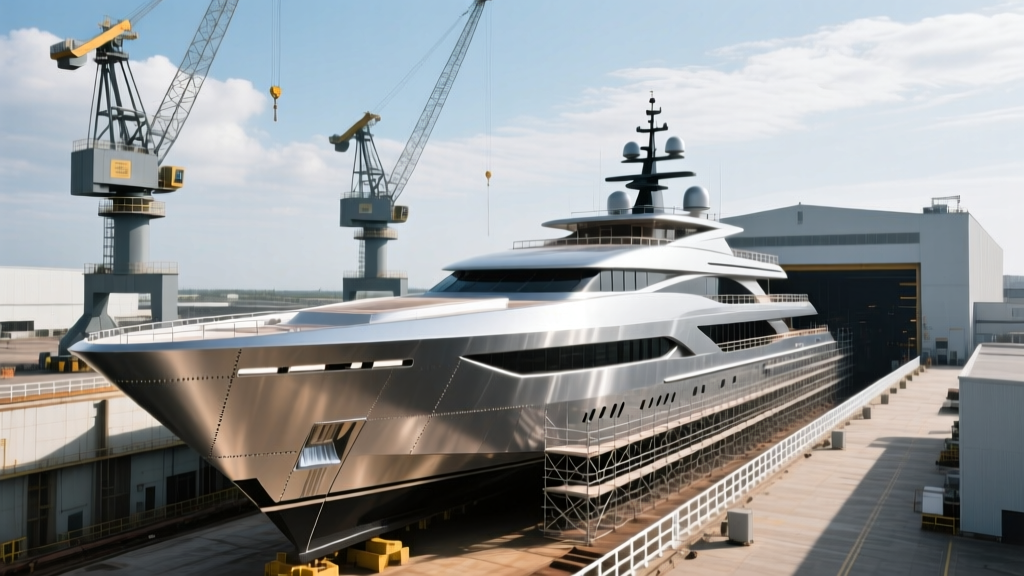
When an owner finally decides to commission their ultimate, no-compromise custom vessel, they often refer to it as their definitive project. Understanding the this is it yacht cost to build requires shifting from standard marine procurement to complex, commercial-grade construction estimating. Unlike production boats, a full-custom mega-yacht is essentially a floating luxury hotel combined with a highly regulated commercial power plant. In 2026, shipyard order books are heavily constrained, and material indices for marine-grade metals have stabilized at higher post-pandemic baselines.
To accurately forecast the capital required, estimators must abandon Length Overall (LOA) as the primary metric and instead utilize Gross Tonnage (GT). GT measures the internal volume of the vessel, which correlates far more accurately with labor hours, material mass, and outfitting complexity. According to Boat International, the baseline cost for a full-custom superyacht built in Northern Europe currently ranges from $135,000 to $175,000 per GT, excluding owner-furnished items.
The Golden Rule of Yacht Estimating
Never budget based solely on the hull and machinery (H&M) contract. The shipyard contract typically covers only 55% to 65% of the final delivered cost. The remaining 35% to 45% is consumed by owner supplies, naval architecture fees, classification society surveys, project management, and sea-trial contingencies.
Phase 1: Naval Architecture and Pre-Construction Engineering
Before a single sheet of steel is cut, the budget must absorb significant engineering expenses. A custom 70-meter+ vessel requires comprehensive computational fluid dynamics (CFD) modeling and physical towing tank tests to optimize the hull form for fuel efficiency and seakeeping.
- Naval Architecture & Exterior Design: Typically 4% to 6% of the total build cost. For a $100M project, expect to allocate $4M to $6M for the design house and engineering firm.
- Interior Architecture: Custom joinery and spatial planning for MCA LY3 (Large Yacht Code) compliance usually adds another 3% to 5%.
- Classification & Regulatory Consulting: Engaging Lloyd's Register or RINA early in the design phase is non-negotiable. Plan for $300,000 to $500,000 in initial surveyor retainers and plan-approval fees to ensure the design meets SOLAS and MARPOL standards.
Phase 2: Hull Construction and Material Cost Matrix
The structural phase is where material selection drastically alters the budget trajectory. While steel remains the standard for hulls over 50 meters due to its acoustic dampening and cost-efficiency, the superstructure material dictates the vessel's center of gravity and overall price tag.
| Material Application | Specific Alloy / Grade | 2026 Est. Cost per Metric Ton | Labor Multiplier |
|---|---|---|---|
| Main Hull Plating | AH36 Marine Steel | $1,200 - $1,450 | 1.0x (Baseline) |
| Superstructure | 5083-H116 Aluminum | $4,800 - $5,500 | 2.5x (TIG/MIG Welding) |
| Exhaust & High-Heat | Duplex Stainless Steel (2205) | $6,200 - $7,100 | 3.0x (Specialized Purging) |
| Mast / Radar Arch | Carbon Fiber Composite | $45,000+ (Fabricated) | 5.0x (Autoclave Curing) |
Understanding the labor multiplier is critical for budget planning. Aluminum requires specialized welders, strict temperature control, and non-destructive testing (NDT) like X-ray and ultrasonic inspection on every seam. This is why an all-aluminum 60-meter vessel can cost as much as a 75-meter steel-hulled equivalent.
Phase 3: Marine MEP and Outfitting Complexities
Mechanical, Electrical, and Plumbing (MEP) systems on a mega-yacht dwarf those of a comparable luxury mansion. The marine environment demands redundancy, vibration isolation, and saltwater corrosion resistance.
Critical MEP Budget Drivers
- Dynamic Positioning (DP2) Systems: Essential for zero-anchoring in sensitive coral reefs. A full DP2 system with azimuth thrusters and drop-down GPS sensors adds $2.5M to $4M to the propulsion budget.
- Watermaking & HVAC: Reverse osmosis desalination plants capable of producing 100+ tons of fresh water daily, paired with titanium-plate heat exchangers for the HVAC chillers, typically consume $1.5M to $2.2M.
- Acoustic Isolation: To meet the stringent RINA Comfort Class or Lloyd's 100PC notation, main engines must be mounted on active pneumatic isolators, and bulkheads require mass-loaded vinyl (MLV) decoupling. Budget $800,000 to $1.2M purely for acoustic engineering and materials.
Hidden Costs and Contingency Planning
The most common point of failure in yacht budget planning is underestimating owner-furnished equipment (OFE) logistics and shipyard change orders. When you source custom Italian marble or specialized AV equipment directly, you assume the liability for integration delays.
"A shipyard's profit margin is often protected by rigid change-order clauses. If an owner decides to move a watertight bulkhead to enlarge the owner's suite after the 3D model is frozen, the re-engineering, re-classification, and structural rework can trigger a $250,000 penalty for a single modification. Freeze the design early to protect your contingency."
— Senior Project Manager, Northern European Shipyard
The Contingency Matrix
Do not use a flat 10% contingency. Instead, apply a risk-weighted contingency matrix based on the build phase:
- Hull & Machinery Contract: 5% (Fixed-price shipyard contracts limit upside risk).
- Interior Joinery & Outfitting: 15% (Highly susceptible to material delays and design changes).
- Owner-Furnished Equipment (OFE): 20% (Shipping delays, customs duties, and integration mismatches).
- Sea Trials & Commissioning: 10% (Unforeseen software bugs in integrated bridge systems and vibration harmonics).
Financial Framework: Allocating Your Capital
To execute a flawless build, structure your capital deployment in alignment with the shipyard's payment milestones. Shipyards typically require a refund guarantee from a Tier-1 bank, which costs the owner 1.5% to 2.5% of the guaranteed amount in banking fees. Ensure your financial institution understands the intricacies of maritime asset-backed lending.
Ultimately, calculating the true cost of your definitive project requires treating the vessel not as a consumer purchase, but as a multi-year commercial construction endeavor. By anchoring your estimates to Gross Tonnage, respecting the labor multipliers of marine alloys, and ring-fencing your interior outfitting contingency, you will secure a financially viable path to the water.
Written by
David NakamuraDavid Nakamura is a licensed architect (AIA) and construction technology writer focused on sustainable building methods, mass timber engineering, and high-performance building envelopes. He holds a Master of Architecture from the University of Washington and is a certified Passive House Consultant (CPHC). David spent eight years at the Seattle firm Mithun, where he led the design of three LEED Platinum projects, before founding his own practice specializing in net-zero residential design. He serves on the editorial advisory board of GreenBuilder Magazine and has authored peer-reviewed papers on cross-laminated timber (CLT) connections for the Journal of Structural Engineering. In his spare time, David teaches woodworking at Pratt Fine Arts Center and kayaks the Puget Sound.
More from David Nakamura
View all
Construction Cost
Labor Cost to Build a Deck Per Sq Ft: 2026 Installation Guide
Discover the exact labor cost to build a deck per sq ft in 2026. This installation guide breaks down contractor rates, complexity factors, and hidden fees.
Aug 4, 2026

Construction Cost
How Much Does It Cost to Build a 3 Bedroom House? Financing Guide
Learn exactly how much it costs to build a 3 bedroom house and explore 2026 financing options, construction loan types, and budget frameworks for your build.
Aug 4, 2026

Construction Cost
Cost to Build a Tennis Court: 2026 Guide
How much does it cost to build a tennis court in 2026? Breakdowns for asphalt, concrete, and synthetic surfaces plus fencing and lighting.
Jul 30, 2026