How Much Money Did It Cost to Build the Titanic? Scope & Cost Analysis
Discover how much money it cost to build the Titanic by breaking down 1912 materials, labor, and scale through a modern construction scope calculator lens.
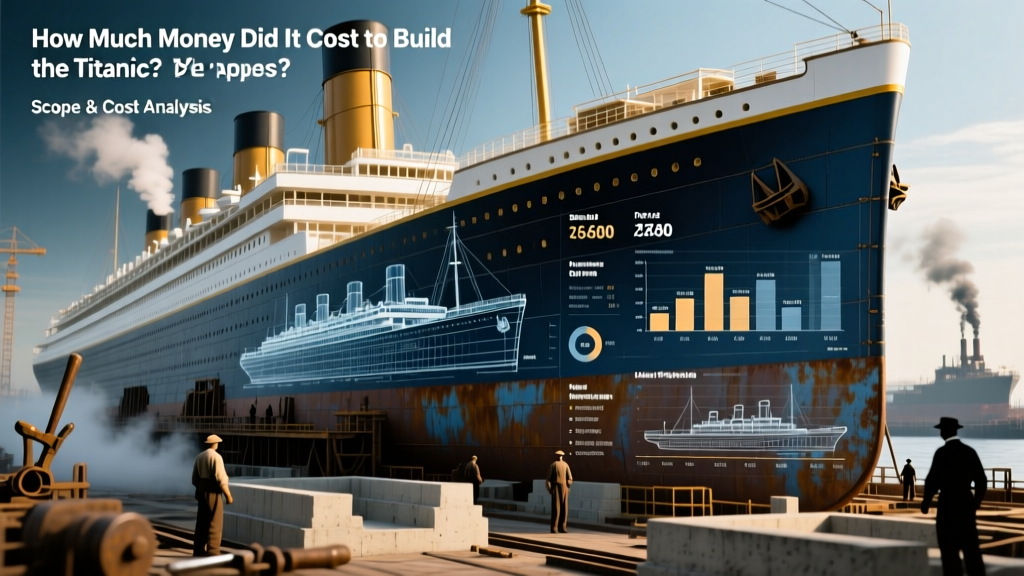
The 1912 Baseline: Original Ledger vs. Modern Scope
When evaluating historical mega-projects through a modern construction estimating lens, the RMS Titanic remains one of the most fascinating case studies in scale, material density, and labor allocation. To answer the fundamental question of how much money did it cost to build the titanic, we must look past the simple historical ledger and apply a Size & Scope Calculator methodology. This approach breaks the vessel down into gross tonnage, material takeoffs, labor productivity rates, and maritime-specific MEP (Mechanical, Electrical, and Plumbing) equivalents.
The White Star Line commissioned Harland and Wolff in Belfast to construct the Olympic-class liners on a cost-plus basis. The final documented construction cost for the Titanic was approximately £1.5 million in 1912. At the time, this translated to roughly $7.5 million USD. However, a raw historical figure fails to capture the true scope of the project. By deconstructing the ship into modern estimating categories, we can understand the actual resource density required to build the largest moving object in human history at that time.
• Gross Register Tonnage: 46,328 GRT
• Dimensions: 882 ft 9 in (length) x 92 ft 6 in (beam)
• Displacement: 52,310 tons
• Peak Workforce: ~14,000 shipyard employees (approx. 3,000 dedicated to Titanic at peak)
• Original Cost: £1,500,000 GBP ($7,500,000 USD in 1912)
Material Takeoff: Quantifying the Leviathan
A modern size and scope calculator begins with the structural skeleton. The Titanic’s hull was constructed using Siemens-Martin open-hearth steel, a premium material for the era known for its uniform quality and tensile strength. The sheer volume of materials required represents a massive procurement and logistics effort, even by 2026 industrial standards.
| Material Category | Estimated Quantity / Scope | Estimator Notes & Specifications |
|---|---|---|
| Steel Plating | ~24,000 tons | Plates ranged from 1 inch to 1.5 inches thick. Sourced from Dalzell Steel and Works in Scotland. |
| Rivets | ~3,000,000 units | Weighting over 1,200 tons total. Midsection used steel rivets; bow/stern used wrought iron due to spatial constraints for hydraulic tools. |
| Timber & Decking | ~1,500 tons | Teak for upper decks, oak for structural framing, and pine for interior bulkheads and cabinetry. |
| Electrical Wiring | 400+ miles | Copper wiring for the ship's 10,000+ incandescent lamps and early radio communication arrays. |
| Boilers & Machinery | 29 boilers, 159 furnaces | Scotch marine boilers weighing up to 91 tons each, requiring massive reinforced steel bedding. |
According to archives maintained by the Royal Museums Greenwich, the decision to use wrought iron rivets in the bow and stern—where the curvature of the hull made heavy hydraulic riveters impossible to maneuver—has been heavily scrutinized by modern metallurgists. Wrought iron from that era often contained high concentrations of slag, making the rivets brittle in freezing water. From a modern quality assurance (QA) perspective, this represents a critical failure in material specification driven by spatial constraints and tool limitations of the 1910s.
Labor Productivity & Man-Hour Estimation
Calculating the labor scope of the Titanic requires understanding early 20th-century shipyard productivity. Harland and Wolff operated the Queen's Island shipyard with a workforce that peaked at over 14,000 men. The construction timeline spanned exactly three years: the keel was laid on March 31, 1909, the hull was launched on May 31, 1911, and the fitting-out process concluded in March 1912.
The Rivet Factor and Manual Labor Density
In modern construction, automated welding has largely replaced riveting, drastically reducing man-hours per ton of steel. On the Titanic, riveting was a highly specialized, labor-intensive process. A standard riveting squad consisted of five men: a heater, a catcher, a holder-up, and two riveters.
- Heating: Rivets were heated in portable forges to roughly 1,000°C (1,832°F).
- Insertion: The catcher used tongs and a tin shield to catch the glowing rivet and insert it into the pre-drilled hole.
- Setting: The holder-up braced the head with a heavy dolly, while the riveters used pneumatic hammers (or hand hammers in tight spaces) to forge the tail into a sealing head.
Estimating 3 million rivets at an average rate of 500 rivets set per squad per day, the fastening scope alone required millions of specialized man-hours, highlighting a labor density that would be economically unviable in modern shipbuilding.
Maritime MEP: The Unseen Scope Creep
In commercial building estimation, MEP (Mechanical, Electrical, and Plumbing) systems often account for 30% to 40% of total project costs. The Titanic was essentially a floating, self-sustaining municipality, and its maritime MEP equivalent was staggering in scope.
The vessel featured a complex network of 400 miles of electrical wiring powered by four 400-kilowatt steam-driven generators. The plumbing scope included over 1,000 toilets and baths, requiring massive freshwater storage tanks and a dedicated desalination plant capable of producing 14,000 gallons of fresh water daily. Furthermore, the HVAC equivalent—a network of thermotank ventilation systems—pulled heated or cooled air through miles of sheet metal ducting to maintain climate control in first-class cabins. This level of mechanical integration pushed the project's scope far beyond a simple steel hull, driving the final cost-plus ledger to its £1.5 million peak.
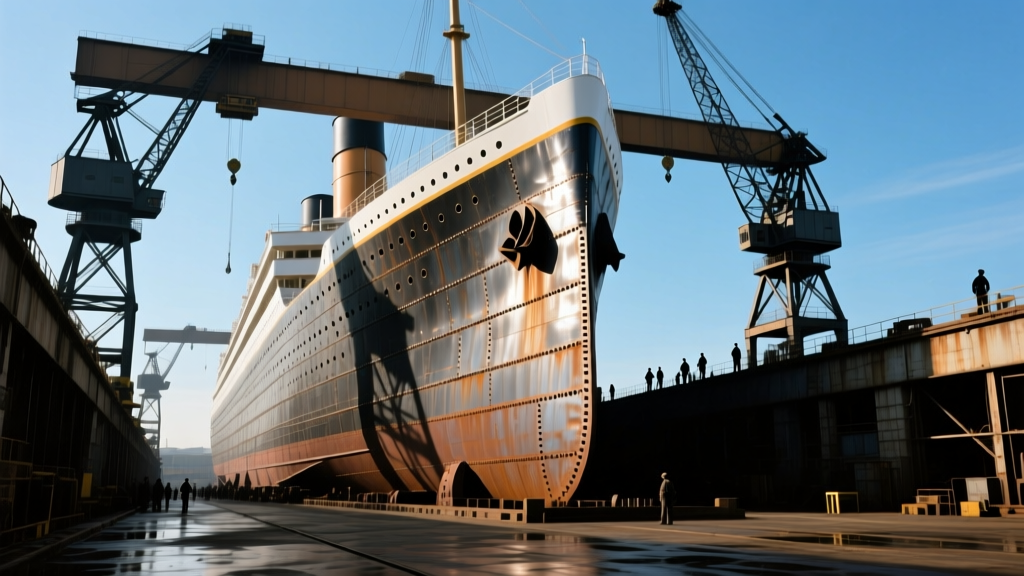
Inflation, Indexing, and the True Replacement Cost
To understand the true cost of the Titanic in today's economy, estimators must avoid relying solely on standard Consumer Price Index (CPI) calculators. Standard CPI measures the cost of consumer goods, not heavy industrial construction. Using the UK National Archives Currency Converter, £1.5 million in 1912 equates to roughly £190 million to £220 million in today's purchasing power. However, this is a massive underestimation of the actual replacement cost.
Estimator's Note on Maritime Indexing: Heavy industrial construction costs scale much faster than consumer goods due to regulatory compliance, advanced material science, and unionized labor rates. Applying a modern heavy-industrial construction multiplier, the raw hull and machinery of a Titanic-equivalent vessel would cost between $450 million and $600 million today. However, building it to modern SOLAS (Safety of Life at Sea) maritime codes would push the cost significantly higher.
Scope Comparison: Titanic vs. Modern Mega-Cruise Ships
To contextualize the Titanic's cost, we must compare its size and scope to modern Oasis-class and Icon-class cruise ships. While the Titanic was the pinnacle of 1912 engineering, modern vessels dwarf it in both gross tonnage and technological density.
| Metric | RMS Titanic (1912) | Icon of the Seas (2024) | Scope Variance |
|---|---|---|---|
| Gross Tonnage | 46,328 GT | 250,800 GT | 5.4x Larger |
| Length | 882 ft 9 in | 1,198 ft | 1.35x Longer |
| Original Cost | $7.5 Million USD | ~$2.0 Billion USD | 266x Higher Nominal Cost |
| Cost per Gross Ton | ~$161 / GT (1912) | ~$7,974 / GT (2024) | Massive Tech/Regulatory Premium |
| Crew to Passenger Ratio | 1 to 2.7 | 1 to 2.4 | Similar Service Scope |
As reported by CNN Travel during the launch of Royal Caribbean's Icon of the Seas, modern mega-ships cost roughly $2 billion. This exponential increase in cost per gross ton is not merely due to inflation; it represents a massive expansion in project scope. Modern ships include LNG (Liquefied Natural Gas) propulsion systems, advanced wastewater treatment plants, digital twin navigation arrays, and entertainment infrastructure that simply did not exist in 1912.
The Estimator's Verdict
When asking how much money did it cost to build the titanic, the literal answer is £1.5 million. But from a construction estimating perspective, the Titanic was a masterclass in early 20th-century resource allocation. It was built at a time when manual labor was cheap, environmental regulations were nonexistent, and safety redundancies were minimal.
If a modern shipyard were contracted to build the exact Titanic today—using 1912 materials but adhering to 2026 labor rates, safety codes, and environmental standards—the project scope would balloon. The manual riveting of 3 million joints alone would trigger catastrophic labor overruns under modern occupational health and safety regulations. Ultimately, the Titanic's true cost is best understood not just as a historical ledger entry, but as a benchmark that highlights the evolution of construction scope, material science, and the staggering premium we now pay for safety and technological integration in mega-project development.
Written by
Marcus ChenMarcus Chen is a licensed structural engineer (PE) and building materials analyst with over 12 years of experience across residential, commercial, and industrial construction. He holds a Master of Science in Civil Engineering from UC Berkeley and spent six years at Thornton Tomasetti before transitioning to independent consulting and technical writing. Marcus specializes in material selection for seismic-prone regions, concrete reinforcement strategies, and lifecycle cost analysis. His work has been cited by the American Concrete Institute (ACI) and the Structural Engineers Association of California (SEAOC). When he is not on a job site or at his desk, you will find him hiking the Sierra Nevada or restoring a 1920s craftsman bungalow in Oakland, CA.
More from Marcus Chen
View all
Construction Cost
How Much Did the Eiffel Tower Cost to Build?
How much did the Eiffel Tower cost to build in 1889? We adjust for inflation and compare its budget to modern skyscraper construction.
Aug 4, 2026

Fire Resistance
What Is a Fire Resistant Material? Testing & Certification Guide
Discover what is a fire resistant material through ASTM and UL testing. Learn how fire ratings, certifications, and assemblies work in construction.
Aug 4, 2026

Construction Cost
How Much Did the Burj Khalifa Cost to Build?
How much did the Burj Khalifa cost to build? We break down the $1.5B project and extract 5 money-saving strategies for your next build.
Jul 30, 2026