How Much Does It Cost to Build a Retaining Wall? Budget Guide
Discover exactly how much it costs to build a retaining wall. Get detailed budget breakdowns for concrete, timber, and stone materials plus labor rates.

The Structural Reality of Retaining Wall Budgets
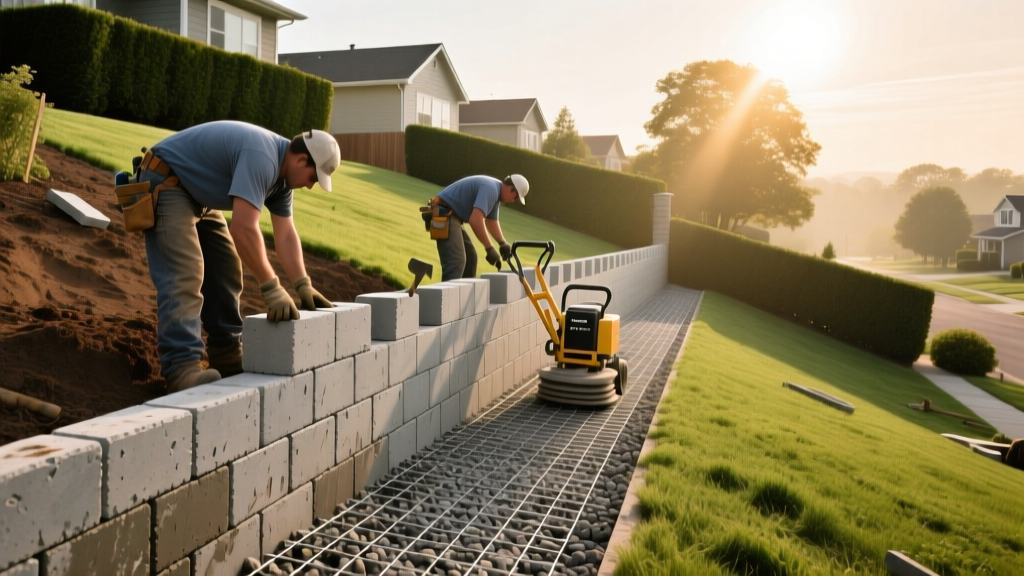
When calculating how much it costs to build a retaining wall, homeowners often focus solely on the visible face material. This is a critical budgeting error. A retaining wall is a structural earth-retention system, not a decorative fence. The primary cost drivers are subsurface preparation, hydrostatic drainage management, and soil reinforcement. Failing to budget for 3/4-inch clear crushed stone base material, perforated drainage pipes, and geogrid reinforcement will result in wall bulging, toe failure, or complete collapse within the first freeze-thaw cycle.
Executive Cost Summary (Per Square Foot of Wall Face)
- Economy (Treated Timber): $15 – $25 per sq. ft. installed
- Standard (Segmental Concrete Block): $25 – $45 per sq. ft. installed
- Premium (Poured Concrete / Natural Stone): $45 – $85+ per sq. ft. installed
- National Average Total Project Cost: $3,800 – $8,500 for a standard residential yard wall (approx. 100 sq. ft.)
Material Breakdown: Face Costs vs. System Costs
The visible material represents only 30% to 50% of the total material cost. Below is a breakdown of the face materials, keeping in mind that you must add backfill aggregate, drainage pipe, and base rock to these figures.
| Material Type | Face Material Cost (Per Sq. Ft.) | Lifespan & Structural Notes |
|---|---|---|
| Segmental Retaining Wall (SRW) Block (e.g., Allan Block Classic, Versa-Lok) |
$6.00 – $12.00 | 75+ years. Pin-based or lip-based interlocking systems. Requires 10-degree batter angle. |
| Poured Concrete | $18.00 – $35.00 | 100+ years. Requires forming, #4 or #5 rebar dowels, and a concrete pump truck for large pours. |
| Natural Stone (Mortared) | $25.00 – $50.00 | 50-100 years. Highly labor-intensive. Requires a concrete footing below the frost line. |
| Pressure-Treated Timber (6x6 Southern Yellow Pine) |
$4.00 – $8.00 | 15-25 years. Requires galvanized deadmen anchors and timber spikes. Susceptible to rot. |
| Gabion Baskets | $10.00 – $20.00 | 50+ years. Wire mesh cages filled with 4-8 inch cobble. Permeable, no drainage pipe required. |
The Hidden Costs That Derail Retaining Wall Budgets
Contractors refer to the "buried budget." For every dollar spent on the face block, expect to spend $0.60 to $1.00 on the structural backfill and drainage systems.
1. Base and Backfill Aggregate
Never use round river rock or gravel with "fines" (dust) for retaining wall backfill. Fines retain water and cause frost heave. You must use 3/4-inch clear crushed angular aggregate (meeting ASTM D448 #57 standards). This material locks together under compaction and allows water to flow freely to the drain pipe. Budget $45 to $75 per ton delivered, plus the cost of a skid steer or mini-excavator to move it.
2. Hydrostatic Drainage Systems
Hydrostatic pressure (water trapped behind the wall) is the number one cause of retaining wall failure. A proper system includes:
- Perforated Pipe: 4-inch SDR 35 PVC or rigid corrugated pipe placed at the base of the wall, wrapped in non-woven geotextile fabric (e.g., Mirafi 140N) to prevent silt clogging.
- Weeep Holes: If using mortared stone or poured concrete, PVC weep hole inserts must be cored every 4 to 6 feet along the base.
3. Geogrid Reinforcement
For any SRW wall exceeding 3 feet in height, or walls supporting structural surcharge loads (like a driveway or patio above the wall), uniaxial or biaxial geogrid is mandatory. Geogrid layers are sandwiched between block courses and extend back into the compacted soil (typically 60% of the wall's height). Budget $1.50 to $3.50 per square foot for commercial-grade geogrid (e.g., Tenax TT series).
4. Engineering and Permits
According to the International Building Code (IBC), retaining walls over 4 feet in height (measured from the bottom of the footing to the top of the wall) require a stamped design from a licensed structural engineer. Engineering plans typically cost $800 to $2,500. Municipal permits add another $150 to $400.
Labor Rates and Equipment Requirements
Retaining wall installation is heavy, technical labor. Professional hardscape crews charge between $65 and $125 per hour per worker, or they will bid the project at $15 to $35 per square foot of wall face for labor alone.
Expert Warning on Compaction: Proper base compaction is non-negotiable. The base aggregate must be compacted using a vibratory plate compactor with a minimum of 5,000 lbs of centrifugal compaction force. Hand-tamping or using a lightweight DIY rental tamper will result in differential settlement and a wavy wall face within one year.
Decision Matrix: Matching Wall Type to Budget and Site
Use this matrix to determine which system aligns with your site constraints and financial parameters.
| Wall Type | Max Height (Unreinforced) | Equipment Needed | Best Use Case |
|---|---|---|---|
| Timber | 4 Feet | Post hole auger, chainsaw, sledgehammer | Tight budgets, wooded lots, temporary erosion control |
| SRW Block | 4 Feet (Up to 15ft+ with geogrid) | Plate compactor, mini-excavator, masonry saw | Standard suburban grading, tiered gardens, high ROI |
| Poured Concrete | Unlimited (Engineered) | Excavator, forming lumber, concrete pump truck | Modern architecture, supporting heavy vehicular surcharge |
| Gabion | 10+ Feet (Stepped) | Skid steer, crane/clamshell for large rock | Riparian zones, high-water flow areas, industrial aesthetics |
Real-World Budget Scenarios
Scenario A: The Tiered Garden Wall (SRW Block)
Dimensions: 40 feet long x 3 feet high (120 sq. ft. face).
Material Choice: Allan Block Classic in a slate grey blend.
Site Conditions: Moderate slope, no structural surcharge, good draining sandy-loam soil.
Cost Breakdown:
- Face Block (approx. 130 blocks): $1,100
- Capstones: $350
- Base & Backfill Aggregate (12 tons): $750
- Drainage Pipe & Fabric: $150
- Labor (2-man crew, 3 days): $2,800
- Total Estimated Cost: $5,150 ($42.91 per sq. ft.)
Scenario B: The Driveway Retention Wall (Engineered SRW)
Dimensions: 60 feet long x 5 feet high (300 sq. ft. face).
Site Conditions: Clay soil, supporting a driveway 4 feet behind the wall top (requires surcharge engineering).
Cost Breakdown:
- Face Block & Capstones: $3,200
- Aggregate (35 tons): $2,100
- Geogrid Reinforcement (Uniaxial, 3 layers): $1,400
- Drainage System: $350
- Structural Engineer Stamp: $1,200
- Municipal Permit: $250
- Labor & Equipment (Mini-excavator, 6 days): $8,500
- Total Estimated Cost: $17,000 ($56.66 per sq. ft.)
Frequently Asked Questions
Can I build a retaining wall myself to save money?
You can DIY a timber or small SRW block wall under 3 feet in height. However, the physical toll of moving tons of 3/4-inch crushed stone and the technical requirement of achieving a perfectly level, compacted base course make it highly prone to error. If the first course of block is off by 1/8th of an inch, that error multiplies exponentially as the wall rises.
Does a retaining wall increase property value?
Yes, but the ROI depends on the utility it creates. A retaining wall that flattens a steep, unusable backyard into a functional patio space yields a high return (often 70% to 100% of the cost at resale). A purely decorative wall in an already flat yard yields a much lower ROI.
Why do contractors refuse to quote walls without a site visit?
Subsurface conditions dictate the budget. A site visit allows the contractor to check for utility lines, assess soil type (clay requires more drainage and geogrid than sand), measure the slope for excavation volume, and determine if heavy machinery can actually access the backyard without destroying existing landscaping or fences.
Written by
Priya KapoorPriya Kapoor is a real estate market analyst and construction economics researcher with expertise in housing affordability, development feasibility, and infrastructure investment. She holds a Master of Regional Planning from Cornell University and previously worked as a senior analyst at CBRE's Investment Properties group, where she modeled returns for $4B in mixed-use development pipelines. Priya now runs an independent research practice advising developers, municipalities, and REITs on construction cost forecasting and market timing. She publishes the quarterly "BuildMat Market Pulse" report tracking material price indices across 12 commodity categories. Based in Austin, TX, Priya serves on the board of Habitat for Humanity Austin and is a marathon runner.
More from Priya Kapoor
View all
Construction Cost
Cost to Build a 1600 Sq Ft Home in 2026: Full Breakdown
Accurate 2026 cost to build a 1600 sq ft home—material, labor, and regional pricing breakdowns included. Plan your budget with real-time estimates.
Aug 11, 2026

Wood & Lumber
Name the Types of Wood for Pressure Treatment and Preservation
Learn how to name the types of wood best suited for pressure treatment. Compare species treatability, chemical retention levels, and 2026 preservation costs.
Aug 4, 2026

Stone & Masonry
Stone Veneer Suppliers Lindenhurst: 2026 Cost Analysis
Analyze 2026 stone veneer costs in Lindenhurst, NY. Compare local supplier pricing, delivery fees, and Suffolk County installation labor rates.
Aug 4, 2026