How Much Would It Cost to Build a Water Park? 2026 Savings
Discover exactly how much it costs to build a water park in 2026. Explore CapEx breakdowns, filtration savings, and phased build strategies.

The True Baseline: How Much Would It Cost to Build a Water Park?
Estimating the capital expenditure (CapEx) for a water park requires moving beyond generic square-foot averages. The cost to build a water park in 2026 is dictated by the attraction mix, filtration technology, and site-specific geotechnical challenges. According to development data tracked by the World Waterpark Association, total project costs for commercial aquatic facilities generally range from $150 to $450 per square foot of total site area, but this metric shifts dramatically based on the facility tier.
2026 Cost Tiers by Scale
- Micro/Splash Pad (0.5 - 1 Acre): $750,000 – $2.5 Million. Ground-level zero-depth entry, interactive wet decks, and basic shade structures.
- Boutique/Resort Park (2 - 5 Acres): $8 Million – $22 Million. Includes a lazy river, 1-2 major slide complexes, a children's aqua play structure, and full commercial pump rooms.
- Regional Destination (10 - 20 Acres): $35 Million – $85 Million+. Features wave pools, high-capacity thrill slides, extensive hardscaping, dedicated substations, and multi-building guest services.
Capital Expenditure (CapEx) Breakdown by Zone
To understand where your budget is actually going, you must decouple the site work from the attraction procurement. The following matrix illustrates the typical budget allocation for a 5-acre boutique water park.
| Project Phase / Zone | % of Total Budget | Cost Estimate (5-Acre Park) | Primary Cost Drivers |
|---|---|---|---|
| Site Prep, Grading & Utilities | 15% - 20% | $1.8M - $2.4M | Soil stabilization, dewatering, 3-phase electrical mains |
| Pool Basins & Concrete Hardscape | 20% - 25% | $2.4M - $3.0M | Gunite/shotcrete, rebar, coping, decking, drainage |
| Attractions (Slides, Play Structures) | 30% - 35% | $3.6M - $4.2M | Fiberglass flumes, steel towers, wave generation tech |
| Filtration, Pumps & Chemical Systems | 12% - 15% | $1.4M - $1.8M | RMF filters, VFD pumps, UV sanitization, BAS controls |
| Theming, Landscaping & Shade | 10% - 15% | $1.2M - $1.8M | Tensile shade sails, artificial rockwork, queue lines |
5 High-Impact Money-Saving Strategies for 2026
Cutting corners on structural engineering or safety systems is a liability nightmare. However, strategic value engineering during the design phase can shave 15% to 25% off your total CapEx while simultaneously reducing long-term operational expenditure (OpEx).
1. Specify Regenerative Media Filters (RMF) Over High-Rate Sand
Traditional high-rate sand filters require massive physical footprints and consume millions of gallons of water annually during backwashing. By specifying Neptune-Benson Defender Regenerative Media Filters (using perlite or cellulose media), developers achieve a 40% to 60% reduction in pump room square footage. This directly reduces the concrete, HVAC, and land costs associated with the mechanical building. Furthermore, RMFs operate at lower head-loss, allowing you to specify smaller, less expensive fractional-horsepower circulation pumps.
2. Modular Fiberglass Flumes vs. Cast-in-Place Concrete
For slide complexes, never default to cast-in-place concrete flumes unless the design demands extreme, non-standard geometries. Modular fiberglass flumes manufactured by industry leaders like ProSlide Technology or WhiteWater West are precision-molded off-site. The Financial Delta: A 400-foot concrete flume requires extensive custom formwork, weeks of curing time, and specialized plastering. The equivalent modular fiberglass flume arrives in numbered segments, snapping together on pre-engineered steel galvanized towers. This reduces installation labor costs by up to 45% and accelerates the critical path schedule by 2 to 3 months, saving heavily on construction loan interest.
3. Mandate Variable Frequency Drives (VFDs) on All Pump Motors
A standard 50HP circulation pump running at full speed 24/7 will consume roughly $35,000 to $42,000 in annual electricity (based on 2026 commercial utility rates). Installing a VFD panel allows the Building Automation System (BAS) to ramp the pump down to 35% capacity during closed hours while maintaining minimum turnover rates mandated by local health codes. The CapEx premium for a VFD panel is typically $4,500 to $8,000 per pump, yielding an ROI in under 14 months.
Pneumatic wave generation systems (which use massive air compressors to push water) offer superior wave quality but require heavy 3-phase electrical infrastructure and specialized acoustic dampening. For mid-tier parks, mechanical plunger or hydraulic wedge systems offer a 30% lower upfront CapEx and are significantly easier for local maintenance teams to service without specialized pneumatic certifications.
4. Implement the 'Anchor + Add' Phased Rollout
Financing a $20M water park on day one strains debt-service coverage ratios. The most financially resilient developers use a phased approach. Phase 1 (Year 1): Build the 'Anchor'—a high-throughput lazy river, a massive multi-level aqua play structure, and one iconic thrill slide (e.g., a 6-story bowl or funnel slide). This establishes the park's skyline and drives initial attendance. Phase 2 (Year 3): Use retained earnings and favorable refinancing to add the wave pool and secondary slide complex. Crucially, you must over-engineer the Phase 1 pump room and utility mains to handle Phase 2 loads, avoiding the need to rip up concrete and replace main breaker panels later.
5. UV Sanitization to Slash Chemical OpEx
While a commercial UV sanitization system (like TrojanUV) adds $40,000 to $80,000 to initial filtration costs, it destroys chloramines (the compounds responsible for the 'indoor pool smell' and red eyes) and inactivates Cryptosporidium. This allows you to reduce the baseline free-chlorine PPM from 3.0 down to 1.0. For a 500,000-gallon facility, this chemical reduction saves $15,000 to $25,000 annually in bulk sodium hypochlorite purchasing and hazardous material storage compliance.
Hidden Cost Traps That Destroy Margins
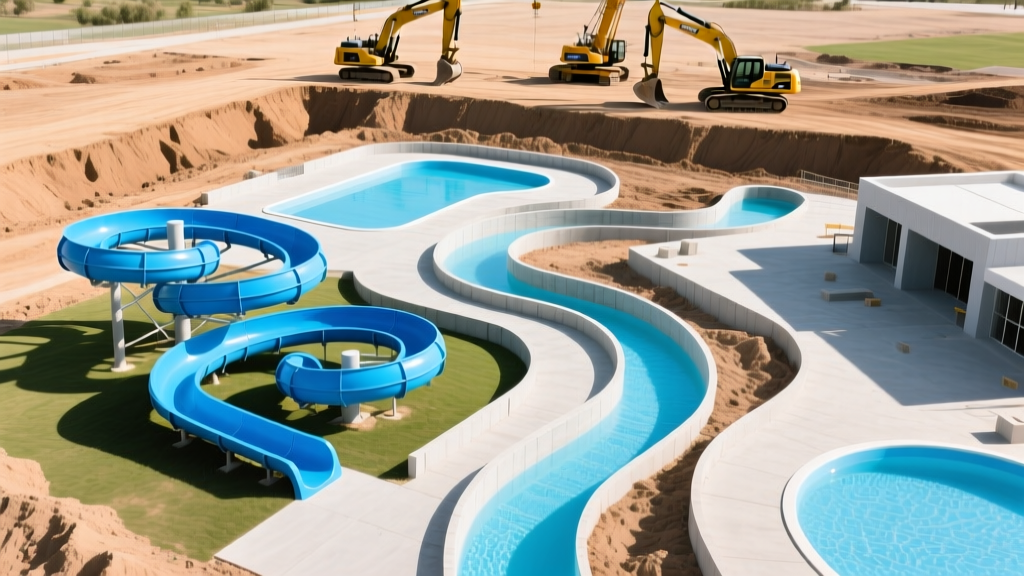
According to feasibility reports reviewed by the International Association of Amusement Parks and Attractions (IAAPA), the most common cause of budget overruns in aquatic construction isn't the attractions—it's the dirt and the pipes.
- High Water Table Dewatering: Excavating a 6-foot-deep wave pool basin in coastal or high-water-table areas requires continuous well-point dewatering systems. If your geotechnical report doesn't account for this, expect $150,000+ in change orders just to keep the hole dry enough to pour the gunite.
- Utility Main Upgrades: A regional water park can demand 2,000+ gallons per minute (GPM) during peak fill times and massive electrical loads. If the local municipal water main is only 8 inches in diameter, the municipality will force you to pay for a miles-long trenching project to upgrade it to a 16-inch main at your sole expense.
- Acoustic Mitigation: If your park borders residential zones, local zoning boards may mandate acoustic fencing or limit the decibel output of your mechanical rooms and slide splashdowns, requiring expensive sound-baffling architecture.
Sourcing and Vendor Negotiation Tactics
When procuring attractions and mechanical systems, leverage the competitive landscape of the amusement manufacturing industry. Request 'shell-only' bids for slide towers, allowing your local structural steel contractor to bid on the galvanized supports, which is often 20% cheaper than buying the steel directly from the slide manufacturer. Furthermore, schedule attraction deliveries for late autumn; manufacturers often discount floor models or offer favorable financing terms to clear warehouse space before the new fiscal year.
Written by
James ThorntonJames Thornton is a construction industry veteran with 25 years of hands-on experience in wood framing, lumber grading, and residential building codes. He started as a framing carpenter in rural Oregon, earned his ICC Residential Building Inspector certification, and eventually became a senior plan reviewer for the City of Portland Bureau of Development Services. James holds a B.S. in Wood Science & Technology from Oregon State University and is a certified lumber grader through the West Coast Lumber Inspection Bureau (WCLIB). He has inspected over 3,000 residential construction sites and authored the city's internal guide on advanced framing techniques (2x6 at 24" O.C.). James lives in Bend, OR, where he builds custom timber-frame cabins and competes in lumberjack sports.
More from James Thornton
View all
Insulation
Best Home Insulation Materials: Complete 2026 Guide
Compare top home insulation materials for 2026. Find R-values, installed costs per square foot, and best uses for fiberglass, spray foam, and mineral wool.
Aug 4, 2026

Sustainable Building
Certify Your Green Building Material for LEED and WELL
Step-by-step guide to certifying a green building material for LEED v5 and WELL v2. Master EPDs, HPDs, and VOC limits for 2026 project specifications.
Aug 4, 2026

Stone & Masonry
Veneer Stacked Stone Panels: Interior Design & Style Showcase
Discover how veneer stacked stone panels transform interiors. Explore modern design profiles, material pairings, and technical installation specs.
Aug 4, 2026