How Much Does It Cost to Build a Wedding Venue? 2026 Breakdown
Discover how much it costs to build a wedding venue in 2026. Detailed breakdown of structural, MEP, and finishing costs for a 5,000 sq ft facility.

The True Cost to Build a Wedding Venue: Beyond the Square Footage
When evaluating how much does it cost to build a wedding venue, developers must look far beyond standard commercial construction metrics. A wedding venue is a specialized assembly space requiring high-capacity infrastructure, luxury finishes, and strict adherence to noise and occupancy codes. In 2026, the national average to build a fully equipped, 5,000-square-foot wedding venue ranges from $1.75 million to $3.5 million, translating to $350 to $700 per square foot in hard construction costs. This excludes land acquisition, which varies wildly by region.
Unlike standard retail or office builds, venues demand specialized mechanical systems to handle sudden spikes in occupancy, commercial-grade culinary infrastructure, and acoustic isolation. Below is a comprehensive, phase-by-phase breakdown of where your capital will be deployed.
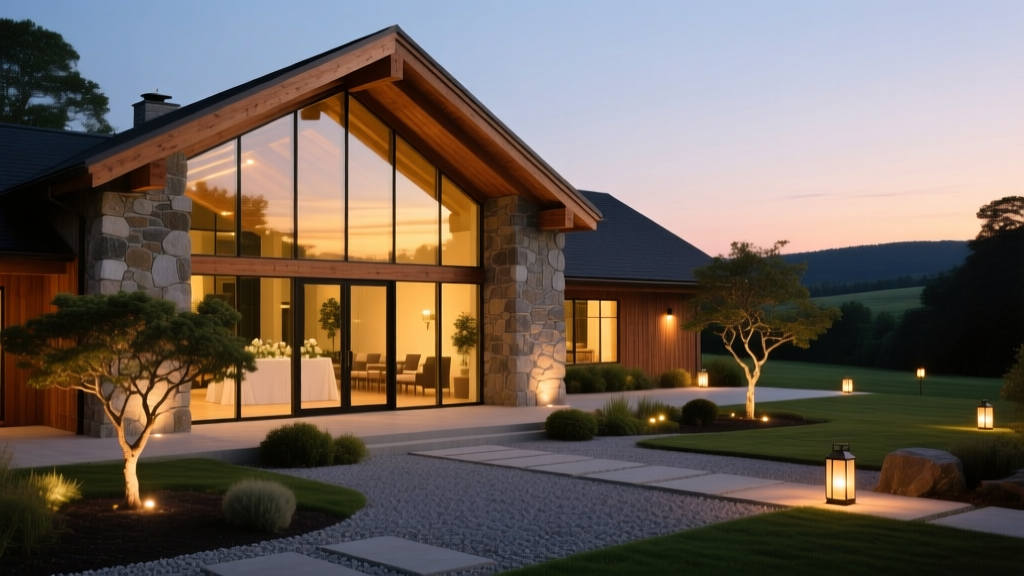
Phase 1: Zoning, Permitting, and Site Preparation
Before breaking ground, you must secure the right to operate. Wedding venues typically fall under Assembly Group A-3 occupancy in the International Building Code (IBC). Because venues generate high traffic and noise, they rarely qualify for by-right zoning in residential or standard commercial zones.
Most rural and semi-rural venues require a Conditional Use Permit. The CUP process involves environmental impact studies, traffic analyses, and public hearings. Budget $25,000 to $60,000 in soft costs for land-use attorneys and civil engineers to navigate this 6-to-12-month process. Consult the U.S. Small Business Administration for local permitting frameworks.
Site Work and Utilities
Rural venues often lack municipal water and sewer. Installing a commercial-grade septic system designed for 300+ peak users, alongside a high-yield well and 10,000-gallon water storage cistern, costs between $85,000 and $140,000. Furthermore, parking requirements dictate one space per 3 to 4 attendees. Paving and lighting a 75-space lot with permeable pavers and bioswales for stormwater management adds $110,000 to $180,000.
Phase 2: Structural Shell and Envelope
The architectural style dictates your shell costs. Clear-span interiors are non-negotiable for ballrooms to avoid obstructed sightlines. Here is how the three most popular venue structures compare in 2026:
| Structure Type | Cost per Sq. Ft. | Pros | Cons |
|---|---|---|---|
| Timber Frame / Post-and-Beam | $180 - $260 | High aesthetic value, exposed architecture reduces drywall costs | Requires specialized engineering, longer lead times for materials |
| Steel Clear-Span Rigid Frame | $120 - $170 | Fastest erection time, maximum unobstructed floor space | Industrial look requires heavy interior cladding to feel luxurious |
| Masonry / Insulated Concrete Form (ICF) | $200 - $300 | Superior acoustic isolation, high thermal mass, lower HVAC loads | Highest material and labor costs, difficult to modify post-build |
Phase 3: High-Capacity MEP Systems
Mechanical, Electrical, and Plumbing (MEP) systems represent the most complex variable in venue construction. A ballroom holding 250 dancing guests generates massive latent and sensible heat loads that standard rooftop units cannot handle efficiently.
HVAC: Dedicated Outdoor Air Systems (DOAS)
ASHRAE Standard 62.1 requires 15 to 20 CFM of outdoor air per person in assembly spaces. To prevent humidity spikes and odor buildup, modern venues utilize a Dedicated Outdoor Air System (DOAS) paired with Variable Refrigerant Flow (VRF) heat pumps. This decoupled approach conditions fresh air separately from the interior temperature, costing $22 to $35 per square foot but reducing long-term energy waste by up to 30%.
Plumbing and Luxury Restrooms
IBC Chapter 29 mandates strict fixture ratios for Assembly occupancies (typically 1 water closet per 40 females and 1 per 75 males). However, luxury venues overbuild these ratios to prevent lines, often aiming for 1 fixture per 25 guests. Outfitting restrooms with touchless commercial fixtures, stone countertops, and high-end ventilation aligns with EPA WaterSense commercial guidelines, balancing luxury with water conservation. Expect to spend $60,000 to $95,000 on premium restroom buildouts.
Phase 4: Commercial Kitchen and Catering Infrastructure
Even if you do not operate an in-house culinary team, a prep kitchen is mandatory for outside caterers. A 600-square-foot commercial prep kitchen requires:
- Type 1 Exhaust Hoods: With integrated fire suppression systems ($18,000 - $25,000).
- Make-Up Air (MUA) Units: To balance negative pressure when hoods are running ($8,000 - $12,000).
- Grease Interceptors: Exterior 1,000-gallon concrete traps to prevent municipal sewer fouling ($6,500 - $9,000).
- Heavy-Duty Flooring: Quarry tile with integral cove base and trench drains ($18 - $24 per sq. ft.).
Total kitchen buildout costs range from $130,000 to $220,000, depending on whether you include walk-in coolers and commercial dishwashers or leave it as a shell for caterers to bring mobile equipment.
Phase 5: Acoustic Treatments and Interior Finishes
Sound bleed is the number one cause of venue complaints and permit revocations. If your venue features a ceremony space adjacent to a reception hall, the dividing wall must achieve a minimum Sound Transmission Class (STC) of 55. This requires staggered-stud framing, dual layers of 5/8-inch Type X gypsum board, and acoustic sealant at all penetrations.
Standard insulation fails to block the low-frequency bass from a DJ's subwoofer. Install International Code Council compliant resilient channels and mass-loaded vinyl (MLV) in the ceiling plenums above the dance floor to prevent structure-borne noise from traveling to the bridal suites or outdoor patios.
Interior finishes for the main ballroom, including engineered hardwood dance floors, architectural lighting grids, and plaster or wood-slat wall treatments, typically cost $90 to $160 per square foot.
Comprehensive Cost Matrix: 5,000 Sq. Ft. Venue Breakdown
The following matrix models a mid-to-high-end 5,000 sq. ft. venue (3,500 sq. ft. ballroom, 600 sq. ft. kitchen, 500 sq. ft. restrooms/suites, 400 sq. ft. lobby) in a suburban-rural transition zone in 2026.
| Construction Phase | Low Estimate | High Estimate | Key Variables |
|---|---|---|---|
| Site Work & Utilities | $140,000 | $260,000 | Septic vs. municipal, grading, well depth |
| Foundation & Concrete | $85,000 | $130,000 | Soil bearing capacity, radiant heat tubing |
| Structural Shell & Roof | $450,000 | $850,000 | Timber frame vs. steel, standing seam metal roof |
| MEP Systems | $320,000 | $550,000 | DOAS HVAC, 3-phase electrical upgrades |
| Commercial Kitchen | $130,000 | $220,000 | Hood sizes, walk-in coolers, trench drains |
| Interior Finishes & Acoustics | $350,000 | $680,000 | STC ratings, flooring grade, lighting grids |
| Hardscaping & Parking | $110,000 | $210,000 | Permeable pavers, exterior uplighting, patio |
| Soft Costs & Permits | $165,000 | $300,000 | Architect fees, CUP legal fees, impact fees |
| Total Estimated Cost | $1,750,000 | $3,200,000 | Excludes land acquisition and FF&E |
Hidden Costs and Edge Cases
When underwriting your venue development, account for these frequently overlooked capital expenditures:
- Fire Apparatus Access Roads: Rural fire marshals often require 20-foot-wide paved access roads with a 50-foot turning radius for ladder trucks, even if the road is only used for emergencies. This can add $40,000+ to paving costs.
- Alcohol Licensing Architecture: Many state liquor control boards require specific physical separations (e.g., solid doors, distinct thresholds) between areas where minors are allowed and areas where liquor is stored or consumed. Designing flexible partition walls early saves costly retrofits.
- Generator Backup: A 150kW diesel or natural gas standby generator is critical to prevent food spoilage and evacuate guests safely during rural grid outages. Budget $35,000 to $55,000 for the unit, concrete pad, and automatic transfer switch (ATS).
- Bridal Suite HVAC Independence: Bridal suites require dedicated mini-split systems. If tied to the main ballroom DOAS, the bride and groom will freeze or sweat when the main hall's HVAC cycles down during off-hours.
Building a wedding venue is a high-barrier, high-reward commercial real estate play. By front-loading your budget into robust MEP systems, acoustic isolation, and flexible catering infrastructure, you create an asset that commands premium booking rates and minimizes day-of operational failures.
Written by
Priya KapoorPriya Kapoor is a real estate market analyst and construction economics researcher with expertise in housing affordability, development feasibility, and infrastructure investment. She holds a Master of Regional Planning from Cornell University and previously worked as a senior analyst at CBRE's Investment Properties group, where she modeled returns for $4B in mixed-use development pipelines. Priya now runs an independent research practice advising developers, municipalities, and REITs on construction cost forecasting and market timing. She publishes the quarterly "BuildMat Market Pulse" report tracking material price indices across 12 commodity categories. Based in Austin, TX, Priya serves on the board of Habitat for Humanity Austin and is a marathon runner.
More from Priya Kapoor
View all
Construction Cost
Cost to Build a 1600 Sq Ft Home in 2026: Full Breakdown
Accurate 2026 cost to build a 1600 sq ft home—material, labor, and regional pricing breakdowns included. Plan your budget with real-time estimates.
Aug 11, 2026

Wood & Lumber
Name the Types of Wood for Pressure Treatment and Preservation
Learn how to name the types of wood best suited for pressure treatment. Compare species treatability, chemical retention levels, and 2026 preservation costs.
Aug 4, 2026

Stone & Masonry
Stone Veneer Suppliers Lindenhurst: 2026 Cost Analysis
Analyze 2026 stone veneer costs in Lindenhurst, NY. Compare local supplier pricing, delivery fees, and Suffolk County installation labor rates.
Aug 4, 2026