PVC Decking Performance Ratings: Technical Specs & Load Limits
Analyze PVC decking performance ratings, including ASTM fire codes, thermal expansion rates, slip resistance, and structural load limits.
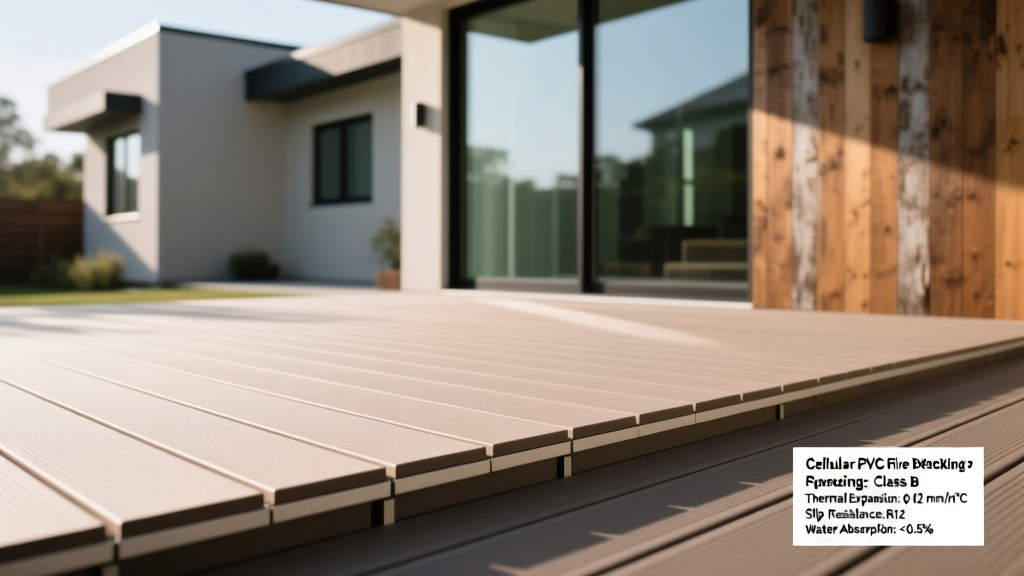
Understanding Cellular PVC Decking Composition
When evaluating PVC decking for high-performance outdoor applications, it is critical to distinguish between solid cellular PVC and capped polymer PVC. Solid cellular PVC is manufactured through an extrusion process that introduces a foaming agent, creating a uniform, closed-cell core with a density typically ranging from 35 to 45 lbs/ft³. This closed-cell structure prevents water absorption entirely, yielding a moisture absorption rate of less than 0.5% over 24 hours.
Capped polymer PVC, conversely, features a denser, harder outer shell (the cap) co-extruded over a lighter cellular or foamed core. The cap is heavily fortified with UV inhibitors, titanium dioxide (TiO2) pigments, and acrylic modifiers to resist micro-scratches and photodegradation. Understanding this material science baseline is mandatory before interpreting structural and environmental performance ratings.
Thermal Expansion and Contraction Metrics
The most significant engineering challenge with PVC decking is its high coefficient of linear thermal expansion (CLTE). Unlike natural hardwoods, which expand primarily in width and thickness, PVC expands significantly along its longitudinal axis. The CLTE for cellular PVC generally sits between 3.3 x 10^-5 and 4.5 x 10^-5 inches per inch per degree Fahrenheit.
To contextualize this specification: a 16-foot PVC deck board subjected to a 100°F temperature delta (e.g., a 20°F winter morning versus a 120°F surface temperature on a summer afternoon) will expand and contract by approximately 0.63 to 0.86 inches. This dictates strict gapping and fastening protocols.
| Material Type | CLTE (in/in/°F) | 16-Ft Board Movement (100°F Delta) | Primary Expansion Axis |
|---|---|---|---|
| Cellular PVC | ~3.8 x 10^-5 | 0.72 inches | Longitudinal |
| Capped Composite | ~2.2 x 10^-5 | 0.42 inches | Longitudinal / Lateral |
| Tropical Hardwood (Ipe) | ~0.3 x 10^-5 | 0.05 inches | Lateral (Width) |
| Pressure-Treated Pine | ~0.2 x 10^-5 | 0.03 inches | Lateral (Width) |
Because of the longitudinal movement, face-screwing PVC decking requires oversized, slotted screw holes to allow the board to glide over the fastener shaft. Failure to route elongated slots will result in the board buckling or the fastener heads shearing off under thermal stress.
Fire Resistance: ASTM E84 and WUI Compliance
PVC decking inherently excels in fire performance due to the chlorine content in the polyvinyl chloride resin, which acts as a natural flame retardant. High-quality PVC decking consistently achieves a Class A fire rating under the ASTM E84 Standard Test Method for Surface Burning Characteristics of Building Materials.
To secure a Class A rating, the material must demonstrate a Flame Spread Index (FSI) of 25 or less and a Smoke Developed Index (SDI) of 450 or less. Most premium PVC decking products test with an FSI between 15 and 20, and an SDI between 100 and 250, well below the maximum thresholds.
For structures located in high-risk wildfire zones, compliance with the FEMA Wildland-Urban Interface (WUI) guidelines and local adaptations of the International Wildland-Urban Interface Code (IWUIC) is mandatory. PVC decking's lack of combustible wood fibers and its self-extinguishing properties make it one of the few synthetic materials that reliably passes the rigorous WUI ember-ignition tests without requiring specialized fire-retardant chemical treatments.
Slip Resistance and Coefficient of Friction (COF)
Because PVC lacks the natural porous grain structure of wood, untextured PVC can become highly slippery when wet. Manufacturers counteract this through deep micro-embossing and wire-brushing techniques during the extrusion process. When evaluating slip resistance, look for testing data based on ASTM D2394 or the European DIN 51130 standard.
- Dry COF: Typically ranges from 0.65 to 0.80, providing excellent barefoot traction.
- Wet COF: Premium embossed PVC maintains a wet COF of 0.50 to 0.60. Anything below 0.50 is considered a slip hazard for commercial or poolside applications.
- DIN 51130 Rating: Look for an R10 or R11 classification, which indicates the board can maintain traction on an incline of 10 to 19 degrees when coated with a standardized oil/slip agent.
Structural Load Limits and Joist Spacing
The Modulus of Elasticity (MOE) and Modulus of Rupture (MOR) for cellular PVC are lower than those of dense structural lumber or composite materials reinforced with wood flour. Consequently, PVC decking requires stricter substructure support to prevent deflection under live loads.
According to standard ICC-ES evaluation reports and National Fire Protection Association (NFPA) codes adapted for residential structures, the deflection limit for deck boards is L/360 under a 300-pound concentrated point load. To meet this specification, framing must adhere to the following parameters:
Required Joist Spacing
- Perpendicular Installation (90°): Maximum 16 inches on-center (OC) for standard 5/4-inch (1-inch actual) thick boards.
- Diagonal Installation (45°): Maximum 12 inches on-center (OC) to prevent mid-span sagging.
- Commercial/High-Traffic: Maximum 12 inches on-center regardless of board orientation to accommodate higher uniform live loads (typically 100 PSF vs. 40 PSF residential).
2026 Market Leaders: Specification Comparison Matrix
When specifying PVC decking for architectural or high-end residential projects, comparing the exact technical data sheets of market leaders reveals distinct performance trade-offs. Below is a specification matrix of top-tier PVC lines currently dominating the market.
| Brand & Line | Core Technology | Nominal Thickness | Max Joist Span (90°) | WUI Compliant | Warranty (Fade/Stain) |
|---|---|---|---|---|---|
| TimberTech AZEK Landmark | Capped Polymer (Multi-layer) | 5/4 in (1.0 in actual) | 16 in OC | Yes (Select Colors) | 50-Year |
| Wolf Decking Serenity | Solid Cellular PVC | 1 in (0.94 in actual) | 16 in OC | Yes | 25-Year |
| Fiberon Promenade | Capped Cellular PVC | 5/4 in (1.0 in actual) | 16 in OC | Yes | 50-Year |
| Kleer PVC Decking | Solid Cellular PVC | 5/4 in (1.0 in actual) | 16 in OC | Yes | Lifetime (Transferable) |
Fastening System Compatibility and Edge Clearances
The fastening methodology for PVC decking must accommodate both structural uplift resistance and thermal movement. Hidden clip systems are the industry standard for PVC, but they require precise installation tolerances.
Hidden Clip Systems
Stainless steel or glass-filled polymer hidden clips grip the grooved edges of the PVC board. When installing these clips, the fastener must be driven into the joist at a strict 90-degree angle. The clip must be seated firmly against the board groove, but a 1/16-inch gap must be maintained between adjacent clips to allow for lateral board movement. For 16-inch OC framing, this requires exactly one clip per joist intersection.
Face Fastening Constraints
If face fastening is required (such as on stair treads or perimeter picture-frame borders), you must use specialized PVC-compatible screws with reverse-thread heads designed to pull the material flush without creating a 'mushroom' effect. The minimum edge clearance for any face screw in PVC decking is 1.5 inches from the board edge and 1.0 inch from the board end to prevent the cellular core from splitting or blowing out under the screw head's torque.