Most Durable Pool Deck Material: Lifespan & Heat Guide
Compare the most durable pool deck material options. Analyze lifespan, heat retention, SRI values, and chlorine resistance for porcelain, travertine, and concrete.

The Hostile Microclimate of Poolside Environments
Selecting the right pool deck material is an exercise in material science, not just aesthetics. Poolside environments subject hardscapes to a brutal combination of chemical exposure, thermal shock, and constant moisture. Chlorinated or saltwater splashing introduces aggressive salts that attack porous substrates. Direct UV exposure bakes the surface, degrading topical sealers, while freeze-thaw cycles in northern climates exploit microscopic fissures to cause spalling and delamination.
To achieve a 30- to 50-year lifespan, the chosen pool deck material must possess low water absorption, high thermal emittance, and structural resistance to chemical erosion. Below, we break down the technical specifications, failure modes, and lifecycle costs of the top three most durable materials used in modern outdoor construction.
The Pool Deck Durability & Performance Matrix
Before examining specific installations, it is critical to understand how the leading materials perform against standardized metrics. The following matrix compares expected lifespans, water absorption rates (per ASTM C373), and Solar Reflectance Index (SRI) values, which dictate how hot the surface gets under direct sunlight.
| Material Profile | Expected Lifespan | Water Absorption | Typical SRI Value | Slip Resistance (DCOF) |
|---|---|---|---|---|
| 20mm Porcelain Pavers | 50+ Years | < 0.5% | 30 - 45 (Color dependent) | > 0.42 (Wet) |
| Natural Travertine (Tumbled) | 30 - 50 Years | 3.0% - 5.0% | 40 - 55 | > 0.45 (Wet) |
| Exposed Aggregate Concrete | 25 - 40 Years | 4.0% - 7.0% | 20 - 35 | > 0.50 (Wet) |
| Poured Standard Concrete | 20 - 30 Years | 5.0% - 8.0% | 15 - 25 | 0.30 - 0.40 (Hazardous) |
Deep Dive: Top 3 Most Durable Pool Deck Materials
1. 20mm Porcelain Pavers: The Modern Heavyweight
For maximum structural durability and near-zero maintenance, 20mm (3/4-inch) thick porcelain pavers represent the pinnacle of modern hardscape engineering. Manufactured by pressing refined clays at over 4,000 PSI and firing them at 2,200°F, these pavers achieve a vitrified state with a water absorption rate of less than 0.5%. According to guidelines published by the Tile Council of North America (TCNA), this extreme density renders the material virtually impervious to freeze-thaw damage and completely immune to chlorine or saltwater degradation.
For pool decks, avoid mortaring porcelain directly to a concrete slab. Water that bypasses the grout joints will become trapped, leading to efflorescence and tile pop-off. Instead, utilize a pedestal system (e.g., Bison or Jouplast) over a sloped concrete substrate, or a compacted open-graded aggregate base for sand-set installations. This allows immediate subsurface drainage, keeping the deck surface dry and slip-resistant.
2. Natural Travertine: The Heat-Deflecting Classic
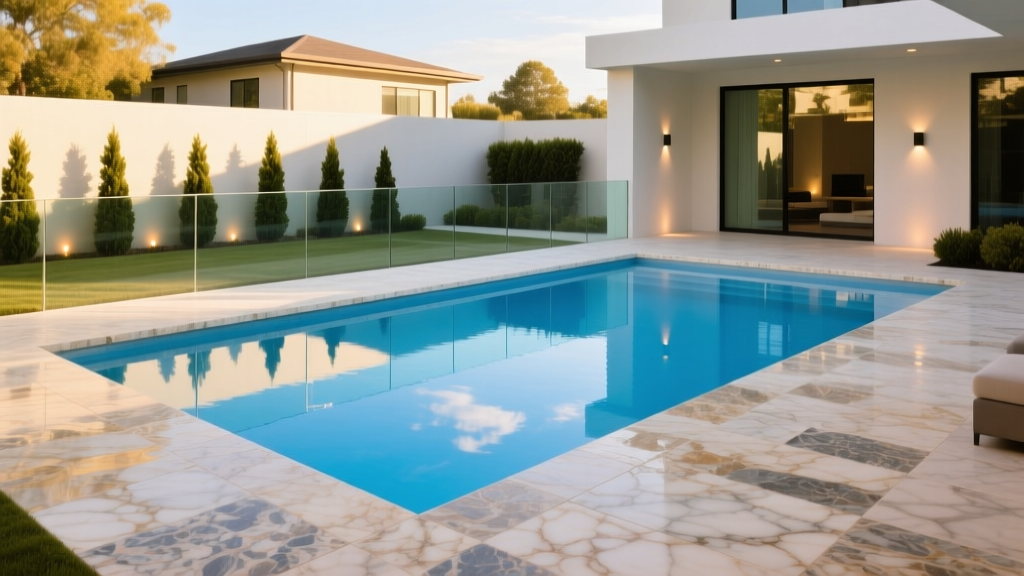
Travertine remains a premier pool deck material primarily due to its thermal properties. Unlike dense concrete or dark composite materials that absorb and radiate solar energy, travertine's naturally porous geological structure and high calcium carbonate content give it a high Solar Reflectance Index (SRI). On a 95°F day, a light-colored tumbled travertine deck can remain 20°F to 30°F cooler to the touch than standard brushed concrete.
However, durability in natural stone requires strict adherence to finishing and sealing protocols. The Natural Stone Institute mandates that exterior travertine in wet environments be "tumbled" or "chiseled" rather than polished, ensuring a Dynamic Coefficient of Friction (DCOF) above 0.42 to prevent slip hazards. Furthermore, the stone must be sealed with a penetrating silane/siloxane sealer. Never use a topical acrylic sealer on travertine pool decks; topical sealers trap subsurface moisture, create a severe slip hazard when wet, and will peel under UV exposure within 18 months.
3. Exposed Aggregate Concrete: The Budget Workhorse
When budget constraints preclude natural stone or porcelain, exposed aggregate concrete offers a highly durable alternative to standard broom-finished concrete. The durability of this pool deck material relies entirely on the mix design and the wash-out process. For climates experiencing freezing temperatures, the concrete mix must be air-entrained (containing 4% to 6% microscopic air bubbles) to provide expansion chambers for freezing water, as recommended by the American Concrete Institute (ACI).
The exposed aggregate surface provides excellent inherent slip resistance. To maximize lifespan, the surface must be sealed with a non-yellowing, aliphatic acrylic urethane sealer mixed with a polymer anti-skid grit. This specific sealer chemistry resists UV degradation far better than standard aromatic acrylics, extending the resealing cycle from 12 months to 36 months.
Critical Failure Modes: Why Pool Decks Degrade Prematurely
Even the most expensive pool deck material will fail if the detailing at the transitions is flawed. The majority of premature pool deck failures occur not in the field of the deck, but at the coping joints and drainage planes.
Coping Joint Delamination
The coping is the capstone that bridges the pool's structural bond beam and the deck surface. Because the pool structure and the deck foundation settle and expand at different rates, the joint between the coping and the deck field is a high-stress zone. Grouting this joint with rigid cementitious grout guarantees cracking. Instead, this joint must be routed out and filled with a high-movement, UV-stable polyurethane sealant, such as Sikaflex-1a or MasterSeal NP 1, which can accommodate up to 35% joint movement without tearing.
Subgrade Erosion and Settling
Water splashing off the deck edge or escaping through unsealed joints will wash away poorly compacted subgrades. If a sand-set travertine or porcelain deck is installed over native clay without a proper geotextile fabric and a 4-inch base of crushed angular gravel (ASTM #57), hydrostatic pressure and soil liquefaction will cause the pavers to sink and pool water against the home's foundation.
Never install a pool deck material with a flat grade. The industry standard mandates a minimum slope of 1/4 inch per foot (2% grade) away from the pool edge and the home's foundation. Failure to maintain this slope will result in standing water, accelerating chemical erosion and promoting algae growth in the substrate.
Lifecycle Maintenance Framework for Maximum Lifespan
Durability is a combination of material selection and scheduled maintenance. Follow this timeline to ensure your pool deck material reaches its maximum engineered lifespan.
- Year 1 (Initial Cure & Seal): For concrete and natural stone, allow a minimum 28-day cure time before applying any penetrating sealers. Test the sealer's water-beading properties in high-splash zones.
- Year 2 (Joint Inspection): Inspect all polyurethane coping joints and control joints. Look for adhesion loss or tearing. Clean out compromised joints with a wire brush and re-prime before injecting new sealant.
- Year 3 (Deep Clean & Reseal): Power wash the deck using a maximum of 1,500 PSI with a 25-degree fan tip to avoid etching the surface. For exposed aggregate, apply a fresh coat of aliphatic acrylic urethane. For travertine, reapply silane/siloxane penetrating sealer.
- Year 5 (Substrate & Grade Audit): Check the perimeter of the deck for soil erosion. Ensure that splash-back has not created negative grading that directs water back toward the pool bond beam or the house foundation.
Expert Verdict: Choosing Your Material
If your primary objective is absolute structural longevity with zero sealing requirements, 20mm porcelain pavers installed on a pedestal system are the undisputed winner, offering a 50-year lifespan with impervious water resistance. If barefoot comfort and heat reduction in a southern climate are paramount, tumbled travertine provides unmatched thermal emittance, provided you commit to a three-year penetrating sealer cycle. For large-scale commercial or budget-conscious residential projects, air-entrained exposed aggregate concrete delivers the best balance of slip resistance, durability, and cost per square foot.
Written by
Priya KapoorPriya Kapoor is a real estate market analyst and construction economics researcher with expertise in housing affordability, development feasibility, and infrastructure investment. She holds a Master of Regional Planning from Cornell University and previously worked as a senior analyst at CBRE's Investment Properties group, where she modeled returns for $4B in mixed-use development pipelines. Priya now runs an independent research practice advising developers, municipalities, and REITs on construction cost forecasting and market timing. She publishes the quarterly "BuildMat Market Pulse" report tracking material price indices across 12 commodity categories. Based in Austin, TX, Priya serves on the board of Habitat for Humanity Austin and is a marathon runner.
More from Priya Kapoor
View all
Construction Cost
Cost to Build a 1600 Sq Ft Home in 2026: Full Breakdown
Accurate 2026 cost to build a 1600 sq ft home—material, labor, and regional pricing breakdowns included. Plan your budget with real-time estimates.
Aug 11, 2026

Wood & Lumber
Name the Types of Wood for Pressure Treatment and Preservation
Learn how to name the types of wood best suited for pressure treatment. Compare species treatability, chemical retention levels, and 2026 preservation costs.
Aug 4, 2026

Stone & Masonry
Stone Veneer Suppliers Lindenhurst: 2026 Cost Analysis
Analyze 2026 stone veneer costs in Lindenhurst, NY. Compare local supplier pricing, delivery fees, and Suffolk County installation labor rates.
Aug 4, 2026