Cost to Build a Composite Deck: 2026 Material Comparison
Analyze the 2026 cost to build a composite deck. Compare Trex, TimberTech, and PVC pricing, hidden framing costs, and long-term ROI against wood.

The True Cost to Build a Composite Deck in 2026
• Pressure-Treated Wood: $18 – $28 per sq. ft.
• Mid-Tier Composite: $32 – $45 per sq. ft.
• Premium Composite: $48 – $68 per sq. ft.
• Advanced PVC: $60 – $85 per sq. ft.
Based on a standard 320 sq. ft. (16x20) rectangular deck with standard stair access and no complex multi-level framing.
Calculating the exact cost to build a composite deck requires moving beyond the per-board retail price. In 2026, material costs for capped composite decking range from $7.50 to $14.00 per linear foot, but the installed price is heavily dictated by substructure requirements, hidden fastening systems, and regional labor rates. For a standard 320-square-foot deck, homeowners should budget between $10,240 and $21,760 for a fully installed composite system, compared to $5,760 to $8,960 for pressure-treated southern yellow pine.
The price premium of composite materials is primarily driven by the polymer cap thickness, the core composition (wood-flour vs. mineral-based), and proprietary heat-mitigating technologies. Understanding these variables is critical for accurately forecasting your project budget and selecting a product that aligns with your local climate.
Material Matrix: Composite vs. Pressure-Treated Wood vs. PVC
Before locking in a specific brand, it is necessary to evaluate the broader material categories. The following matrix contrasts the physical properties and financial commitments of the three dominant decking materials available on the market.
| Feature | Pressure-Treated Wood | Capped Composite | Advanced PVC |
|---|---|---|---|
| Material Cost (per sq. ft.) | $4.00 – $7.00 | $8.50 – $14.50 | $12.00 – $18.00 |
| Installed Cost (per sq. ft.) | $18 – $28 | $32 – $68 | $60 – $85 |
| Expected Lifespan | 10 – 15 years | 25 – 30 years | 30 – 50+ years |
| Moisture Resistance | Low (Prone to rot/warping) | High (If fully capped) | Absolute (Zero wood fiber) |
| Heat Retention | Moderate | High (Unless cool-touch tech) | Moderate to High |
| Maintenance | Annual sealing/staining | Soap and water wash | Soap and water wash |
Brand-by-Brand Composite Pricing Breakdown
Trex: From Enhance to Transcend Lineage
Trex dominates the market share, and their pricing tiers reflect distinct performance jumps. The entry-level Trex Enhance line features a scalloped bottom profile, which reduces weight and material cost, bringing installed prices to the $32–$42 per square foot range. However, the scalloped design limits span capabilities and requires tighter joist spacing (12 inches on-center for diagonal installs).
For premium applications, the Trex Transcend Lineage series represents the top tier. Priced at $55–$68 per square foot installed, Lineage utilizes proprietary heat-mitigating technology that reflects solar radiation, keeping boards up to 40% cooler than traditional dark composites. This is a critical investment for south-facing decks or installations in high-UV climates where barefoot comfort is a priority.
TimberTech: Advanced PVC vs. Capped Composite
TimberTech segments its offerings strictly between composite and PVC. The TimberTech Landmark composite line offers a thick, cathedral-grain polymer cap over a wood-composite core, landing in the $48–$60 installed range. It excels in impact resistance and color depth.
Conversely, TimberTech Advanced PVC (such as the Landmark or Vintage collections) eliminates wood flour entirely. According to data from the USDA Forest Products Laboratory, eliminating organic material from the deck board completely halts the biological decay cycle caused by fungi and moisture ingress. Advanced PVC costs 20% to 30% more than premium composite but is mandatory for ground-level decks, docks, or areas with constant moisture exposure where composite cores might eventually wick water if the cap is scratched.
Fiberon: Mineral-Based and PVC Innovations
Fiberon’s Paramount PVC line is highly regarded for its micro-dome tread pattern, offering superior slip resistance (coefficient of friction > 0.5) compared to traditional wood-grain embossing. Installed costs hover around $62–$78 per square foot. For composite, the Fiberon Concordia line utilizes a four-sided cap and a dense core, providing excellent stiffness that allows for 16-inch on-center joist spacing even in diagonal layouts, saving money on substructure framing.
Hidden Cost Drivers That Inflate Your Budget
Contractor quotes often focus on the surface boards, leaving homeowners blindsided by necessary substructure and accessory costs. When calculating the total cost to build a composite deck, factor in these frequently overlooked line items:
- Joist Tape (Mandatory for Longevity): Composite boards will easily last 30 years, but standard pressure-treated joists will rot in 15. Applying butyl joist tape (like Trex Protect or G-Tape) costs $0.50 to $0.85 per linear foot. For a 320 sq. ft. deck, add $400–$600 to protect the framing from moisture trapping.
- Hidden Fastening Systems: Driving standard screws through the face of a composite board voids most manufacturer warranties and ruins the aesthetic. Universal hidden fastener clips (e.g., Simpson Strong-Tie or Trex Hideaway) cost $1.10 to $1.50 per square foot. Starter clips and breaker board clips add an additional $150–$250 to the hardware budget.
- Picture Framing and Fascia: Composite boards have a visible core on the cut ends. Hiding these ends requires miter-cut picture framing or installing solid composite fascia boards. This requires specialized cutting blades, extra blocking, and increases labor time by 15% to 20%.
- Helical Piles vs. Concrete Footings: Traditional poured concrete sonotubes cost $80–$120 per pier. Helical steel piles, which are increasingly preferred for composite decks to prevent frost heave and minimize site disruption, cost $180–$250 per pier. A 12-pier deck will see a $1,200+ increase in foundation costs.
Long-Term ROI: When Does Composite Pay for Itself?
To justify the initial premium, evaluate the 10-year cost of ownership. Pressure-treated wood requires professional cleaning, sanding, and staining every two to three years. At an average cost of $800 per maintenance cycle, a 10-year wood maintenance budget equals $3,200 to $4,000. Furthermore, the Trex Cost Estimator and various remodeling industry reports consistently highlight that composite decking retains higher residual home value due to its transferable warranties and zero-maintenance appeal.
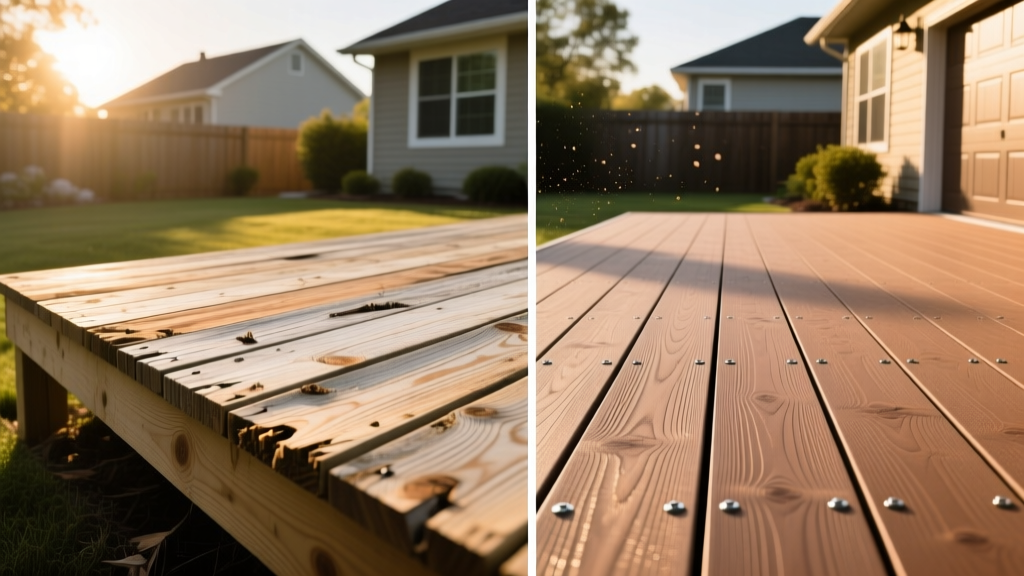
Unlike wood, composite and PVC boards expand and contract significantly along their length with temperature fluctuations. If your contractor does not leave the manufacturer-specified 3/16-inch gap at board ends and uses rigid fasteners instead of slotted hidden clips, the boards will buckle and warp within the first summer. Always verify your installer's familiarity with composite-specific gapping matrices.
Decision Framework: Which Material Should You Choose?
Select your material based on your specific environmental constraints and budget tolerance:
- Choose Mid-Tier Composite (Trex Enhance / Fiberon Good Life) if: You are upgrading a standard backyard deck on a moderate budget, the deck is elevated with good airflow underneath, and you want to eliminate annual staining.
- Choose Premium Composite (Trex Transcend Lineage / TimberTech Landmark) if: You are building in a high-UV environment, require deep, realistic wood-grain aesthetics, and plan to use the deck barefoot frequently.
- Choose Advanced PVC (TimberTech Advanced PVC / Fiberon Paramount) if: You are building a ground-level deck (less than 12 inches of clearance), a dock, or a pool surround where standing water, chlorine, and organic debris will constantly assault the board surface.
Frequently Asked Questions
Can I install composite decking over my existing wood joists?
Yes, provided the joists are structurally sound, free of rot, and properly spaced (usually 16 inches on-center). However, you must inspect the joists, replace any compromised sections, and apply butyl flashing tape over the top of every joist before laying the new composite boards to prevent trapped moisture from destroying the old framing.
Does composite decking increase property value?
Composite decks generally yield a higher return on investment at resale compared to wood decks. Buyers are increasingly willing to pay a premium for outdoor living spaces that do not require immediate maintenance or future replacement costs.
Written by
James ThorntonJames Thornton is a construction industry veteran with 25 years of hands-on experience in wood framing, lumber grading, and residential building codes. He started as a framing carpenter in rural Oregon, earned his ICC Residential Building Inspector certification, and eventually became a senior plan reviewer for the City of Portland Bureau of Development Services. James holds a B.S. in Wood Science & Technology from Oregon State University and is a certified lumber grader through the West Coast Lumber Inspection Bureau (WCLIB). He has inspected over 3,000 residential construction sites and authored the city's internal guide on advanced framing techniques (2x6 at 24" O.C.). James lives in Bend, OR, where he builds custom timber-frame cabins and competes in lumberjack sports.
More from James Thornton
View all
Insulation
Best Home Insulation Materials: Complete 2026 Guide
Compare top home insulation materials for 2026. Find R-values, installed costs per square foot, and best uses for fiberglass, spray foam, and mineral wool.
Aug 4, 2026

Sustainable Building
Certify Your Green Building Material for LEED and WELL
Step-by-step guide to certifying a green building material for LEED v5 and WELL v2. Master EPDs, HPDs, and VOC limits for 2026 project specifications.
Aug 4, 2026

Stone & Masonry
Veneer Stacked Stone Panels: Interior Design & Style Showcase
Discover how veneer stacked stone panels transform interiors. Explore modern design profiles, material pairings, and technical installation specs.
Aug 4, 2026