Trailer Decking Material Selection Framework: Wood vs Metal
Choose the best trailer decking material with our expert framework. Compare Apitong, oak, pine, aluminum, and steel for payload, cost, and lifespan.

The Core Variables in Trailer Deck Selection
Selecting the correct trailer decking material requires balancing static weight, dynamic point loads, environmental exposure, and total cost of ownership. A deck that fails prematurely usually does so not because the wood or metal was inherently weak, but because the material was mismatched to the trailer's specific operational profile. Skid steers exert massive point loads on a small footprint, while lumber distributes weight evenly across the crossmembers. Furthermore, the decking itself contributes to the gross vehicle weight (GVW); every pound saved on the deck is a pound added to your legal payload capacity.
Steel diamond plate offers immense compressive strength but weighs approximately 10.2 lbs per square foot (at 1/4-inch thickness). Extruded aluminum planks weigh roughly 3.5 lbs per square foot. On a 48-foot flatbed, switching from steel to aluminum saves nearly 3,200 lbs of deck weight, directly translating to 3,200 lbs of additional revenue-generating payload.
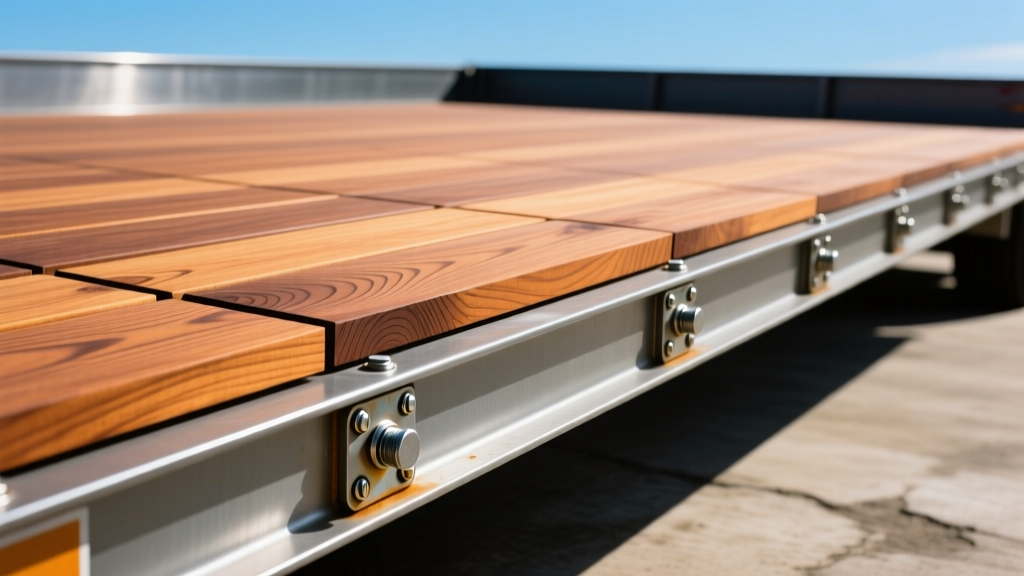
Hardwood vs. Softwood vs. Metal: The Material Matrix
The following matrix provides a baseline comparison of the most common trailer decking materials used in commercial and heavy-duty utility applications. Pricing reflects early 2026 market averages for standard 2x8 nominal dimensions or equivalent structural plank profiles.
| Material | Density (lbs/ft³) | Janka Hardness | Est. Cost (2x8 / LF) | Expected Lifespan |
|---|---|---|---|---|
| Apitong (Keruing) | 55 | 1,300 lbf | $5.50 - $7.00 | 10 - 15 Years |
| White Oak | 47 | 1,360 lbf | $4.80 - $6.20 | 7 - 12 Years |
| SYP (Treated UC4B) | 35 | 870 lbf | $2.15 - $2.80 | 5 - 8 Years |
| Aluminum 6061-T6 | 169 (alloy) | N/A (Yield 40ksi) | $14.00 / Sq Ft | 20+ Years |
Deep Dive: Wood Species Breakdown
Apitong (Keruing) Hardwood
Apitong is the undisputed industry standard for commercial flatbed and step-deck trailers. Sourced from Southeast Asia, this dense hardwood features a Janka hardness rating of 1,300 lbf and a natural interlocking grain that resists splintering and tear-out under heavy steel tracks. According to The Wood Database, Apitong's high density and natural resin content make it highly resistant to decay and insect attack without requiring chemical pressure treatment.
Application Note: Apitong contains high levels of natural silica. Fabricators must use carbide-tipped saw blades and pre-drill all fastener holes to prevent bit breakage and ensure flush seating of carriage bolts.
Southern Yellow Pine (SYP) Pressure-Treated
For utility trailers, equipment haulers, and budget-conscious fleet replacements, SYP is the default choice. However, not all treated pine is equal. You must specify lumber treated to American Wood Protection Association (AWPA) Use Category UC4B (Ground Contact) or UC4C (Heavy Duty). UC4B requires a preservative retention level of 0.60 pcf (pounds per cubic foot) of Alkaline Copper Quaternary (ACQ) or Copper Azole. Standard above-ground treated lumber (UC3B at 0.25 pcf) will rot within three years when subjected to road spray, trapped moisture, and constant ground-level humidity.
White Oak
White oak is heavily favored in the logging and heavy equipment sectors. Unlike red oak, which has open capillaries that wick moisture, white oak features a closed cellular structure (tyloses) that makes it virtually impermeable to water. This natural rot resistance allows it to perform exceptionally well in wet, muddy environments where chemical treatments might leach out over time.
Metal and Alternative Decking Options
Aluminum Extruded Planks
Aluminum decking utilizes 6061-T6 alloy extrusions, offering a yield strength of 40,000 psi. As noted by The Aluminum Association, this specific alloy provides an optimal strength-to-weight ratio and excellent corrosion resistance. Aluminum planks are typically manufactured with integrated interlocking edges and hidden fastener channels, creating a seamless, rattle-free deck. While the upfront material cost is 4x to 6x higher than Apitong, the elimination of rot, the 20-year lifespan, and the massive payload weight savings yield a lower total cost of ownership for high-mileage commercial fleets.
Steel Tread Plate (Diamond Plate)
Steel is reserved for specialized applications: lowboy trailers, heavy machinery haulers, and scrap metal containment. A 1/4-inch steel tread plate can withstand extreme point loads from excavator buckets and steel-tracked pavers that would crush wood fibers. However, steel requires rigorous maintenance, including regular priming and painting with zinc-rich epoxies to prevent oxidation from road salts.
Never use standard steel fasteners with pressure-treated SYP or aluminum decking. The copper in modern ACQ and CA-C wood preservatives is highly corrosive to standard steel and will cause rapid galvanic corrosion when in contact with aluminum. You must use 304 or 316 stainless steel fasteners, or hot-dipped galvanized (HDG) hardware meeting ASTM A153 standards. Electroplated zinc hardware will fail within 18 months.
The 4-Step Selection Decision Tree
Use this framework to finalize your material specification based on operational parameters:
- Define the Primary Load Type: If the trailer primarily carries concentrated point loads (skid steers, steel tracks, excavators), select White Oak, Apitong, or 1/4-inch Steel Tread Plate. If carrying distributed loads (lumber, palletized goods, vehicles), SYP or Aluminum is sufficient.
- Calculate Payload Sensitivity: If the trailer operates at maximum GVW limits and every pound of payload translates to direct revenue (e.g., long-haul commercial flatbeds), the premium for Aluminum 6061-T6 extrusions is mathematically justified by the 3,000+ lbs of weight savings.
- Assess Environmental Exposure: For trailers stored outdoors in coastal or high-humidity regions, avoid standard SYP. The constant moisture will accelerate fastener corrosion and wood decay. Opt for Apitong or Aluminum.
- Determine Maintenance Tolerance: If the fleet lacks a dedicated maintenance bay for annual wood sealing or steel repainting, specify rough-sawn Apitong (which requires zero sealing) or interlocking Aluminum planks.
Installation Best Practices for Maximum Lifespan
Even the most expensive Apitong or Aluminum deck will fail prematurely if installed incorrectly. Follow these structural mandates:
- Crossmember Spacing: For wood decking, crossmembers must be spaced no more than 12 inches on center (OC) to prevent deflection under dynamic loads. For aluminum extruded planks, follow the manufacturer's specific span tables, typically allowing 16 to 18 inches OC due to the integrated structural ribs.
- Fastener Pattern: Use a minimum of two fasteners per board, per crossmember. For 2x8 wood planks, use 3/8-inch diameter carriage bolts or structural lag screws (like FastenMaster ThruLok) rather than standard nails, which will back out under the vibrational stress of highway transit.
- Board Spacing: When installing wood decking, leave a strict 1/8-inch to 3/16-inch gap between boards. This allows for seasonal expansion and prevents water pooling, which is the primary catalyst for fungal decay in SYP.
By aligning your trailer decking material with the specific mechanical and environmental demands of your operation, you eliminate premature structural failures, reduce long-term maintenance costs, and maximize legal payload efficiency.
Written by
Sarah WhitfieldSarah Whitfield is a chartered quantity surveyor (MRICS) and construction cost analyst with 15 years of experience in material pricing, procurement strategy, and project budgeting. She earned her degree in Construction Management from the University of Reading (UK) and has worked on projects ranging from $2M custom homes to $180M mixed-use developments across North America and Europe. Sarah currently leads cost estimating for BuildMat Insight, maintaining a proprietary database of 4,000+ material price points updated quarterly. She is a frequent contributor to RSMeans cost data panels and has presented at the International Cost Engineering Council (ICEC) congress. Based in Denver, CO, Sarah is an avid trail runner and volunteer mentor for Women in Construction.
More from Sarah Whitfield
View all
Wood & Lumber
What Are the Different Types of Wood? A Builder's Guide
Compare structural softwoods, finish hardwoods, and engineered lumber. Analyze Janka ratings, MOE values, and 2026 pricing for construction.
Aug 4, 2026

Walls & Panels
Steel Framing vs Wood Framing: Corrosion and Moisture Defense
Compare steel framing vs wood framing for moisture resistance. Learn about galvanized coatings, condensation risks, and corrosion protection strategies.
Jul 21, 2026

Stone & Masonry
How to Cut Stone Veneer: Wet Saw vs Grinder Comparison
Compare the best tools for cutting stone veneer. We review wet saws, angle grinders, and chop saws to help you achieve clean, chip-free cuts.
Jul 21, 2026