How to Use a Deck Material List Calculator for Flawless Planning
Learn how to use a deck material list calculator to generate an accurate Bill of Materials, avoid waste, and prevent costly construction delays.

The Core Inputs: Feeding the Deck Material List Calculator
Relying solely on total square footage when using a deck material list calculator guarantees a flawed takeoff. A precise Bill of Materials (BOM) requires granular inputs that account for structural geometry, material constraints, and local building codes. Before opening your calculator, finalize the following design parameters to ensure your output reflects reality.
Joist Spacing and Decking Orientation
Composite and PVC decking manufacturers dictate strict joist spacing requirements based on board orientation. A standard 16-inch on-center (OC) layout is acceptable for perpendicular (90-degree) board placement. However, if your design features a 45-degree diagonal pattern, the Trex Installation Guide and similar manufacturer specs mandate a 12-inch OC framing layout. This single design choice increases your joist lumber requirements by 33%. Input the correct OC spacing into your calculator, not just the overall footprint.
Board Length Optimization
Most calculators default to standard 16-foot or 20-foot board lengths. If your deck is 14 feet deep, a 16-foot board yields 2 feet of waste per row. By adjusting the calculator input to 12-foot or 14-foot boards (if available from your supplier), you can reduce material waste from 12% down to 2%, saving hundreds of dollars on premium composite materials.
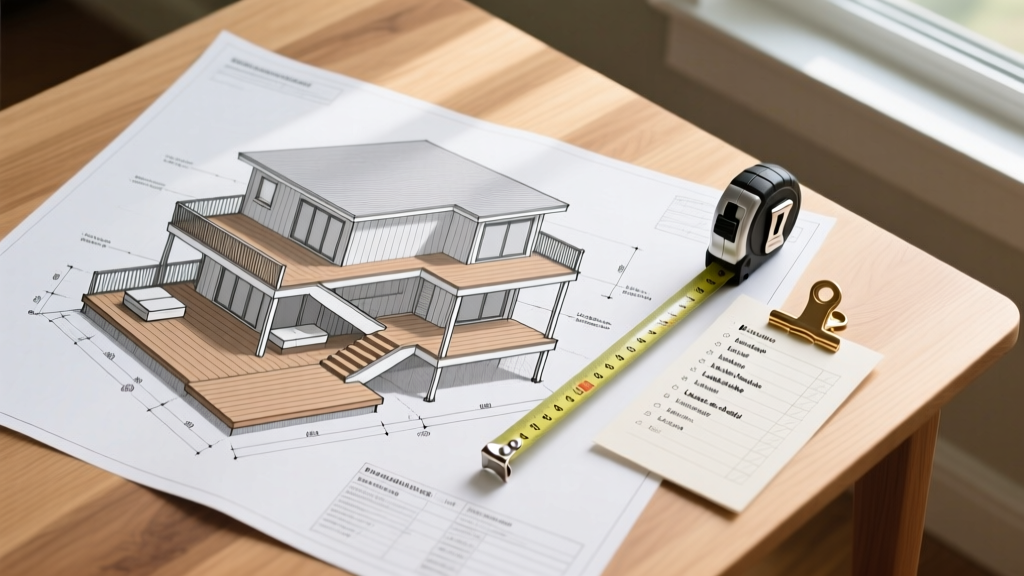
Decoding the Bill of Materials (BOM)
A raw calculator output provides a baseline, but professional builders apply real-world adjustment factors to account for cutting waste, structural blocking, and hardware failure. Use the matrix below to adjust your calculator's raw numbers before generating purchase orders.
| Material Category | Calculator Baseline | Real-World Adjustment | Adjustment Rationale |
|---|---|---|---|
| Composite Deck Boards | 1,000 sq ft | +10% to +15% | Cuts, miter joints, and manufacturing defects |
| Pressure-Treated Joists | 50 pieces | +5 pieces | Blocking for picture-framing and stair landings |
| Hidden Fasteners | 2,500 pieces | +10% overage | Starter clips, breakage, and dropped hardware |
| Fascia / Rim Boards | 120 linear ft | +20% waste | Mitered corners require precise, wasteful cuts |
| Structural Screws | 5 lbs | +2 lbs | Stripped heads and miscellaneous framing needs |
The "Hidden Hardware" Trap: What Calculators Miss
Automated deck material list calculators excel at calculating surface area and primary framing members, but they frequently fail to account for the specialized hardware required for code compliance and structural longevity. If your calculator does not have specific input fields for the following elements, you must add them to your BOM manually.
Never rely on standard lag screws for ledger board attachment. Modern building codes require structural screws or through-bolts with specific washers. According to the American Wood Council's DCA-6 Prescriptive Deck Guide, ledger attachments typically require 1/2-inch diameter structural screws (such as Simpson Strong-Tie SDWS) spaced in two staggered rows. Calculate exactly 1.5 screws per linear foot of ledger board to ensure code compliance.
Stair Stringer Hangers and Blocking
If your design includes stairs, the calculator will estimate stringer lumber, but it will likely omit the specialized hangers required to attach those stringers to the deck rim. Standard joist hangers (like the LUS26) are not rated for the sheer and uplift forces of stair stringers. You must manually add stair stringer hangers (e.g., Simpson LSC or A35Z) and the additional 2x8 or 2x10 blocking required behind the rim joist to provide a solid nailing surface.
Picture Framing and Edge Blocking
Picture framing (running a perimeter board parallel to the deck edge to hide end grains) is a premium design choice that calculators rarely anticipate. This technique requires continuous blocking between the outer joists to support the perimeter board. Add 2x6 or 2x8 blocking spaced every 12 inches along the entire perimeter of your deck to your material list.
Manual Verification Framework: The Fastener Math
Do not blindly trust the fastener count generated by a deck material list calculator. Fasteners are relatively cheap, but running out mid-installation halts progress and forces you to mix fastener batches, which can lead to inconsistent board gapping. Use this manual verification formula to double-check your hidden fastener requirements.
- Calculate Joist Intersections: Multiply the total number of deck boards by the number of joists they cross. For a 400 sq ft deck (20x20) with 16-inch OC joists, you will have approximately 15 interior joists plus 2 rim joists (17 total). If using 5.5-inch wide boards, you need roughly 130 boards. 130 boards x 17 joists = 2,210 intersections.
- Add Starter Clips: Hidden fastener systems require specific starter clips at the ends of the boards where the hidden fastener groove cannot reach. Add 2 starter clips per board (260 clips).
- Apply the Breakage Factor: Add 5% for dropped, stripped, or defective fasteners (approx. 125 pieces).
- Total Order: 2,210 + 260 + 125 = 2,595 fasteners. Order three boxes of 1,000 to ensure uninterrupted installation.
Translating the List to Purchase Orders
Once your deck material list calculator has generated a verified BOM, the final planning phase involves strategic sourcing. How you order materials is just as critical as what you order, particularly when working with high-end composite or PVC decking.
Pro-Tip: The Dye Lot Rule
Composite decking is manufactured in batches, and slight color variations occur between different production runs (dye lots). When finalizing your material list, ensure your supplier pulls all deck boards, fascia, and stair treads from the exact same dye lot. If your calculator indicates you need 65 boards, and the local yard only has 40 in stock, special order the remaining 25 to match the batch rather than mixing inventory from different stores.
Managing LTL Freight vs. Box Store Pickup
For decks exceeding 300 square feet, the volume of materials will exceed the capacity of a standard box truck or trailer. Pressure-treated 5/4x6 decking and composite boards are heavy and prone to warping if strapped improperly to a personal vehicle. Factor LTL (Less Than Truckload) freight delivery into your planning timeline. LTL freight requires a flat, accessible drop zone (usually a driveway) and adds 3 to 7 days to your procurement schedule. Ensure your calculator's output is finalized before placing the freight order, as returning partial pallets of composite decking incurs steep restocking fees and return freight charges.
By treating a deck material list calculator as a foundational planning tool rather than an infallible oracle, you bridge the gap between digital design and physical construction. Verifying joist spacing, manually calculating hidden hardware, and strategizing your dye-lot sourcing will transform a rough estimate into a bulletproof construction plan.
Written by
James ThorntonJames Thornton is a construction industry veteran with 25 years of hands-on experience in wood framing, lumber grading, and residential building codes. He started as a framing carpenter in rural Oregon, earned his ICC Residential Building Inspector certification, and eventually became a senior plan reviewer for the City of Portland Bureau of Development Services. James holds a B.S. in Wood Science & Technology from Oregon State University and is a certified lumber grader through the West Coast Lumber Inspection Bureau (WCLIB). He has inspected over 3,000 residential construction sites and authored the city's internal guide on advanced framing techniques (2x6 at 24" O.C.). James lives in Bend, OR, where he builds custom timber-frame cabins and competes in lumberjack sports.
More from James Thornton
View all
Insulation
Best Home Insulation Materials: Complete 2026 Guide
Compare top home insulation materials for 2026. Find R-values, installed costs per square foot, and best uses for fiberglass, spray foam, and mineral wool.
Aug 4, 2026

Sustainable Building
Certify Your Green Building Material for LEED and WELL
Step-by-step guide to certifying a green building material for LEED v5 and WELL v2. Master EPDs, HPDs, and VOC limits for 2026 project specifications.
Aug 4, 2026

Stone & Masonry
Veneer Stacked Stone Panels: Interior Design & Style Showcase
Discover how veneer stacked stone panels transform interiors. Explore modern design profiles, material pairings, and technical installation specs.
Aug 4, 2026