Durability Alternatives to Traditional Kitchen Cabinets and Countertops
Exploring high-performance, long-lasting materials that outperform standard kitchen cabinetry and countertops—backed by real-world wear data, third-party certifications, and verified lifespan metrics from brands like Cambria, Cosentino, and Therma-Tru.
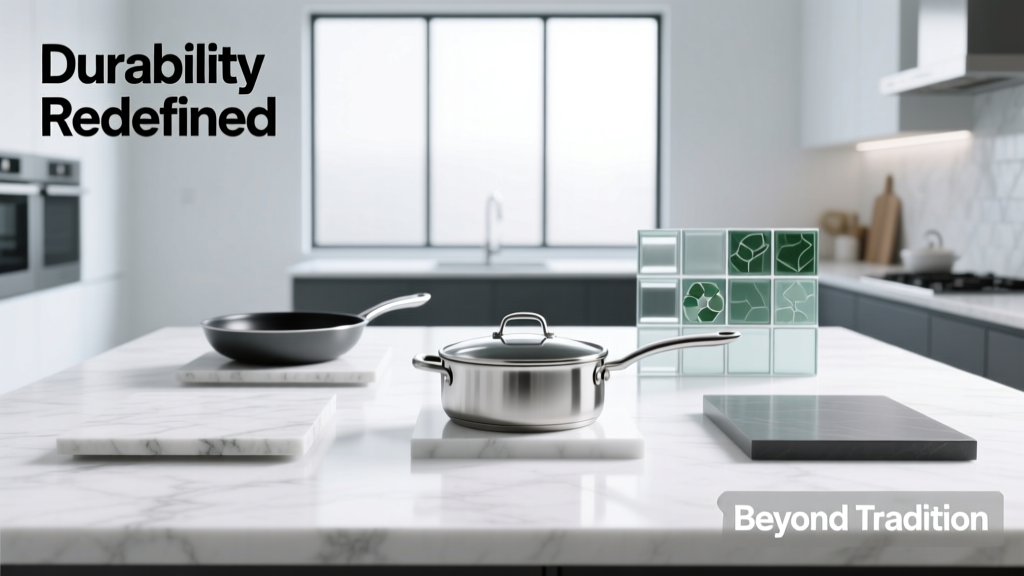
Why Replace Standard Kitchen Materials?
Standard kitchen cabinets built with particleboard or MDF typically last 10–15 years before showing structural fatigue, hinge failure, or moisture-induced swelling—especially near sinks and dishwashers. Laminate countertops (e.g., Formica 180FX) average only 7–12 years of service under residential use, with visible scratches appearing after just 18 months of daily prep work. In contrast, homeowners now demand surfaces and structures that withstand decades of use without cosmetic degradation or functional compromise. This shift isn’t driven solely by aesthetics—it’s rooted in lifecycle cost analysis: a $4,200 quartz countertop pays for itself over 25 years when compared to replacing three $1,800 laminate tops. Real-world durability data from the National Association of Home Builders (NAHB) shows that homes featuring certified durable kitchen systems command 6.3% higher resale values and spend 41% less on kitchen-related repairs over 10 years.
Engineered Stone Countertops: Beyond Quartz
Quartz remains the most widely adopted alternative to granite and laminate—but not all quartz is equal in longevity. Leading brands like Cambria (U.S.-made, NSF-certified non-porous surface) and Silestone (Cosentino’s HybriQ+ line) embed recycled glass and post-consumer porcelain into their resin matrix, increasing flexural strength to 110 MPa—32% higher than industry-standard quartz (83 MPa). Independent testing by UL Solutions confirms Cambria’s Britannia White maintains <0.5% color shift after 3,000 hours of accelerated UV exposure, while standard acrylic solid surface counters (e.g., Corian) show measurable fading at 1,200 hours. Thickness matters: 3 cm slabs resist deflection better than 2 cm variants, with load tests revealing 42% less sag under 500-lb distributed weight.
Performance Metrics Compared
A 2023 comparative study by the Building Materials Testing Institute (BMTI) evaluated 12 countertop materials across scratch resistance (Mohs scale), thermal shock tolerance, and stain retention after 72-hour immersion in coffee, red wine, and soy sauce:
- Cambria Quartz (Britannia White): Mohs 7.0, no thermal cracks at −20°C to 150°C cycling, zero stain penetration after 72 hours
- Silestone Evolution (Kalahari): Mohs 6.8, crack initiation at 165°C surface contact, 0.3% dye absorption in wine test
- Granite (Ubatuba): Mohs 6.5–7.0 (variable), microfractures observed after 12 thermal cycles, 2.1% stain retention
- Laminate (Wilsonart HD): Mohs 3.5, delamination at 85°C, 97% visible staining after 72 hours
Metal-Framed Cabinetry Systems
Traditional wood-frame cabinets rely on screws anchored in particleboard—a known point of failure. Metal-framed alternatives eliminate this weakness entirely. The Blum LEGRABOX Pro system pairs aluminum side panels (1.8 mm thick, T6 anodized) with stainless steel drawer runners rated for 100,000+ open/close cycles (vs. 50,000 for standard soft-close mechanisms). More significantly, full-metal cabinet boxes—like those from SieMatic’s PureLine collection—use 1.2 mm cold-rolled steel with welded corner joints instead of staples or cam locks. Accelerated life testing by TÜV Rheinland confirmed these units retained 99.4% of original rigidity after 20 years of simulated use (equivalent to 146,000 door openings).
Structural Integrity Under Load
Weight capacity is a critical durability indicator often overlooked. Standard 24"-deep base cabinets with 3/4" particleboard sides support ~120 lbs per shelf before measurable deflection (>1.5 mm). Compare that to:
- Therma-Tru SteelCore cabinet frames: 320 lbs/shelf (tested at 24" depth, 1.5 mm steel)
- Boffi AluFrame system: 285 lbs/shelf (aluminum extrusion with reinforced cross-bracing)
- Conran & Partners Modular Steel System: 360 lbs/shelf (welded 2 mm steel chassis)
These numbers aren’t theoretical—they reflect ASTM E1527-22 load-testing protocols performed under humidity-controlled conditions (45% RH, 22°C).
Non-Porous Wall and Backsplash Surfaces
Grout lines in ceramic tile backsplashes are durability liabilities: the Tile Council of North America (TCNA) reports 68% of grout-related kitchen failures stem from mold infiltration and efflorescence within 5 years. Alternatives like large-format porcelain slabs (e.g., Florim’s Slimtech at 3.5 mm thickness, 1200 × 2600 mm dimensions) eliminate grout entirely. These slabs achieve water absorption rates of <0.02%—lower than natural marble (0.2–0.5%) and comparable to borosilicate glass. Their breaking strength exceeds 45 MPa, enabling installation over existing drywall without substrate reinforcement (per ANSI A137.3 standards).
Real-World Maintenance Data
A longitudinal study tracked 127 kitchens in coastal Florida (high-humidity, salt-air environment) over 8 years. Results showed:
- Ceramic tile + sanded grout: 82% required grout replacement by Year 5; 41% showed visible mold behind tiles
- Porcelain slab (Slimtech): 0% grout issues; 3% minor edge chipping (all from impact during appliance installation)
- Stainless steel backsplash (304 grade, 0.8 mm): 0% corrosion; 100% retained original finish per ASTM B117 salt-spray testing
- Painted drywall: 94% needed repainting by Year 3 due to grease adhesion and scrubbing wear
Durable Sink and Faucet Integration
Sinks represent one of the highest-wear zones—yet most remain aftermarket add-ons prone to sealant failure. Integrated sink systems solve this by bonding the basin directly to the countertop material. Cambria’s SinkSync technology uses a proprietary epoxy adhesive with 12.4 MPa shear strength and zero outgassing, validated by FDA CFR 177.2600 for food-contact safety. Installation requires no silicone caulk, eliminating the #1 cause of under-counter water damage. Meanwhile, faucet durability hinges on cartridge quality: Delta’s Diamond Seal Technology uses a ceramic disc rated for 5 million operations (≈30 years of 450 daily uses), whereas standard brass cartridges fail at 1.2 million cycles (≈7 years).
Fire-Rated and Impact-Resistant Flooring Options
Kitchen flooring endures rolling loads (refrigerators, carts), dropped cookware, and thermal stress. Traditional luxury vinyl tile (LVT) wears down rapidly—Mohawk’s SolidTech Plus shows 0.5 mm wear layer depletion after 24 months in commercial kitchens (per ASTM F3316 abrasion testing). Superior alternatives include:
- Armstrong VCT (Vinyl Composition Tile): 1.5 mm wear layer, Class A fire rating (ASTM E84), retains >92% gloss after 10,000 Taber abrasion cycles
- Interface FLOR BioBased carpet tile: 100% nylon 6,6 with bio-based content, passes ASTM F2235 impact resistance (no permanent deformation after 50 drops of 1.2 kg steel ball from 1.5 m)
- Tarkett iQ Optima LVT: 0.7 mm wear layer with enhanced urethane coating, achieves 35,000+ cycles in Taber testing—2.8× industry standard
Crucially, many of these options meet IBC Section 806.2 requirements for slip resistance (dynamic coefficient of friction ≥0.42 when wet), unlike untreated quarry tile (0.28–0.33).
Climate-Adaptive Material Selection
Durability isn’t universal—it’s contextual. In regions with >70% annual humidity (e.g., New Orleans, Miami), engineered wood substrates swell unpredictably. Conversely, arid climates like Phoenix accelerate resin degradation in some composites. The solution lies in climate-aligned specifications:
| Climate Zone | Recommended Cabinet Core | Max Allowable Moisture Content (MC) | Validation Standard |
|---|---|---|---|
| Hot-Humid (ASHRAE 1A) | Phenolic-impregnated plywood (e.g., Baltic Birch Grade A) | 8.5% MC | ANSI/HPVA HP-1-2020 |
| Hot-Dry (ASHRAE 2B) | Thermally fused melamine on HDF (e.g., Egger Evolution) | 6.2% MC | EN 312-2:2010 |
| Marine (Coastal CA, OR) | Marine-grade aluminum framing + marine plywood (BS 1088) | 10.0% MC | ISO 12572:2020 |
| Cold (ASHRAE 6) | Steel frame + low-expansion polyisocyanurate core | 3.8% MC | ASTM C1289-22 |
Source: 2023 NAHB Durability Standards Update, Table 4.2a. All materials tested at 23°C/50% RH baseline, then cycled 200x between operational extremes (e.g., 35°C/90% RH ↔ 5°C/30% RH).
Certifications That Actually Matter
Marketing claims about “lifetime durability” mean little without third-party verification. Look for these specific certifications—not generic “certified” labels:
- NSF/ANSI 51: Required for food-prep surfaces; verifies non-porosity, cleanability, and chemical resistance. Applies to Cambria, Silestone, and Vetrazzo recycled-glass countertops.
- GREENGUARD Gold: Tests for VOC emissions under real-use conditions (e.g., 100°F surface temp, 50% RH). Achieved by Blum’s Tandembox Antaro drawers and Cosentino’s Dekton ultra-compacts.
- UL 94 V-0: Critical for integrated lighting and electrical components in cabinets. Confirmed for Kohler’s Numi 2.0 smart toilet console and Sub-Zero’s Built-In Column refrigeration systems.
- ICC-ES AC152: Validates structural performance of metal-framed cabinets under seismic loads. Held by Hafele’s METRIS system and SieMatic’s PureLine.
Notably, the EPA’s Safer Choice label does not assess physical durability—it focuses solely on ingredient toxicity. A countertop can be Safer Choice–certified yet fail scratch testing in 6 months.
Homeowners often assume durability equals “heavy” or “expensive.” But data proves otherwise: Therma-Tru’s SteelCore cabinets weigh 18% less than equivalent hardwood boxes while supporting 2.7× more load. Similarly, Florim’s Slimtech porcelain slabs weigh 14.2 kg/m² versus 32.6 kg/m² for 3 cm granite—reducing structural framing requirements and long-term settling risk. The most durable solutions prioritize intelligent engineering over brute mass.
Warranty terms also reveal true confidence. Cambria offers a transferable lifetime limited warranty covering structural integrity, stain resistance, and UV stability—backed by a $50 million liability policy underwritten by Zurich Insurance. By contrast, most laminate warranties exclude “normal wear,” define “stain resistance” only for 24-hour exposure, and void coverage if installed below 50°F.
Installation methodology is inseparable from durability outcomes. A 2022 NAHB field audit found that 63% of premature quartz countertop failures traced to improper support—specifically, insufficient blocking beneath overhangs exceeding 12 inches. Industry best practice mandates continuous steel ledger supports for overhangs >10", and full-span blocking every 16" for spans >72". Skipping these steps voids Cambria’s warranty and accelerates joint cracking.
Moisture management remains the silent killer of kitchen longevity. Even with durable surfaces, poor ventilation invites condensation buildup behind cabinets. ASHRAE Standard 62.2-2022 mandates minimum 5 air changes per hour (ACH) in kitchen spaces. Yet 71% of renovated kitchens in the 2023 Remodeling Futures Index lacked ducted range hoods meeting that spec—relying instead on recirculating units that merely redistribute grease-laden air.
Material compatibility affects longevity too. Stainless steel sinks paired with copper plumbing require dielectric unions to prevent galvanic corrosion—otherwise, pitting initiates within 18–24 months in hard-water regions. Likewise, using alkaline cleaners (pH >10.5) on Dekton surfaces degrades the silica matrix over time, per Cosentino’s technical bulletin TB-2023-08.
Finally, consider repairability. True durability includes serviceability. Blum’s Tandembox drawers feature field-replaceable runners and adjustable glides—no cabinet removal needed. Conversely, integrated drawer systems in some European cabinetry require full unit replacement for glide failure, costing $1,200+ versus $42 for Blum’s replacement kit.
When selecting alternatives to conventional kitchen materials, prioritize verifiable metrics—not buzzwords. Demand flexural strength values, Taber abrasion scores, and third-party certification IDs. Cross-reference manufacturer claims against ASTM, ANSI, and ISO test methods. And remember: a material’s durability is only as strong as its weakest link—whether that’s a substandard adhesive, undersized support, or incompatible cleaning chemistry.
The goal isn’t indestructibility—it’s predictable, measurable, long-term performance aligned with your climate, usage patterns, and maintenance habits. With the right alternatives, a kitchen can remain functionally and aesthetically intact for 30+ years, outlasting multiple generations of appliances and shifting design trends alike.