Choosing Deck Materials: A 2026 Design & Cost Guide
Compare top deck materials for 2026. Explore costs, lifespan, and design frameworks for wood, composite, PVC, and aluminum outdoor structures.
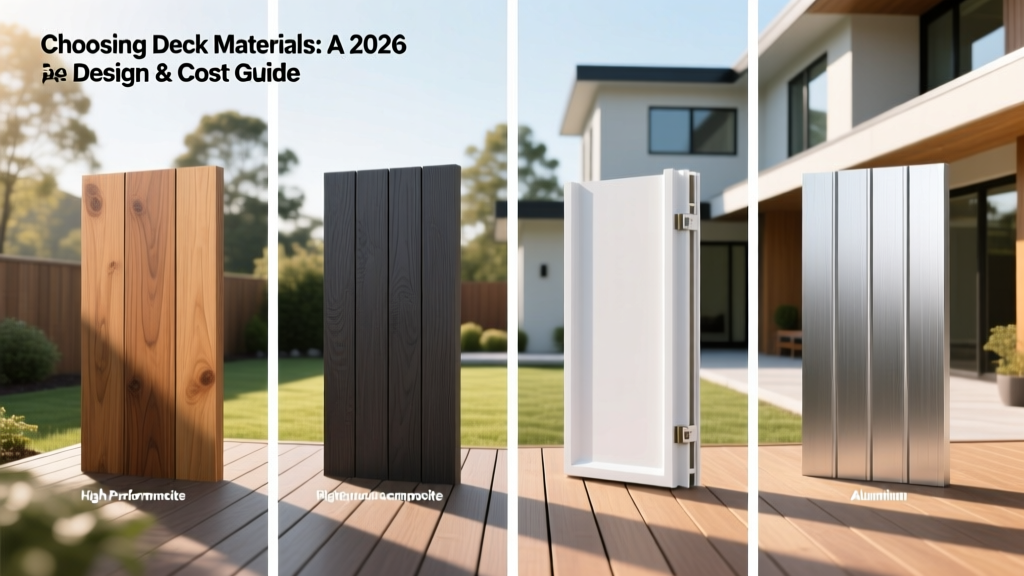
The 2026 Deck Material Selection Framework
Selecting the right deck materials requires balancing upfront capital expenditure against long-term maintenance, structural load requirements, and local climate stressors. In 2026, the outdoor living market has shifted heavily toward low-maintenance alternatives, yet traditional wood remains a dominant force in budget-conscious builds. To make an informed design decision, you must evaluate materials across four critical vectors: initial cost per square foot, expected lifespan, annual maintenance hours, and thermal expansion coefficients.
- Budget under $6/sq ft: Pressure-Treated Southern Yellow Pine (PT SYP).
- Balance of cost & longevity ($8-$11/sq ft): Capped Wood-Plastic Composite (WPC).
- High moisture/stain resistance ($11-$15/sq ft): Cellular PVC.
- Wildfire zones & maximum span ($16+/sq ft): Extruded Aluminum.
Material Deep-Dive: Performance & Cost Metrics
1. Pressure-Treated Southern Yellow Pine (PT SYP)
Pressure-treated wood remains the baseline for residential decking. Modern PT lumber is treated with micronized copper azole (MCA) or alkaline copper quaternary (ACQ). When sourcing PT SYP, verify the retention levels to ensure it matches your structural application. According to the American Wood Protection Association (AWPA), above-ground deck boards require a minimum retention level of 0.25 pounds per cubic foot (PCF), while structural posts in ground contact demand 0.40 PCF or higher.
Cost: $3.50 to $5.50 per square foot (material only).
Design Caveat: PT wood shrinks and twists as it dries. For 5.5-inch wide boards, install them tight (no gap) if the lumber is wet from treatment; if kiln-dried after treatment (KDAT), leave a 1/8-inch gap to allow for minor seasonal expansion.
2. Capped Wood-Plastic Composite (WPC)
Composite decking has evolved past the first-generation uncapped boards that suffered from mold and fading. Today's standard is co-extruded capped composite, featuring a dense polyethylene core wrapped in a protective polymer shell. Premium lines like Trex Transcend Lineage or Fiberon Concordia utilize advanced heat-mitigation technology that reduces surface temperatures by up to 15% in direct sunlight compared to older composites.
Cost: $7.00 to $11.00 per square foot.
Design Caveat: Composites expand and contract primarily along their length. A 16-foot board can expand up to 1/8 inch for every 40-degree Fahrenheit temperature swing. You must follow manufacturer gapping schedules precisely—typically 3/16 inch end-to-end at installation temperatures around 50°F—to prevent buckling in summer.
3. Cellular PVC Decking
Unlike WPC, cellular PVC contains zero wood flour or organic fibers. Products like TimberTech Advanced PVC are manufactured from a solid cellular foam structure that is impervious to moisture absorption. This makes PVC the superior choice for ground-level decks, dock applications, or regions with relentless humidity where organic wood fibers in composites might still harbor surface mold.
Cost: $10.00 to $14.50 per square foot.
Design Caveat: PVC is highly susceptible to thermal expansion—often 30% to 50% more than WPC. Use hidden fastening systems designed specifically for PVC that allow for lateral movement, and never face-screw PVC boards without oversized pre-drilled holes to accommodate shifting.
4. Extruded Aluminum Decking
Aluminum decking is a niche but rapidly growing category, driven by strict building codes in wildfire-prone areas. Extruded aluminum boards are non-combustible, rot-proof, and incredibly rigid. Because of their high structural strength, aluminum boards can often span 24 inches on center (OC), compared to the 16-inch OC maximum for most wood and composite boards, reducing the amount of substructure framing required.
Cost: $15.00 to $22.00 per square foot.
Design Caveat: Aluminum conducts heat rapidly but also dissipates it quickly. It can feel cold underfoot in winter and may produce a metallic acoustic echo when walked on with hard-soled shoes. It is best utilized in commercial applications, boardwalks, or strict Wildland-Urban Interface (WUI) zones as defined by CAL FIRE guidelines.
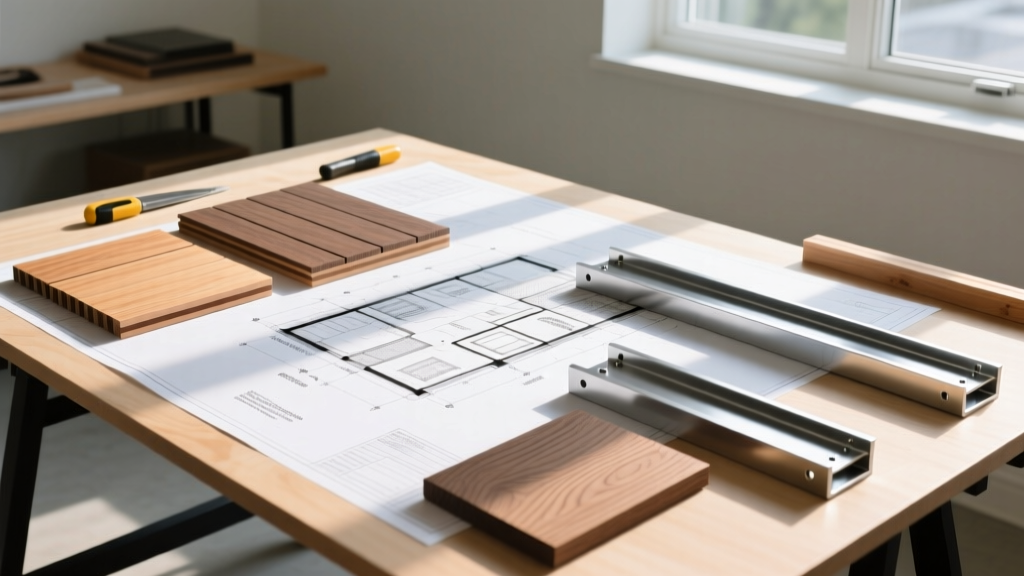
Comprehensive Deck Materials Comparison Matrix
| Material Type | Avg. Cost / Sq Ft | Expected Lifespan | Maintenance Hrs/Yr | Max Joist Span |
|---|---|---|---|---|
| PT SYP Wood | $3.50 - $5.50 | 15 - 20 Years | 8 - 12 Hours | 16" OC |
| Capped Composite | $7.00 - $11.00 | 25 - 30 Years | 1 - 2 Hours | 16" OC |
| Cellular PVC | $10.00 - $14.50 | 30 - 50 Years | 1 - 2 Hours | 16" OC |
| Extruded Aluminum | $15.00 - $22.00 | 50+ Years | 0 Hours | 24" OC |
The Hidden Cost: Substructure and Fasteners
A common failure in deck planning is allocating 90% of the budget to the surface boards while neglecting the substructure. The USDA Forest Products Laboratory notes that substructure rot is the leading cause of premature deck failure, often occurring while the surface boards remain perfectly intact.
Joist Protection
If you are using a PT wood substructure, applying a butyl-based joist tape (such as Trex Protect or G-Tape) to the top of every joist and beam is mandatory for long-term survival. The tape prevents water from pooling on the horizontal surfaces and seals around fastener penetrations. This adds roughly $0.50 to $0.75 per square foot to the total project cost but effectively doubles the lifespan of the wooden frame.
Hidden vs. Face Fasteners
For composite and PVC, hidden clip systems (e.g., Trex Hideaway or TimberTech CONCEALoc) cost an additional $1.50 to $2.50 per square foot compared to color-matched face screws. However, hidden clips automatically enforce the correct gapping for thermal expansion and eliminate the risk of surface mushrooming or water pooling in screw divots. Face screws should only be used on the perimeter boards (fascia and picture-frame borders) where hidden clips cannot engage.
Climate-Specific Material Matching
Designing for the microclimate ensures your material investment survives local environmental stressors.
- Coastal & Saltwater Environments: Avoid standard steel fasteners and untreated aluminum. Use 316-grade stainless steel face screws and hidden clips to prevent galvanic corrosion and rust bleeding. Cellular PVC is highly recommended here as it will not absorb salt spray.
- Heavy Snow & Freeze-Thaw Cycles: Avoid porous materials. Uncapped composites and standard wood will absorb meltwater, which freezes and causes micro-fracturing (spalling). Capped WPC or Aluminum with integrated drainage channels are optimal.
- High UV / Desert Climates: Dark-colored composite and PVC boards can reach surface temperatures exceeding 140°F in direct summer sun, making them unusable barefoot. Specify light-colored, heat-reflective PVC or aluminum, and design integrated pergola shading to reduce direct solar gain.
FAQ: Deck Material Planning
Can I mix different deck materials on the same structure?
Yes, and it is a highly recommended design strategy. Using a capped composite for the main field and a contrasting cellular PVC for the picture-frame border provides a high-end aesthetic while utilizing the more rigid PVC to create clean, mitered corners that resist the expansion and contraction gaps required by the composite field.
Does the color of composite decking affect structural performance?
Color does not affect the structural load capacity, but it drastically impacts thermal expansion. Darker colors absorb more heat, causing the boards to expand more significantly than lighter colors. When installing dark composite boards in full sun, you must adhere to the manufacturer's maximum temperature gapping tolerances to prevent the boards from pushing against each other and warping out of plane.
What is the best deck material for a rooftop or balcony application?
For rooftop decks, weight and fire resistance are the primary constraints. Extruded aluminum is the premier choice due to its lightweight nature (reducing load on the roof structure) and non-combustible properties. If using composite, verify that the specific product line is rated for rooftop applications, as some manufacturers void warranties if the underside of the board lacks adequate cross-ventilation, leading to heat trapping and structural sagging.
Written by
Sarah WhitfieldSarah Whitfield is a chartered quantity surveyor (MRICS) and construction cost analyst with 15 years of experience in material pricing, procurement strategy, and project budgeting. She earned her degree in Construction Management from the University of Reading (UK) and has worked on projects ranging from $2M custom homes to $180M mixed-use developments across North America and Europe. Sarah currently leads cost estimating for BuildMat Insight, maintaining a proprietary database of 4,000+ material price points updated quarterly. She is a frequent contributor to RSMeans cost data panels and has presented at the International Cost Engineering Council (ICEC) congress. Based in Denver, CO, Sarah is an avid trail runner and volunteer mentor for Women in Construction.
More from Sarah Whitfield
View all
Wood & Lumber
What Are the Different Types of Wood? A Builder's Guide
Compare structural softwoods, finish hardwoods, and engineered lumber. Analyze Janka ratings, MOE values, and 2026 pricing for construction.
Aug 4, 2026

Walls & Panels
Steel Framing vs Wood Framing: Corrosion and Moisture Defense
Compare steel framing vs wood framing for moisture resistance. Learn about galvanized coatings, condensation risks, and corrosion protection strategies.
Jul 21, 2026

Stone & Masonry
How to Cut Stone Veneer: Wet Saw vs Grinder Comparison
Compare the best tools for cutting stone veneer. We review wet saws, angle grinders, and chop saws to help you achieve clean, chip-free cuts.
Jul 21, 2026