Long-Lasting Deck Ideas: Material Lifespan Analysis
Discover long-lasting deck ideas with our durability analysis. Compare wood, composite, and aluminum lifespans, failure modes, and hidden framing costs.
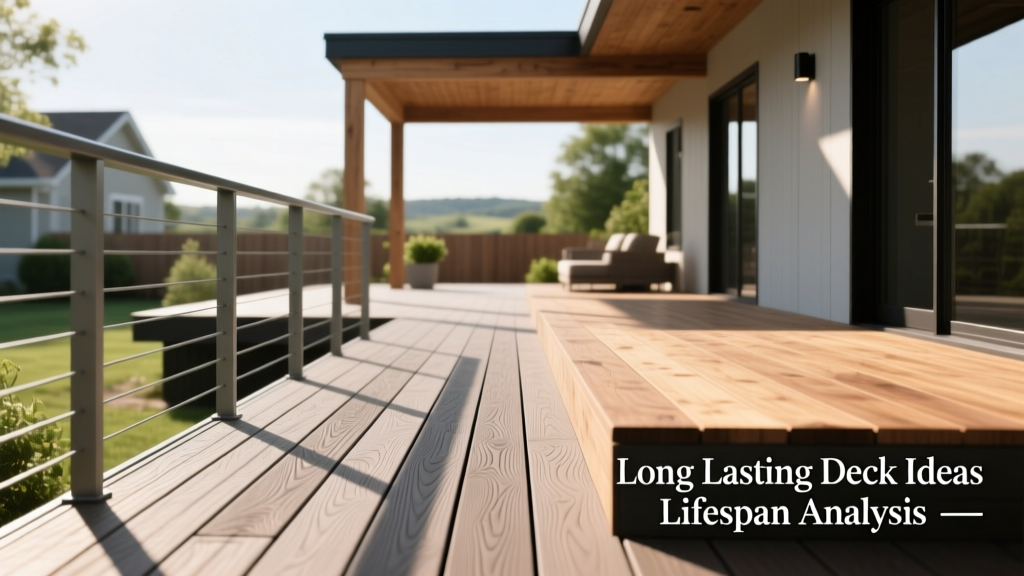
The True Cost of Deck Degradation
When evaluating deck ideas, homeowners and contractors often fixate on upfront material costs and aesthetic appeal. However, the true metric of a successful outdoor structure is its lifecycle cost, which encompasses initial installation, ongoing maintenance, and ultimate replacement. A deck that costs $12,000 to build but requires $4,500 in maintenance and early replacement over 15 years is vastly more expensive than a $16,000 structure that performs flawlessly for 30 years with minimal upkeep.
Material degradation is driven by four primary environmental stressors: ultraviolet (UV) radiation, moisture intrusion, thermal expansion/contraction, and biological agents (fungi and insects). Understanding how specific decking materials react to these stressors is critical for selecting long-lasting deck ideas tailored to your specific microclimate.
Material Failure Matrix: How Decks Actually Die
Before selecting a material, it is essential to understand its specific failure modes. The table below breaks down the primary degradation vectors for the three most common decking categories.
| Material Category | Primary Failure Mode | Secondary Threat | Expected Lifespan |
|---|---|---|---|
| Pressure-Treated Pine | Moisture absorption leading to cupping, checking, and fungal decay. | UV graying and surface splintering. | 10–15 years |
| Tropical Hardwood (Ipe) | End-grain checking and fastener back-out due to density. | UV silvering (aesthetic, not structural). | 25–40+ years |
| Capped Composite | Thermal expansion causing buckling if improperly gapped. | Mold/mildew in shaded, damp zones. | 25–30 years |
| Extruded Aluminum | Powder-coat UV fading (chalking) over decades. | Galvanic corrosion if paired with wrong fasteners. | 50+ years |
Hardwood & Pressure-Treated Wood: Managing Moisture and UV
Wood remains a popular choice for deck ideas due to its natural aesthetics and lower initial cost, but it requires rigorous moisture management. Standard Southern Yellow Pine (SYP) pressure-treated lumber must be specified correctly for its application. According to the USDA Forest Products Laboratory, lumber intended for deck joists and posts in contact with concrete or soil must meet AWPA (American Wood Protection Association) Use Category UC4A (Ground Contact), which requires a minimum retention level of 0.31 pcf (pounds per cubic foot) of copper azole or ACQ preservative. Deck boards, which are above ground, only require UC3B (0.25 pcf), but upgrading to UC4A for the boards provides a crucial safety margin against rot in high-moisture climates.
The Tropical Hardwood Alternative
For those seeking wood deck ideas with extreme longevity, Ipe (Tabebuia spp.) is the industry benchmark. With a Janka hardness rating of 3,680 lbf—nearly six times harder than cedar—Ipe is virtually impervious to insect damage and structural rot. However, its density (roughly 69 lbs/ft³) creates specific installation challenges. Ipe shrinks and swells very little tangentially, but it is highly prone to end-grain checking (splitting at the board ends). To prevent this, every cut end must be immediately sealed with a wax-based end-grain sealer like Anchorseal. Furthermore, because Ipe is so dense, pre-drilling is mandatory for face-screwing, or contractors must use specialized hidden clip systems designed for hardwood's specific dimensional tolerances.
Capped Composite & PVC: The Thermal Expansion Challenge
Modern composite decking has evolved far beyond the first-generation uncapped boards that suffered from severe staining and fading. Today's long-lasting deck ideas rely on capped composite or solid PVC boards featuring a 20-to-30-mil polymer shield that resists moisture intrusion and UV fading. Products like Trex Transcend Lineage or Azek Vintage offer exceptional stain resistance and require virtually zero chemical maintenance.
However, the Achilles' heel of polymer-based decking is thermal expansion. While wood expands primarily across its width (tangentially) when wet, composite and PVC expand primarily along their length when heated. A 12-foot PVC board can expand up to 1/8 inch during a 50°F temperature swing. If a contractor installs these boards tight end-to-end without accounting for the installation-day temperature, the boards will buckle and push against the fascia when summer heat hits.
Installation Specifics for Polymer Decking
- Temperature Gapping: Always consult the manufacturer's thermal expansion chart. If installing on a 40°F morning, leave a 3/16-inch gap at board ends; if installing on an 85°F afternoon, a 1/16-inch gap may suffice.
- Hidden Fasteners: Use manufacturer-specific hidden fastener clips (e.g., Trex Hideaway). These clips lock into the board's side groove and allow for lateral movement while maintaining a consistent 1/8-inch side gap for drainage.
- Color Selection: Dark-colored composite boards (like deep browns or charcoals) can reach surface temperatures of 140°F+ in direct summer sunlight. In southern climates, specify lighter, high-reflectance colors or PVC boards with specialized heat-mitigating cap layers to prevent thermal softening and barefoot burns.
Aluminum Decking: The 50-Year Structural Solution
When extreme durability and zero maintenance are the primary goals, aluminum decking represents the pinnacle of long-lasting deck ideas. Extruded aluminum deck boards, typically manufactured from 6061-T6 marine-grade alloy, will not rot, warp, crack, or burn. They are particularly advantageous for second-story decks because their interlocking extrusion designs often feature integrated water-shedding channels, keeping the substructure completely dry and creating a waterproof storage space below.
The lifespan of an aluminum deck is dictated not by the metal itself, but by its finish. Bare aluminum will oxidize and dull. High-quality aluminum decking is finished with an AAMA 2604 compliant powder coat, which provides superior resistance to UV chalking and color fading. According to the American Galvanizers Association, aluminum also naturally forms a protective oxide layer when scratched, preventing the spread of corrosion, provided it is not in direct, continuous contact with dissimilar metals like untreated steel or copper.
The Hidden Lifespan Killer: Substructure and Fasteners
The most common reason a deck fails prematurely is not the deck boards, but the rotting of the wooden joists and ledger board. Water that drains through the gaps in composite or aluminum deck boards sits directly on top of the horizontal joists, creating a perpetual moisture trap that accelerates fungal decay.
Mandatory Substructure Upgrades
To ensure your substructure outlasts your premium decking, implement the following protocols:
- Butyl Joist Tape: Apply a high-quality butyl-rubber flashing tape (such as Trex Protect or G-Tape) to the top of every joist and the ledger board before laying deck boards. Butyl rubber remains flexible across extreme temperature ranges and seals around fastener penetrations, preventing water from soaking into the end-grain of the joists.
- Ledger Board Flashing: The ledger board connection to the house is the single most critical structural and waterproofing detail. Use a continuous piece of Z-flashing or a self-adhering ice-and-water shield membrane that laps up the house wall and over the ledger board, integrated seamlessly with the home's weather-resistant barrier.
- Hardware Upgrades: Standard G90 galvanized joist hangers will rust in 10 to 15 years, especially when exposed to the acidic runoff of cedar or redwood. Upgrade to hot-dipped galvanized (HDG) Z185 hardware or stainless steel connectors. For homes within one mile of a saltwater coastline, FEMA's Building Science guidelines strictly mandate Type 316 stainless steel for all structural connectors due to the aggressive nature of chloride-induced corrosion.
Climate-Specific Decision Framework
Selecting the right material requires matching the product's strengths to your local environmental stressors. Use this framework to finalize your deck ideas:
- High-Moisture / Heavy Shade (Pacific Northwest, Southeast): Avoid uncapped composites and standard pine. Opt for capped PVC (which absorbs zero moisture) or aluminum. Ensure 24-inch on-center joist spacing is reduced to 16-inch to prevent sagging if the material softens in high heat and humidity.
- Extreme Temperature Swings (Mountain West, Midwest): Avoid long, continuous runs of PVC without expansion breaks. Hardwoods like Ipe or dimensionally stable capped composites with hidden fastening systems perform best here.
- Coastal / Salt Air (Within 1 mile of ocean): Aluminum decking with AAMA 2604 powder coating, paired exclusively with Type 316 stainless steel fasteners and structural connectors. Avoid pressure-treated wood, as the salt accelerates the leaching of copper preservatives.
- High Fire Risk Zones (California WUI areas): Aluminum is the only truly non-combustible deck board option. If wood or composite must be used, verify the specific product's Wildland-Urban Interface (WUI) compliance listing, which often requires specialized under-deck enclosures to prevent ember intrusion.