Ipe Decking Deep Dive: Top Brands, Grades & Sourcing
Compare top ipe decking brands, grades, and FSC sourcing. Get 2026 pricing, installation specs, and durability data for premium hardwood decks.
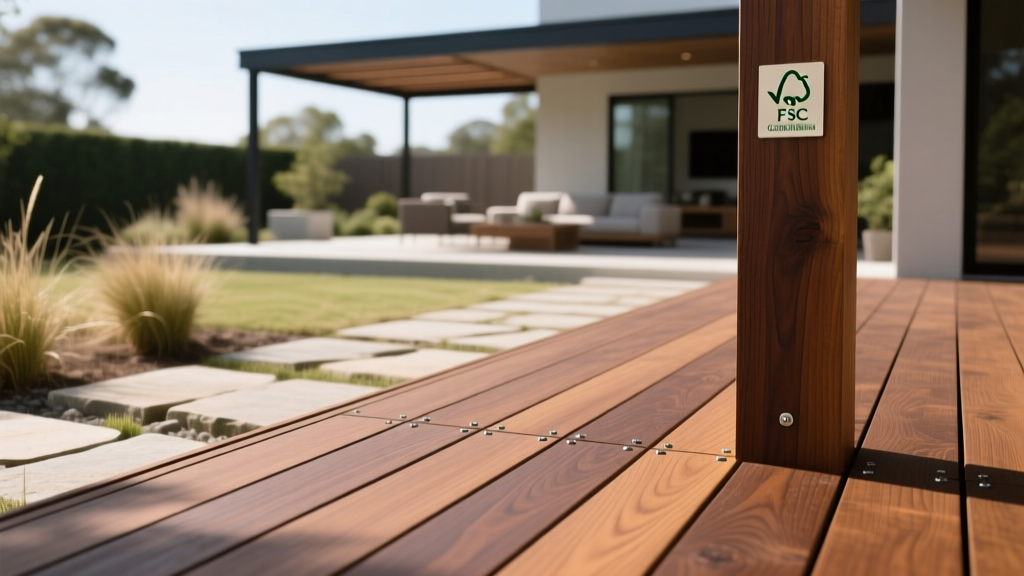
The Anatomy of Ipe: Why Brand and Grade Matter
Ipe (pronounced ee-pay) is not a single manufactured product line; it is a commercial name for lumber harvested from the Handroanthus genus (formerly Tabebuia), primarily sourced from South America. Renowned for its extreme density and natural rot resistance, Ipe boasts a Janka hardness rating of 3,684 lbf and a density of roughly 69 lbs/ft³, according to The Wood Database. Because it is a natural species, quality varies wildly based on the importer's grading standards, kiln-drying processes, and forestry management practices.
Unlike composite decking brands that offer uniform, factory-controlled product lines, purchasing Ipe requires navigating a fragmented market of importers. Understanding the specific brand lines, grading terminology, and sourcing certifications is critical to avoiding high waste factors and premature board failure.
Decoding Ipe Decking Grades: Select vs. Premium vs. #1
The hardwood decking industry lacks the strict, universally enforced grading rules found in structural softwood lumber (like SPF or Douglas Fir). Instead, importers establish their own visual grading parameters. When evaluating brand lines, you will typically encounter three primary tiers.
| Grade Designation | Visual Characteristics | Expected Waste Factor | 2026 Avg. Price (Per Linear Foot) |
|---|---|---|---|
| Premium / Clear | Uniform dark brown/olive color, no knots, no sapwood, tight vertical grain. | 2% - 5% | $5.20 - $7.50 |
| Select / #1 | Minor color variations, occasional small pin knots, minimal sapwood on edges. | 5% - 10% | $4.10 - $5.10 |
| #2 / Commercial | Pronounced color variegation, larger knots, visible sapwood, shorter board lengths. | 12% - 20% | $2.80 - $3.90 |
Top Ipe Decking Importers and Brand Lines
While dozens of lumber yards sell Ipe, a few specialized importers dominate the high-end residential and commercial market with rigorously graded, consistently dried product lines.
AdvantageLumber (Advantage Ipe)
AdvantageLumber is one of the largest direct importers in North America. Their flagship Advantage Ipe line is milled in their own Brazilian facilities, allowing for strict quality control. They offer both standard air-dried (AD) and kiln-dried (KD) options. Their KD Select grade is milled to a precise 5/4 x 6 profile (actual 1" x 5.5") and is dried to 8-12% moisture content, significantly reducing on-site acclimation time and post-installation cupping.
MataverdeDecking (Premium Ipe)
Mataverde positions its Premium Ipe line toward the luxury residential market. They enforce a strict "no sapwood" policy on their premium tier and offer an industry-leading 25-year limited warranty against decay and termite damage. Mataverde also heavily promotes their pre-grooved boards specifically milled for the EB-TY hidden fastener system, saving contractors hours of routing time on site.
Nova USA Wood (Exotic Wood Decking)
Nova caters heavily to architects and commercial developers. Their Ipe lines are frequently specified for high-traffic boardwalks and municipal projects. Nova places a massive emphasis on FSC (Forest Stewardship Council) certification, providing full chain-of-custody documentation required for LEED-certified building projects.
Sourcing, FSC Certification, and the Lacey Act
Sourcing is the most controversial aspect of Ipe decking. Due to its high value, illegal logging in the Amazon basin has historically been a concern. The U.S. Lacey Act strictly prohibits the import of illegally harvested timber. Purchasing undocumented Ipe carries severe legal and financial risks for contractors and homeowners.
When specifying Ipe for a project, you must choose between standard and FSC-certified lines:
- Standard Ipe: Harvested under standard concessions. While legal importers ensure Lacey Act compliance via documentation, the environmental impact is less rigorously audited. This is the most common and affordable option.
- FSC-Certified Ipe: Verified by the Forest Stewardship Council to come from responsibly managed forests that provide environmental, social, and economic benefits. FSC-certified Ipe typically carries a 15% to 25% price premium and often requires a 6-to-8 week lead time for custom orders.
Installation Specifications and Failure Modes
Ipe's extreme density makes it unforgiving during installation. Standard softwood techniques will result in broken tools, split boards, and structural failure.
Fastening and Pre-Drilling
You cannot drive a standard deck screw directly into Ipe. The shear strength of the wood will snap the screw shaft before the head seats. All face-screws must be pre-drilled using high-quality carbide-tipped drill bits. Furthermore, you must use Type 316 marine-grade stainless steel fasteners. Type 304 stainless steel will eventually react with Ipe's high tannin content, causing unsightly black halos around the screw heads.
For hidden fastening, the Simpson Strong-Tie EB-TY or Tiger Claw TC-G systems are the industry standard. Because Ipe has a very low tangential shrinkage rate (approx. 6.6%), use the 3/32" gap tool rather than the 1/8" or 3/16" tools used for softer, more reactive woods like Cumaru or Garapa.
End-Grain Sealing (Critical Step)
Ipe is highly susceptible to end-checking (splitting at the board ends) when exposed to rapid moisture loss. Every single cut end must be sealed within 24 hours using a specialized wax emulsion sealer like Anchorseal Classic or Titebond End Grain Sealer. Failure to seal cut ends will result in 2-to-4-inch splits that compromise the board's structural integrity and visual appeal.
2026 Cost Breakdown: Material, Fasteners, and Labor
Budgeting for an Ipe deck requires looking beyond the per-board cost. The extreme hardness of the wood increases labor time, and the required stainless steel hardware adds to the material budget. Below is a realistic cost breakdown for a 500 sq. ft. ground-level deck using Select Grade Ipe in 2026.
| Project Component | Specification | Estimated Cost (Per Sq. Ft.) |
|---|---|---|
| Ipe Decking (Select) | 5/4 x 6, Kiln-Dried, 8-12% MC | $9.50 - $11.50 |
| Hidden Fasteners | EB-TY or TC-G (316 SS) | $1.20 - $1.60 |
| Substructure (Framing) | Pressure-Treated Pine or Steel | $6.00 - $9.00 |
| Labor (Installation) | Specialized Hardwood Crew | $14.00 - $22.00 |
| Consumables & Sealers | Carbide bits, Anchorseal, Ipe Oil | $0.80 - $1.20 |
| Total Estimated Cost | Turnkey Installation | $31.50 - $45.30 |
Maintenance and UV Oxidation
A common misconception is that Ipe requires annual sealing to maintain its structural integrity. Structurally, Ipe will last 40 to 75 years completely untreated, as verified by the USDA Forest Products Laboratory. However, without UV protection, the surface will oxidize and turn a silvery-gray within 6 to 12 months.
If the goal is to maintain the rich, dark brown hues of the wood, you must apply a penetrating hardwood oil (such as Ipe Oil or Messmer's UV Plus for Hardwoods) immediately after installation, and reapply every 12 to 24 months depending on direct sun exposure. Film-forming finishes like polyurethane or solid stains should never be used on Ipe; the wood's natural oils and density will prevent proper adhesion, leading to rapid peeling and flaking.