True Lifespan of Decking Materials: Wood vs Composite
Compare the true lifespan of wood, composite, and PVC decking materials. Discover real-world durability data, failure modes, and maintenance costs.

The Real-World Lifespan Matrix
Decking materials represent a significant capital expenditure, typically ranging from $9,000 to $30,000 for a standard 200-square-foot build depending on the material tier. While manufacturers market 25-year or lifetime warranties, these documents cover specific defects like structural failure or excessive fading, not the overall functional lifespan of the deck. Real-world degradation is dictated by local climate, UV exposure, substructure integrity, and maintenance adherence. The matrix below outlines the expected functional and aesthetic lifespans of the primary decking materials available in 2026.
| Material Type | Functional Lifespan | Aesthetic Lifespan | Avg. Installed Cost (per sq. ft.) | Primary Failure Mode |
|---|---|---|---|---|
| Pressure-Treated Pine | 15–25 Years | 3–7 Years (before graying) | $18 – $26 | Checking, splintering, joist rot |
| Tropical Hardwood (Ipe) | 40–75 Years | 10–15 Years (before silvering) | $35 – $50 | Fastener corrosion, board cupping |
| Capped Composite | 25–35 Years | 20–30 Years | $32 – $48 | Core moisture intrusion, surface scratching |
| Cellular PVC | 30–50+ Years | 30–50+ Years | $45 – $65 | Thermal expansion, heat retention |
| Aluminum | 50+ Years | 50+ Years | $55 – $80 | Coating delamination, substructure mismatch |
Pressure-Treated Wood: The Baseline Benchmark
Pressure-treated southern yellow pine remains the most common decking material due to its low upfront cost. However, its lifespan is entirely dependent on chemical retention levels and ongoing maintenance. According to the EPA Guidelines on Treated Wood, modern treatments utilize Micronized Copper Azole (MCA-C) or Alkaline Copper Quaternary (ACQ) to resist fungal decay and termite infestation.
AWPA Standards and Edge Cases
A critical mistake that drastically reduces a wood deck's lifespan is using the wrong treatment category. The American Wood Protection Association (AWPA) classifies treated lumber by use category. Decking boards must be rated UC3B (Above Ground, coated with water repellent) or higher. If a builder mistakenly uses UC3A (Above Ground, uncoated) for decking, the boards will absorb moisture rapidly, leading to severe checking and warp within 36 months. For posts embedded in concrete or soil, UC4A (Ground Contact) is mandatory.
Wood decking requires re-sealing or staining every 1.5 to 3 years. Failure to maintain the hydrophobic barrier allows water to penetrate the end-grain, causing the boards to split from the fastener holes outward. Once checking (deep cracking) exceeds 1/4 inch in width, the board's structural integrity is compromised and requires replacement.
Capped Composite Decking: The 25-Year Promise
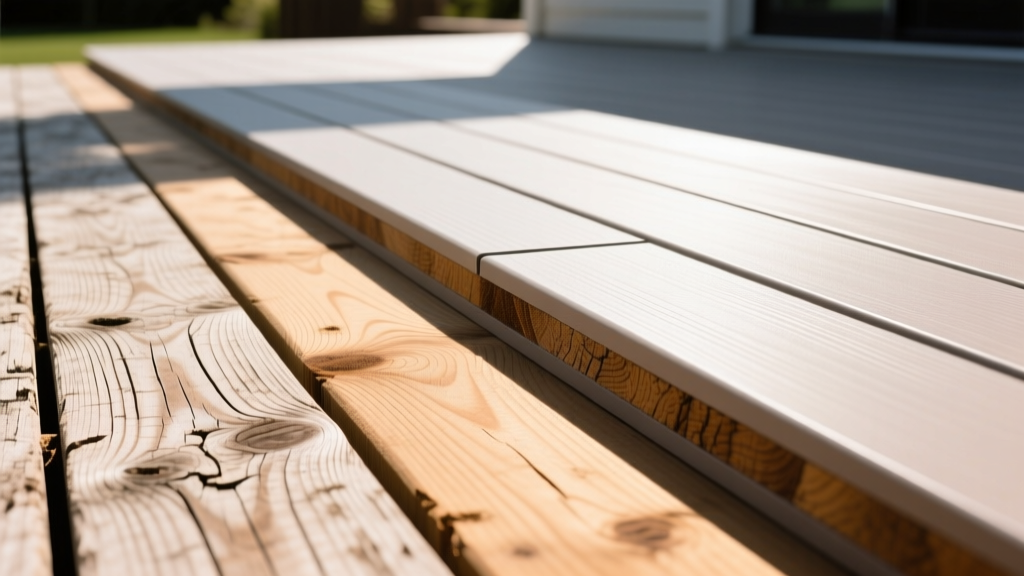
Modern composite decking has largely abandoned the uncapped wood-plastic composite (WPC) formulas of the early 2000s, which were notorious for mold growth and severe swelling. Today's premium composites utilize a co-extrusion process, wrapping a recycled HDPE and wood-flour core in a protective polymer shell. According to the Trex Limited Warranty Guide, premium lines like Trex Transcend or TimberTech Landmark offer 50-year fade and stain warranties, reflecting the durability of the cap layer.
Thermal Expansion and Core Vulnerability
While the Acrylonitrile Styrene Acrylate (ASA) or polyurethane cap is highly resistant to UV degradation and staining, the core remains vulnerable. When installers cut composite boards to fit around posts or fascia, the exposed core is left unprotected. If these cut ends are not sealed with a high-quality end-cap or a copper naphthenate brush-on treatment, moisture wicks into the wood flour core, causing localized swelling that can delaminate the cap from the core.
Furthermore, composite boards expand and contract primarily along their length. Installers must leave a precise 1/8-inch to 3/16-inch gap at butt joints depending on the installation temperature. Failing to account for thermal expansion results in buckled boards that pop off hidden fasteners during peak summer heat.
Cellular PVC Decking: The Premium Lifetime Option
Cellular PVC decking (such as Azek Vintage or TimberTech Advanced PVC) contains zero wood fibers. The core is made from expanded polyvinyl chloride foam, making it entirely impervious to moisture absorption, rot, and termite damage. Because there is no organic material to feed mold or mildew, PVC is the undisputed champion for high-humidity environments, heavy shade, or coastal installations. The USDA Forest Products Laboratory notes that eliminating organic wood components in exterior cladding and decking virtually eliminates biological decay vectors.
Scratch Resistance vs. Heat Retention
The trade-off for PVC's biological immunity is thermal performance. PVC has a higher coefficient of thermal expansion than composite or wood. To prevent bowing, PVC decking strictly requires hidden fastener systems (like Azek's CONCEALoc) that allow for lateral movement, and joist spacing must not exceed 16 inches on center (12 inches on center is recommended for diagonal patterns).
Additionally, darker PVC colors can reach surface temperatures exceeding 150°F in direct midday sun. For south-facing or west-facing decks with zero shade, specifying light-colored PVC (such as coastal gray or sea salt) or switching to capped composite with infrared-reflective pigments is necessary to maintain barefoot comfort.
Hidden Costs: How Substructure Dictates Surface Lifespan
The most common reason a deck fails before the 20-year mark is rarely the decking material itself; it is the substructure. Standard pressure-treated 2x8 or 2x10 joists are highly susceptible to moisture trapping. When water pools on top of the joists beneath the decking boards, it creates a micro-environment that accelerates rot, eventually compromising the fastener holding power.
Applying butyl-based joist flashing tape (e.g., Trex Protect or G-Tape) to the top of all joists and rim boards adds approximately $1.50 to $2.50 per square foot to the total project cost. However, it extends the substructure lifespan from 15 years to 50+ years, ensuring the framing outlasts the surface decking and prevents catastrophic structural failures.
For homeowners investing in premium PVC or aluminum decking with a 50-year expected lifespan, pairing it with traditional wood joists creates a structural mismatch. Upgrading to a structural aluminum framing system (such as Trex Elevations or Fortress Evolution) ensures the entire assembly, from the footings up, shares a unified 50-year lifecycle.
Decision Framework: Matching Material to Climate
Selecting the correct decking material requires aligning the product's physical properties with your specific microclimate. Use the following framework to dictate your material choice:
- Coastal & Salt-Spray Environments: Cellular PVC or Aluminum. Avoid wood and standard composites, as salt accelerates wood fiber degradation and can cause efflorescence or surface pitting on lower-tier composites.
- Heavy Shade & High Humidity (Pacific Northwest, Southeast): Capped Composite or PVC. These materials feature built-in mold inhibitors. Avoid pressure-treated wood, which will remain damp for days and succumb to surface mildew and rot.
- High Sun & Extreme Heat (Southwest, Desert Climates): Tropical Hardwood (Ipe) or light-colored Capped Composite. PVC will soften and expand excessively in sustained 110°F+ ambient heat, while dark composites will retain unbearable surface temperatures.
- Heavy Snow Load & Freeze-Thaw Cycles (Northeast, Midwest): Capped Composite with a textured, slip-resistant surface. The freeze-thaw cycle will rapidly spall and crack uncapped materials, while composite's flexibility handles snow loads better than rigid PVC.
Ultimately, the true lifespan of your deck is determined by the synergy between the surface material, the substructure protection, and the precision of the installation. Specifying a premium board while neglecting joist tape and proper ventilation will invariably result in a premature, costly rebuild.
Written by
Marcus ChenMarcus Chen is a licensed structural engineer (PE) and building materials analyst with over 12 years of experience across residential, commercial, and industrial construction. He holds a Master of Science in Civil Engineering from UC Berkeley and spent six years at Thornton Tomasetti before transitioning to independent consulting and technical writing. Marcus specializes in material selection for seismic-prone regions, concrete reinforcement strategies, and lifecycle cost analysis. His work has been cited by the American Concrete Institute (ACI) and the Structural Engineers Association of California (SEAOC). When he is not on a job site or at his desk, you will find him hiking the Sierra Nevada or restoring a 1920s craftsman bungalow in Oakland, CA.
More from Marcus Chen
View all
Construction Cost
How Much Did the Eiffel Tower Cost to Build?
How much did the Eiffel Tower cost to build in 1889? We adjust for inflation and compare its budget to modern skyscraper construction.
Aug 4, 2026

Fire Resistance
What Is a Fire Resistant Material? Testing & Certification Guide
Discover what is a fire resistant material through ASTM and UL testing. Learn how fire ratings, certifications, and assemblies work in construction.
Aug 4, 2026

Construction Cost
How Much Did the Burj Khalifa Cost to Build?
How much did the Burj Khalifa cost to build? We break down the $1.5B project and extract 5 money-saving strategies for your next build.
Jul 30, 2026