Aluminum Deck Material Guide: Costs, Brands, and Installation
Explore aluminum deck material costs, top brands like LockDry and Wahoo, and installation tips for a waterproof, low-maintenance outdoor living space.
The Economics of Aluminum Deck Material
Aluminum deck material represents the premium tier of outdoor flooring, engineered for scenarios where wood and composite fail: extreme moisture, strict fire codes, and demanding structural spans. While the upfront material cost is significantly higher than traditional options, the lifecycle cost shifts when factoring in zero maintenance, eliminated staining, and a 50-year structural lifespan. According to the Aluminum Association, extruded aluminum decking resists warping, splintering, and rot, making it the definitive choice for marine docks, second-story balconies requiring dry under-deck space, and homes in high-risk fire zones.
- Average Board Cost: $18.00 - $32.00 per square foot
- Weight: ~1.5 to 2.2 lbs per linear foot (approx. 50% lighter than composite)
- Fire Rating: Class A Non-Combustible (WUI Compliant)
- Max Joist Spacing: 24 inches on-center (OC)
Real-World Cost Breakdown: Aluminum vs. Alternatives
When budgeting for a deck build, evaluating the decking board price in isolation leads to inaccurate estimates. Aluminum's superior strength-to-weight ratio allows for wider joist spacing (24" OC compared to 16" OC for composite), which reduces framing lumber costs. Furthermore, interlocking aluminum profiles eliminate the need for separate under-deck drainage membranes.
| Material Type | Board Cost (per sq. ft.) | Framing Spacing | 25-Year Maintenance Cost |
|---|---|---|---|
| Extruded Aluminum | $18.00 - $32.00 | 24" OC | $0.00 |
| Capped Composite | $9.00 - $16.00 | 16" OC | $400 - $800 (cleaning) |
| PVC Decking | $11.00 - $18.00 | 16" OC | $300 - $600 (cleaning) |
| Pressure-Treated Pine | $3.50 - $7.00 | 16" OC | $2,500+ (staining/sealing) |
Top Extruded Aluminum Decking Systems
Not all aluminum decking is manufactured equally. The market is divided into two primary profile categories: watertight interlocking systems and standard gap-spaced boards. Here are the leading manufacturers and their flagship product lines for 2026.
1. LockDry (Watertight Interlocking)
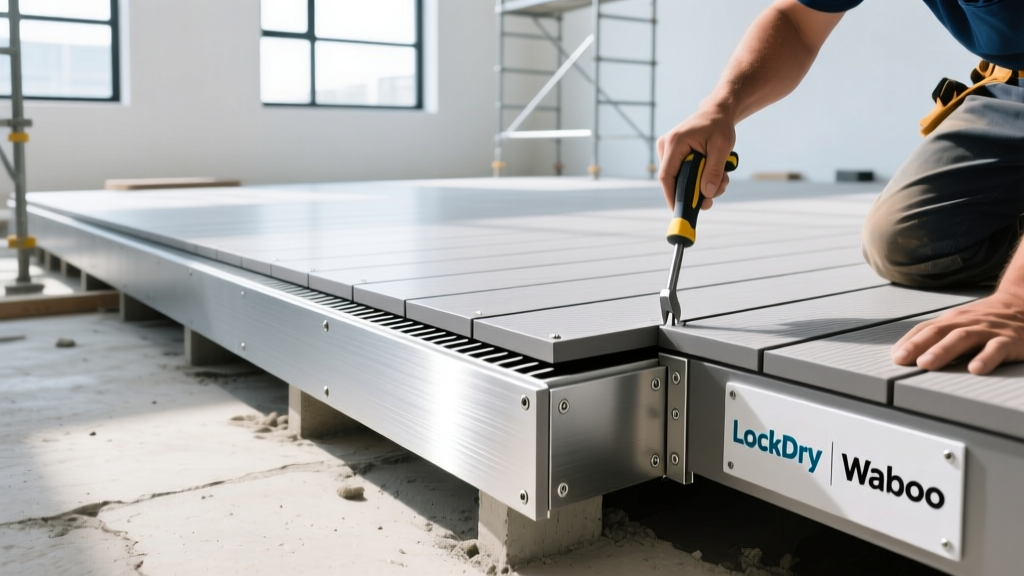
LockDry utilizes a tongue-and-groove interlocking profile that creates a completely waterproof surface. Water is channeled through an integrated sub-channel to the deck's edge or a designated downspout. This makes it the premier choice for second-story balconies where protecting the patio or storage space below is critical. Expect to pay roughly $24 to $28 per square foot for their standard powder-coated finishes.
2. Wahoo Decks - AridDek (T-Lock Drainage)
Wahoo's AridDek features a T-shaped profile that locks together but leaves a small, intentional gap at the surface. Water drains through this gap into a built-in trough beneath the boards, which routes it to the perimeter. This system provides excellent ventilation while keeping the sub-structure completely dry. Pricing averages $19 to $23 per square foot.
3. Craft-Bilt (Wood-Grain Aluminum)
For homeowners who demand the structural benefits of aluminum but reject the industrial aesthetic, Craft-Bilt offers an aluminum board with a deeply embossed wood-grain texture and a multi-tonal powder coat. While it does not feature a built-in drainage channel, it offers superior slip resistance compared to smooth aluminum profiles. Cost: $26 to $32 per square foot.
Structural Framing & Joist Spacing Adjustments
Because extruded aluminum decking possesses a high moment of inertia, it spans greater distances without deflection. The North American Decking and Railing Association (NADRA) guidelines, combined with manufacturer engineering tables, typically permit 24-inch on-center (OC) joist spacing for residential aluminum decks (40 PSF live load).
While 24" OC spacing is permitted, aluminum boards are highly susceptible to lateral twisting if not properly secured at the ends. You must install solid blocking between joists at all board end-joints and at the perimeter rim joist to provide a nailing surface for starter strips and end-terminations.
Mitigating the "Tin Roof" Acoustic Effect
The most common complaint regarding aluminum deck material is acoustic resonance. Heavy rain or hail striking bare aluminum joists and boards can create a loud, metallic drumming effect. To neutralize this, you must decouple the aluminum board from the wooden or steel joist.
- Apply Butyl Joist Tape: Before laying any aluminum boards, apply a high-quality butyl rubber flashing tape (such as Trex Protect or DeckWise WiseWrap) to the top edge of every joist. The rubber acts as an acoustic dampener and prevents direct metal-to-wood contact.
- Use Neoprene Inserts: Some premium aluminum systems include neoprene or EPDM rubber spline inserts that snap into the interlocking joints, further absorbing vibrational energy.
- Insulate the Under-Deck: If the space below is enclosed, installing rigid foam insulation or acoustic batts in the joist bays will absorb sound transmission from above.
Galvanic Corrosion and Fastener Protocols
Aluminum is highly reactive to dissimilar metals in the presence of an electrolyte (water). Using standard galvanized steel or zinc-plated screws will trigger rapid galvanic corrosion, leading to white, powdery oxidation and eventual fastener failure.
- Inland Projects: Use minimum Type 304 stainless steel fasteners or manufacturer-approved aluminum hidden clips.
- Coastal Projects (Within 1 mile of saltwater): You must upgrade to Type 316 marine-grade stainless steel to resist chloride-induced pitting.
- Treated Lumber Contact: If your substructure uses modern ACQ or micronized copper azole (MCA) pressure-treated wood, the copper in the wood will corrode the aluminum. You must use a physical barrier (joist tape) between the treated wood and the aluminum decking.
Thermal Expansion Calculation & Gapping
Aluminum expands and contracts at a rate roughly twice that of wood and half that of PVC. The coefficient of thermal expansion for extruded aluminum is approximately 13 x 10^-6 in/in/°F.
The Practical Rule of Thumb: Allow 1/8 inch of expansion gap for every 10 feet of board length per 100°F temperature swing. If you are installing a 20-foot continuous run in 40°F spring weather, and your region experiences 100°F summers, you must leave a minimum 1/4 inch gap at the butt joints and termination walls. Always consult the specific manufacturer's expansion chart based on the installation day's ambient temperature.
Wildland-Urban Interface (WUI) Compliance
For homes located in fire-prone regions of California, Colorado, and the Pacific Northwest, building codes strictly regulate exterior materials. According to the California Office of the State Fire Marshal, decking in WUI zones must pass rigorous flame spread and ember ignition tests. Aluminum deck material inherently holds a Class A fire rating and is entirely non-combustible. It will not ignite from wind-blown embers, making it one of the few decking materials that guarantees code compliance in high-severity fire zones without requiring specialized fire-retardant chemical treatments.
Expert Verdict: Decision Framework
Determine if aluminum deck material is the correct specification for your project using this matrix:
- You are building a second-story deck and require a 100% waterproof dry-space below without adding a secondary membrane system.
- Your property is located in a designated WUI fire zone where combustible decking is prohibited.
- You are building a marine dock or boat slip where constant submersion and salt spray destroy wood and composite.
- You want to maximize joist spacing to 24" OC to reduce substructure weight on cantilevered balconies.
- You are building a ground-level, single-story deck where under-deck drainage is irrelevant.
- You require a highly realistic, deep-embossed wood aesthetic and prioritize barefoot comfort over structural span capabilities.
- Your project budget is strictly capped below $15 per square foot for the decking surface.
Written by
Elena RodriguezElena Rodriguez is a civil engineer and technical writer specializing in concrete technology, masonry systems, and ASTM/ACI compliance. She earned her B.S. in Civil Engineering from Texas A&M University and spent a decade at a materials testing laboratory, performing over 2,000 concrete compressive strength tests and masonry prism evaluations. Elena is an ACI-certified Field Testing Technician (Grade I) and a member of ASTM Committee C12 on Natural Building Stone. She currently consults on forensic engineering cases involving concrete failures and moisture intrusion. Based in San Antonio, TX, Elena is a proud member of the Society of Women Engineers (SWE) and coaches her daughter's FIRST Robotics team.
More from Elena Rodriguez
View all
Walls & Panels
Cost Analysis: Light Gauge Steel Framing Advantages and Disadvantages
Evaluate light gauge steel framing advantages and disadvantages through a strict cost analysis lens, comparing material, labor, and lifecycle expenses.
Aug 4, 2026

Walls & Panels
Gypsum Board Types: Exact Specifications, Thickness & Dimensions
Compare standard, Type X, and moisture-resistant gypsum board types. Get exact specifications, thicknesses, dimensions, and ASTM standards for your project.
Aug 4, 2026

Fire Resistance
Best Fire-Resistant Outdoor Decking Materials: 2026 Buyer Guide
Discover the best fire-resistant outdoor decking materials for 2026. Compare Class A PVC, aluminum, and hardwood options for WUI compliance and safety.
Aug 4, 2026