Cost to Build a Composite Deck: Complete 2026 Pricing Breakdown
Discover the true cost to build a composite deck in 2026. Get detailed per-square-foot pricing for materials, labor, framing, and hidden extras.

The Baseline: Average Cost to Build a Composite Deck
The national average cost to build a composite deck ranges from $28 to $48 per square foot fully installed. For a standard 16x20-foot deck (320 square feet), homeowners should budget between $8,960 and $15,360. Unlike pressure-treated pine, which requires annual sealing and eventual board replacement, capped composite and PVC decking offer a 25-to-50-year lifespan with near-zero structural maintenance, fundamentally altering the long-term cost of ownership.
Material Cost Matrix: Capped Composite vs. Advanced PVC
Not all composite decking is created equal. The market is split into two primary categories: wood-plastic composite (WPC) with a polymer cap, and advanced capped PVC (polyvinyl chloride) which contains no wood fibers. Understanding this distinction is critical when calculating your material costs.
| Material Type | Material Cost (Per Sq. Ft.) | Key Characteristics | Best Use Case |
|---|---|---|---|
| Entry-Level Capped Composite | $7.50 – $9.50 | Thin polymer cap, scalloped profile, susceptible to heat retention | Shaded areas, budget-conscious flips |
| Premium Capped Composite | $10.50 – $14.00 | Thick 360-degree polymer cap, solid profile, deep wood-grain embossing | Primary residences, high-traffic zones |
| Advanced Capped PVC | $13.50 – $18.50 | Zero wood content, highly stain-resistant, cooler surface temperature | Pool surrounds, coastal homes, full sun |
Labor and Framing: The Hidden Budget Killers
When contractors quote the cost to build a composite deck, framing and labor typically account for 50% to 65% of the total invoice. Composite boards are heavier and more flexible than traditional lumber, requiring tighter joist spacing (12 inches on-center for diagonal patterns, 16 inches on-center for straight lay) compared to the 24-inch spacing sometimes used for thick wood decking.
Pressure-Treated Wood Framing vs. Steel Framing
The most common failure point in composite decking is not the board itself, but the rotting wood substructure beneath it. Upgrading your framing is a critical decision in 2026.
- Pressure-Treated Pine Framing: Adds $9 to $13 per square foot to the project. Requires joist tape (specifically butyl-based, not asphalt-based, to prevent degradation of the composite joist tape adhesive) to protect the cut ends from moisture intrusion.
- Light-Gauge Steel Framing: Adds $15 to $22 per square foot. Systems like Fortress Evolution or Trex Elevations offer a 25-year structural warranty that matches the decking, eliminating the risk of a $10,000 deck surface collapsing on a 15-year-old rotted joist.
Hidden Costs & Upgrades That Inflate Your Quote
Base square-footage estimates rarely include the architectural upgrades and site-prep work that transform a basic platform into a functional outdoor living space. Budget for these specific line items:
- Demolition and Haul-Away: $3.50 – $6.00 per sq. ft. to remove an existing deck and dispose of materials.
- Hidden Fastener Systems: $1.75 – $2.80 per sq. ft. Systems like TigerClaw or Trex Hideaway eliminate face screws, requiring specialized grooved-edge boards and pneumatic installation tools.
- Fascia and Picture-Framing: $12 – $18 per linear foot. Using solid fascia boards to cover the rim joists and creating a picture-frame border requires additional blocking, miter cuts, and specialized riser boards.
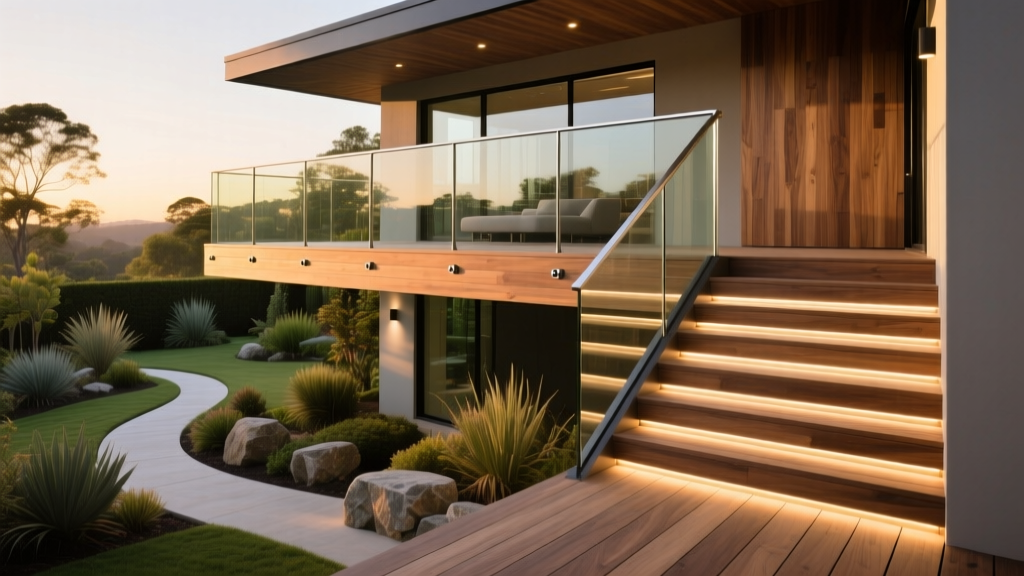
- Integrated Lighting: $85 – $150 per fixture. Low-voltage LED stair riser and post-cap lights require running marine-grade wiring through the framing before the decking is laid.
Brand Pricing Comparison: The Big Three
According to industry data tracked by Angi's composite decking cost guide, the market is dominated by three primary manufacturers. Here is how their flagship lines compare in material-only pricing for 2026:
- Trex: The Enhance Basics line sits at the entry-level ($8.00/sq. ft.), while the premium Transcend Lineage (featuring heat-mitigating technology) commands $14.50/sq. ft.
- TimberTech (by AZEK): Their Prime+ composite is highly competitive at $9.50/sq. ft., but their top-tier Landmark Series (Advanced PVC) pushes the material cost to $17.00/sq. ft.
- Fiberon: The Promenade PVC line offers a lighter-weight, highly slip-resistant surface ideal for docks and pool decks, averaging $15.50/sq. ft.
ROI and Long-Term Cost of Ownership
While the initial cost to build a composite deck is 40% to 60% higher than pressure-treated wood, the return on investment and maintenance savings shift the financial advantage over a 10-year period.
According to the National Association of Realtors' Remodeling Impact Report, a composite deck addition yields an average cost recovery of 68% to 74% at resale. More importantly, eliminating the $400–$600 annual cost of power washing, sanding, and staining a wood deck means the composite premium pays for itself in maintenance savings within 7 to 9 years.
Frequently Asked Questions
Can I install composite decking over my existing wood joists?
Yes, but only if the existing framing passes a rigorous structural inspection. The joists must be free of rot, properly flashed, and spaced at a maximum of 16 inches on-center. You must also apply a high-quality butyl joist tape over the existing wood to prevent moisture from being trapped between the old wood and the new composite boards, which can accelerate wood decay and void the composite manufacturer's warranty.
Does composite decking get too hot to walk on barefoot?
Early-generation composites and dark-colored boards can reach surface temperatures of 140°F+ in direct summer sunlight. For 2026 builds in hot climates, specify boards with heat-reflective polymer caps, such as Trex Transcend Lineage or TimberTech Landmark. These specialized PVC and capped-composite boards utilize infrared-reflective pigments that keep the surface 20°F to 30°F cooler than standard dark composites.
What is the cheapest way to build a composite deck?
To minimize the cost to build a composite deck without sacrificing structural integrity, opt for a ground-level or floating deck design. Eliminating the need for deep concrete footings, tall support posts, and complex stair/stringer engineering can reduce labor and framing costs by 25% to 35%. Additionally, choose a standard straight-lay board pattern rather than a diagonal or herringbone pattern, which increases material waste by 10% to 15% and requires tighter 12-inch joist spacing.
Written by
Marcus ChenMarcus Chen is a licensed structural engineer (PE) and building materials analyst with over 12 years of experience across residential, commercial, and industrial construction. He holds a Master of Science in Civil Engineering from UC Berkeley and spent six years at Thornton Tomasetti before transitioning to independent consulting and technical writing. Marcus specializes in material selection for seismic-prone regions, concrete reinforcement strategies, and lifecycle cost analysis. His work has been cited by the American Concrete Institute (ACI) and the Structural Engineers Association of California (SEAOC). When he is not on a job site or at his desk, you will find him hiking the Sierra Nevada or restoring a 1920s craftsman bungalow in Oakland, CA.
More from Marcus Chen
View all
Construction Cost
How Much Did the Eiffel Tower Cost to Build?
How much did the Eiffel Tower cost to build in 1889? We adjust for inflation and compare its budget to modern skyscraper construction.
Aug 4, 2026

Fire Resistance
What Is a Fire Resistant Material? Testing & Certification Guide
Discover what is a fire resistant material through ASTM and UL testing. Learn how fire ratings, certifications, and assemblies work in construction.
Aug 4, 2026

Construction Cost
How Much Did the Burj Khalifa Cost to Build?
How much did the Burj Khalifa cost to build? We break down the $1.5B project and extract 5 money-saving strategies for your next build.
Jul 30, 2026