How to Choose the Right Deck Lights for Every Outdoor Scenario
Match the right deck lights to your outdoor scenarios. Compare lumens, color temps, and IP ratings for stairs, dining, and security zones.
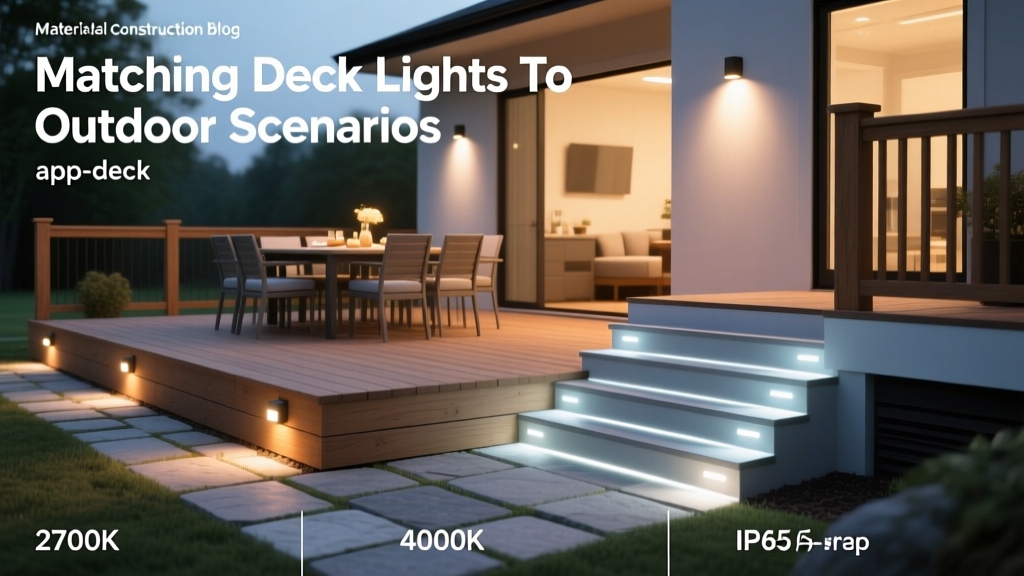
The Scenario-to-Fixture Matching Matrix
Selecting deck lights requires more than picking an attractive fixture; it demands matching the photometric output and physical durability to the specific micro-environment of your outdoor space. A light that works perfectly for a perimeter security zone will cause severe glare if placed over a dining table. Use the matrix below as your foundational decision framework before purchasing any fixtures.
| Scenario / Zone | Optimal Fixture Type | Target Lumens | Color Temp (Kelvin) | Required IP Rating |
|---|---|---|---|---|
| Stair Risers & Pathways | Recessed LED step lights | 15 - 30 lm | 3000K (Crisp White) | IP67 (Submersion) |
| Dining & Lounging Areas | Post cap & railing downlights | 30 - 50 lm | 2700K (Warm White) | IP65 (Water Jets) |
| Perimeter & Security | Flood & directional spotlights | 100+ lm | 4000K (Cool White) | IP65 (Water Jets) |
| Under-Deck Storage / Utility | Strip lights & puck lights | 50 - 80 lm | 4000K (Cool White) | IP67 (Submersion) |
Stair and Transition Safety: Precision Over Power
Stair illumination is the most critical safety application on any deck. The goal is to define the tread edge without blinding the user descending the stairs. Over-lumining stairs is a common contractor error that creates dangerous shadows and glare.
Lumen Output and Beam Angles
For standard 36-inch wide stair treads, a single recessed LED step light producing 15 to 30 lumens is sufficient. The fixture must feature a 120-degree downward beam angle with an integrated louver or frosted polycarbonate lens to shield the LED diode from direct line-of-sight. Brands like Trex DeckLighting and Kichler Landscape offer specific stair-riser models engineered with this exact optical cutoff.
The IP67 Requirement for Horizontal Surfaces
While vertical post lights only require an IP65 rating (protection against low-pressure water jets), stair riser lights and recessed floor lights are horizontal or near-horizontal surfaces where water, melting snow, and ice can pool. You must specify IP67-rated fixtures for these zones. IP67 guarantees the fixture can withstand temporary submersion, preventing the internal driver from shorting out during heavy spring thaws or winter ice dams.
Dining and Lounging Zones: Glare-Free Ambiance
Entertainment zones require a delicate balance: enough light to navigate safely and read a menu, but low enough intensity to maintain a relaxing atmosphere and preserve night vision. According to DarkSky International, excessive outdoor lighting disrupts circadian rhythms and contributes to ecological light pollution.
Expert Rule of Thumb: For seating and dining areas, the light source should never be directly visible from a seated eye level (approximately 42 inches above the deck surface). Always use fixtures with downward-baffled optics.
Color Temperature and Dimming
Stick strictly to 2700K (warm white) for dining zones. This color temperature mimics traditional incandescent bulbs, rendering skin tones and food naturally while promoting melatonin production as the evening progresses. Avoid 3000K or higher in these zones, as the blue-light spectrum feels clinical and harsh in intimate settings. Ensure your low-voltage transformer is compatible with magnetic low-voltage (MLV) or electronic low-voltage (ELV) dimmers, depending on the LED driver type, to allow smooth dimming down to 10% output without flickering.
Perimeter and Security: High-Output Task Lighting
Security lighting serves a distinctly different purpose than ambient deck lighting. Here, the objective is high contrast, shadow reduction, and deterrence. The U.S. Department of Energy recommends using targeted, energy-efficient LEDs with motion sensors rather than leaving high-wattage floodlights on all night.
- Output & Placement: Use directional spotlights producing 100 to 300 lumens mounted at the deck's perimeter or on adjacent structures, angled downward.
- Color Temperature: 4000K (cool white) is ideal for security. The higher blue content increases visual acuity and contrast, making it easier to identify movement and details at the property line.
- Dark Sky Compliance: Ensure security fixtures have a BUG (Backlight, Uplight, Glare) rating of B1-U0-G1 or better. This ensures the light is thrown only onto the target area, not into your neighbor's bedroom window or the night sky.
Power Delivery: 12V Low-Voltage vs. 120V Line-Voltage
Choosing the right power architecture dictates your installation cost, safety profile, and future expandability. For 90% of residential deck applications, 12V low-voltage is the superior choice, but it requires strict adherence to transformer sizing rules.
The 80% Transformer Sizing Rule
Never load a low-voltage transformer to its maximum rated capacity. Operating a 300-watt transformer at 300 watts of LED load will cause overheating, premature failure, and severe voltage drop at the end of the wire run. Always apply the 80% rule: a 300W transformer should carry a maximum of 240W of actual fixture wattage.
Wire Gauge and Voltage Drop
LEDs draw minimal wattage, but the physical distance from the transformer to the furthest fixture dictates your wire gauge. Use the following baseline for 12V systems:
- Up to 50 feet (Total run): 14 AWG direct burial copper wire.
- 50 to 100 feet: 12 AWG direct burial copper wire.
- Over 100 feet: 10 AWG wire, or utilize a multi-tap transformer (switching to 15V or 22V taps at the source to compensate for line loss).
2026 Smart Integration and Control Ecosystems
The outdoor lighting landscape has shifted heavily toward unified smart home ecosystems. When specifying smart deck lights in 2026, prioritize fixtures and controllers that support the Matter protocol over Thread. This mesh-networking standard ensures that your outdoor lights communicate reliably through thick composite decking, masonry retaining walls, and dense foliage without relying on a distant indoor Wi-Fi router.
By integrating a smart low-voltage transformer (such as the WAC Lighting Smart Transformer or Kichler Connect), you can set geofenced automations—triggering stair lights to 100% brightness when your phone enters the driveway, while keeping dining post caps at a dim 20% until you manually adjust them via a wireless outdoor switch. This scenario-based automation maximizes both energy efficiency and the functional utility of your outdoor living space.