Deck Renovation Lifespan Analysis: When to Repair or Replace
Expert deck renovation lifespan analysis comparing substructure vs surface durability, material degradation profiles, and repair versus replacement thresholds.
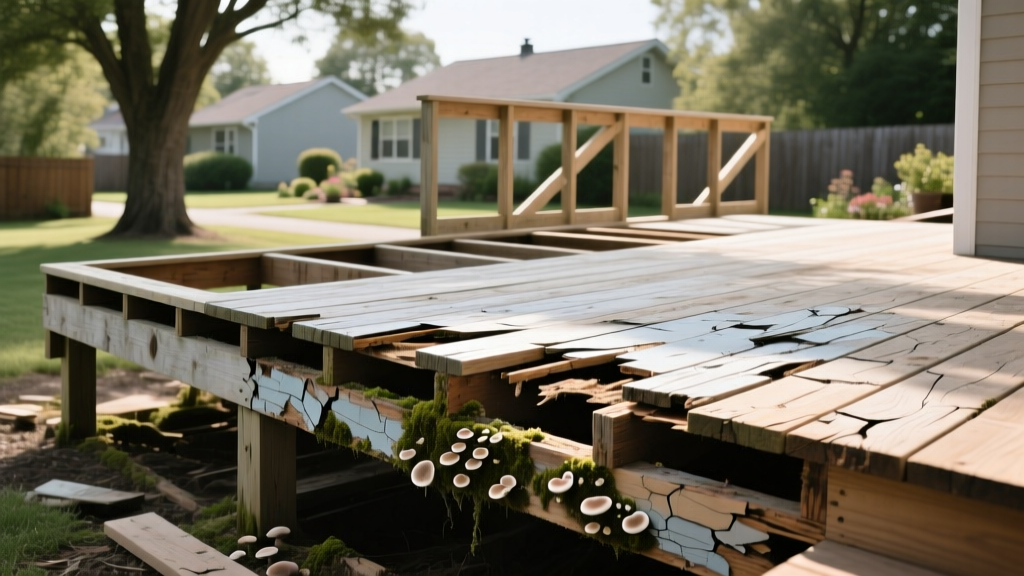
The Substructure vs. Surface Lifespan Paradox
The most critical miscalculation in deck renovation is conflating surface wear with structural degradation. A deck's lifespan is governed by two entirely independent timelines: the decking boards and the structural framing. While surface materials may show cosmetic fatigue within 10 to 15 years, the underlying pressure-treated joists and beams can remain structurally sound for 40 years or more—provided they were properly flashed and ventilated during initial construction.
Conversely, a deck with pristine composite surface boards can be a collapse hazard if the substructure suffers from ledger board rot or fastener corrosion. According to the North American Deck and Railing Association (NADRA), the vast majority of catastrophic deck failures originate at the ledger board connection or the post-to-footing interface, rarely in the decking boards themselves.
| Deck Component | Material Standard | Expected Lifespan | Primary Failure Mode |
|---|---|---|---|
| Surface Boards | Pressure-Treated Pine | 10 - 15 Years | Checking, splintering, cupping, UV degradation |
| Surface Boards | Capped WPC Composite | 25 - 30+ Years | Fading, thermal expansion buckling, edge mold |
| Surface Boards | Mineral-Based / PVC | 30 - 50 Years | Brittle fracture in extreme cold, surface scratching |
| Substructure Framing | UC4A Ground Contact Lumber | 20 - 40 Years | Fungal decay, joist-top moisture rot, fastener shear |
| Hardware & Fasteners | G185 Hot-Dipped Galvanized | 15 - 25 Years | Galvanic corrosion, hydrogen embrittlement |
Diagnostic Framework: The 40% Renovation Threshold
Before initiating a deck renovation, conduct a structural audit using a moisture meter and an awl to probe the joists, ledger, and support posts. The industry standard for determining whether to renovate or completely replace the structure relies on the 40% Cost-Benefit Threshold.
The 40% Rule for Deck Renovation
If the estimated cost to repair the substructure and replace the surface boards exceeds 40% of the cost to build a brand-new deck, full replacement is the mathematically superior choice.
Renovating a compromised substructure to meet current 2026 International Residential Code (IRC) standards often requires retrofitting lateral load connectors, upgrading footing depths below the local frost line, and installing modern joist flashing. These hidden labor costs rapidly erode the savings of a "simple" surface board replacement.
Material-Specific Degradation Profiles
Understanding how specific materials age dictates the scope of your renovation. Different decking technologies fail in fundamentally different ways.
Pressure-Treated Southern Yellow Pine
Wood decking treated with Micronized Copper Azole (MCA) or Alkaline Copper Quaternary (ACQ) resists fungal decay but remains highly susceptible to moisture-driven dimensional changes. The primary failure mode is not rot, but "checking" (longitudinal cracking) and cupping caused by uneven moisture absorption between the exposed top and the shaded bottom of the board. During renovation, if more than 20% of the boards exhibit cupping exceeding 1/8-inch across a 5.5-inch width, selective board replacement will result in a visually mismatched surface. Full surface replacement is required.
Capped Wood-Polymer Composites (WPC)
Modern capped composites, such as Trex Transcend Lineage or TimberTech PRO, utilize a polyethylene or PVC shell over a wood-flour core. These materials do not rot, but they are subject to significant thermal expansion. A 16-foot WPC board can expand and contract up to 1/4-inch across a 100-degree Fahrenheit temperature swing. If a renovation reveals buckled boards or popped hidden fasteners, the root cause is usually inadequate gapping during the original installation (requiring a minimum 3/16-inch side-to-side gap) rather than material defect.
Advanced PVC and Mineral-Based Composites
Materials like TimberTech Advanced PVC or Deckorators Mineral-Based Composite (MBC) eliminate the organic wood flour entirely, rendering them immune to moisture absorption and microbial growth. Their degradation profile is almost exclusively mechanical. MBC decking, in particular, exhibits a near-zero coefficient of thermal expansion. If an MBC deck requires renovation, it is almost certainly due to improper structural framing deflection (joists spaced wider than the manufacturer's 16-inch on-center maximum) rather than material failure.
The Hidden Culprit: Fastener and Hardware Corrosion
A frequent oversight in deck renovation is reusing existing structural hardware or pairing incompatible metals. The American Wood Council's Prescriptive Residential Wood Deck Construction Guide explicitly mandates specific corrosion-resistant coatings based on the preservative chemicals used in the lumber.
- ACQ and Copper Azole Treated Wood: These preservatives are highly corrosive to standard aluminum and basic galvanized steel. You must use hot-dipped galvanized fasteners meeting ASTM A153 Class D (G185 coating thickness) or Type 304/316 stainless steel.
- Coastal and High-Salinity Environments: Within 3,000 feet of a saltwater coast, G185 coatings will degrade rapidly. Type 316 marine-grade stainless steel is mandatory for all structural connectors, lag screws, and joist hangers.
- Galvanic Corrosion: Never mix metal types in a single connection point. Using a stainless steel lag screw through a standard galvanized joist hanger creates a galvanic cell that will rapidly corrode the weaker zinc coating on the hanger.
Ledger Board and Footing Integrity Upgrades
If your renovation involves retaining the existing ledger board attachment to the home, it must be brought up to current structural standards. Older decks frequently relied solely on nails or undersized lag screws to resist gravity loads, and lacked lateral load connectors to prevent the deck from pulling away from the house during seismic events or high winds.
"A properly renovated ledger board requires continuous flashing integrated with the home's weather-resistive barrier, and tension hardware such as the Simpson Strong-Tie DTL2Z to provide a minimum 1,500-pound lateral load resistance per connector."
Furthermore, inspect the post bases. Decks built prior to modern code updates often have 4x4 or 6x6 wooden posts embedded directly in concrete or resting on grade-level concrete pads. This traps moisture at the end-grain, accelerating rot. A proper renovation must sever the rotted post ends and install elevated, code-compliant post bases (like the Simpson Strong-Tie ZMAX series) that maintain a 1-inch air gap between the wood and the concrete footing.
Substructure Preservation: Joist Tape and Flashing
If the structural audit confirms the framing is sound and you are only replacing the surface boards, you must upgrade the substructure's moisture defense. The top edges of wooden joists are highly vulnerable to water pooling, which leads to localized rot and screw pull-through.
During the renovation, apply a high-quality butyl or asphalt-based joist flashing tape (such as G-Tape or Trex Protect) to the top of every joist, beam, and the ledger board before installing the new decking. This creates an impermeable barrier that prevents water infiltration into the fastener holes and extends the lifespan of the wooden substructure by an estimated 10 to 15 years. This minor material investment (typically $0.15 to $0.30 per linear foot) is the single highest-ROI upgrade in any deck renovation project.