Material Selection Guide for Building a Ground-Level Floating Deck
Learn how to select the best framing, decking, and base materials for a ground-level floating deck to prevent rot and ensure structural longevity.
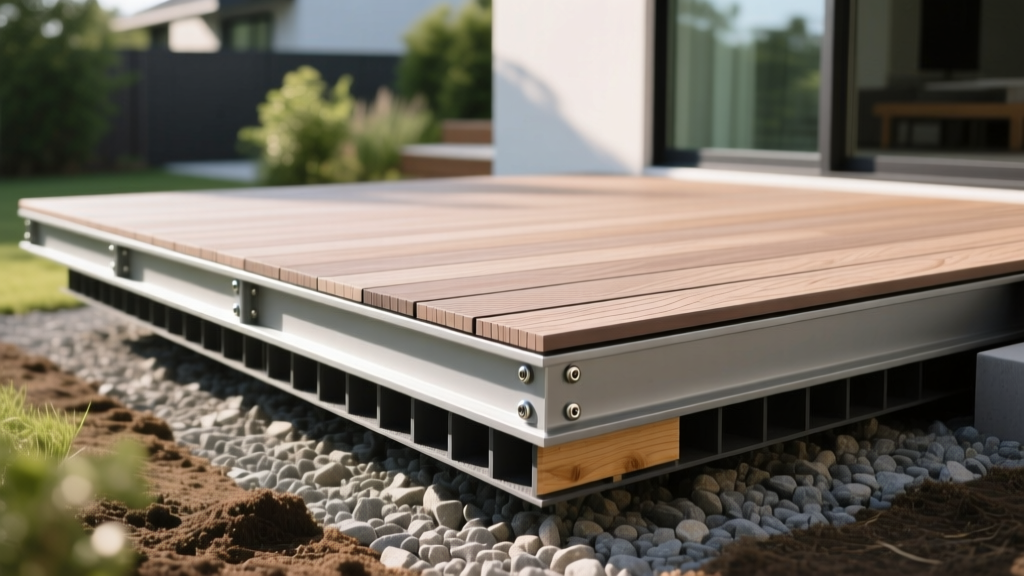
The Structural Reality of Low-Clearance Floating Decks
A floating deck—technically classified as a freestanding deck under the International Residential Code (IRC)—is not attached to a primary structure and rests entirely on independent foundation blocks. Because these structures are typically built low to the ground (often between 6 and 18 inches in height), they create a trapped micro-climate beneath the decking. This severely restricts cross-ventilation and exposes the substructure to high-capillary moisture wicking from the soil.
Selecting materials for a floating deck requires a fundamentally different taxonomy than an elevated, attached deck. Standard above-ground materials will experience premature fungal decay, galvanic corrosion, and composite cupping when subjected to the ground-proximity conditions inherent to floating designs. This guide breaks down the exact material specifications required to ensure a floating deck survives its first decade without structural degradation.
Base Material Taxonomy: Supporting the Float
Under IRC Section R507.3.1, freestanding decks that are less than 200 square feet and do not exceed 30 inches in height above grade are exempt from frost-depth footing requirements. This allows the use of surface-level foundation blocks, but the block material dictates long-term settling.
- Precast Concrete Deck Blocks (Standard): Typically measuring 11x11x8 inches and weighing roughly 48 lbs each. These provide excellent compressive strength but are prone to frost heave in northern climates due to their mass and direct soil contact.
- High-Density Polyethylene (HDPE) Blocks: Products like the TuffBlock weigh under 2 lbs and feature a wider footprint. Their lightweight nature reduces soil compaction and settlement, but they require a strictly leveled base of compacted 3/4-inch crushed angular gravel to prevent lateral shifting.
- Crushed Gravel Pads: For ultra-low floating decks (under 8 inches), skipping blocks entirely and resting pressure-treated joists directly on a 4-inch bed of compacted 3/4-inch crushed stone provides superior drainage and eliminates point-load settlement.
Framing Lumber: Decoding AWPA Use Categories
The most frequent cause of floating deck failure is the use of incorrectly rated pressure-treated lumber. Big-box retailers frequently stock Above-Ground treated lumber for joists, which will rot within 3 to 5 years when placed inches above damp soil.
The American Wood Protection Association (AWPA) classifies treated wood by Use Categories. For a floating deck, you must verify the AWPA Use Category tag on the end of every board:
For builders seeking to eliminate wood rot entirely, light-gauge steel framing (such as Fortress Evolution or Trex Elevate) is an alternative. However, steel C-channels can trap water if not installed with weep holes facing downward, and they require specialized low-profile joist hangers that add 15-20% to the framing hardware budget.
Decking Boards for Low-Clearance Applications
Most composite decking manufacturers explicitly state in their installation guidelines that a minimum of 18 inches of unobstructed under-deck ventilation is required to maintain the warranty. Building a floating deck at 10 inches off the ground violates this requirement, trapping moisture against the bottom of the boards and causing thermal expansion, cupping, and mold growth.
To build a low-clearance floating deck without voiding warranties or causing material failure, you must select from specific material classes:
| Material Type | Moisture Absorption | Low-Clearance Viability | Required Mitigation |
|---|---|---|---|
| Capped Wood-Plastic Composite (WPC) | Low to Moderate | Poor (Under 18 inches) | Must leave perimeter 100% open; no fascia skirting allowed. |
| Capped Polymer (Solid PVC) | Near Zero | Excellent | Can be installed down to 6 inches clearance; skirting permitted if vented. |
| Tropical Hardwood (Ipe, Cumaru) | Very Low | Good | Requires oiling; must use screw-down installation (hidden clips fail when wood swells). |
| Mineral-Based Composite (MBC) | Zero (No organic wood fiber) | Excellent | Highly stable in trapped moisture environments; ideal for ground-level floats. |
If you are committed to using standard capped composite (like Trex Transcend or TimberTech Prime) on a low floating deck, you must consult the manufacturer's specific low-clearance guidelines and ensure the perimeter is entirely open to allow wind to sweep moisture out from under the structure.
Hardware: Preventing Galvanic Corrosion
The high copper content in modern Ground Contact (UC4A) preservatives—specifically Alkaline Copper Quaternary (ACQ) and Copper Azole (CA-C)—acts as a severe corrosive agent to standard metals. Using standard zinc-plated or electro-galvanized screws on a floating deck will result in fastener failure within 24 months.
- Hot-Dipped Galvanized (ASTM A153): You must specify G185 coating (1.85 ounces of zinc per square foot) for all joist hangers, structural screws, and nails. Standard G90 is insufficient for UC4A lumber.
- Stainless Steel (Type 304): The minimum standard for face screws and hidden fasteners in all inland floating deck applications.
- Stainless Steel (Type 316): Mandatory for floating decks built within 10 miles of a saltwater coastline or in areas where de-icing salts are used on adjacent walkways.
2026 Material Cost Breakdown: 12x12 Floating Deck
The following matrix reflects current material costs for a 144-square-foot (12x12) floating deck built 10 inches off the ground, utilizing UC4A framing and solid PVC decking to accommodate the low-clearance ventilation restrictions.
| Component | Material Specification | Quantity | Est. Unit Cost | Total Cost |
|---|---|---|---|---|
| Foundation | TuffBlock HDPE (with 3/4" gravel base) | 21 blocks | $13.50 | $283.50 |
| Framing | 2x8 UC4A Ground Contact Southern Pine | 16 boards | $19.00 | $304.00 |
| Decking | Capped Polymer (Solid PVC) Grooved | 150 sq ft | $12.50/sq ft | $1,875.00 |
| Fasteners | Type 304 SS Hidden Clips & G185 Joist Tape | 1 kit | $210.00 | $210.00 |
| Total Material Cost (Excluding Tax & Delivery) | $2,672.50 | |||
Frequently Asked Questions
Can I use standard composite decking if I add skirting to my floating deck?
No. Adding solid skirting to a low-clearance floating deck traps 100% of the ground moisture beneath the composite boards. Because standard WPC composite contains wood fibers, it will absorb this trapped moisture from the bottom up, leading to severe cupping and edge-swelling. If you must use skirting on a floating deck under 18 inches high, you are restricted to solid PVC, Mineral-Based Composite, or tropical hardwoods, and the skirting itself must incorporate continuous lattice venting.
Do I need to anchor a floating deck to the ground?
While IRC R507.3.1 exempts low-profile freestanding decks from deep frost footings, high-wind zones (such as coastal areas or hurricane-prone regions) require lateral tie-downs. If your local municipality requires wind-uplift resistance, you must swap standard surface deck blocks for auger-style ground anchors driven 36 inches into the soil, attached to the joists via galvanized tension ties.
Should I use joist tape on a floating deck?
Joist tape (butyl or bitumen flashing applied to the top edge of the joists) is highly recommended for floating decks. Because low-clearance decks dry out much slower than elevated decks, water that penetrates the decking gaps and sits on the horizontal surface of the joist will accelerate wood decay. Applying a high-quality butyl joist tape creates an impermeable barrier, significantly extending the lifespan of UC4A framing in damp, low-ventilation environments.