Top Materials for Decks: 2026 Design & Cost Guide
Compare the top materials for decks in 2026. Explore composite, PVC, aluminum, and wood options with real costs, lifespan data, and design tips.
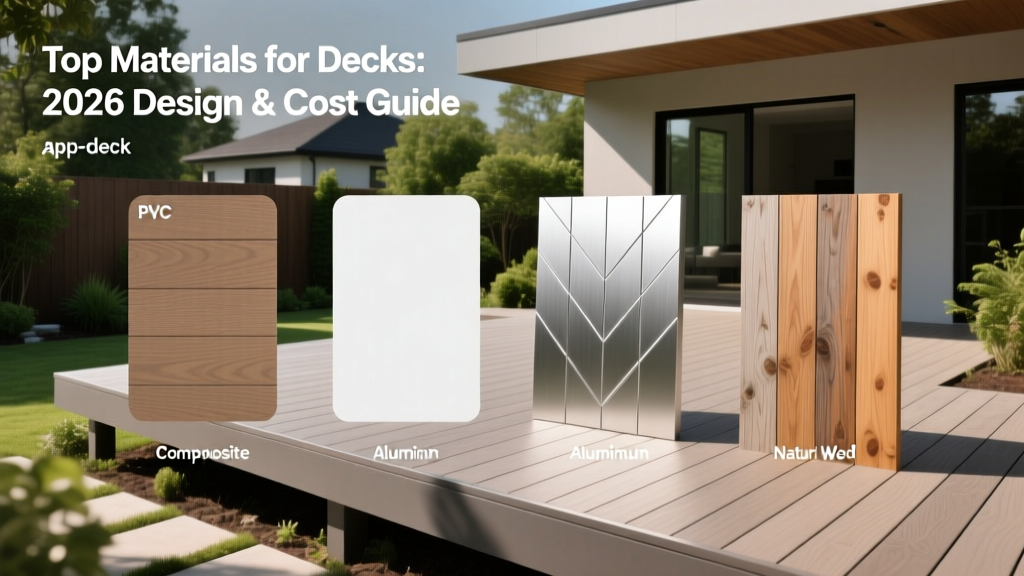
The 2026 Decking Material Landscape: Beyond Basic Wood
Selecting the right materials for decks requires balancing upfront capital expenditure against long-term maintenance, thermal performance, and structural longevity. The 2026 outdoor living market has decisively shifted away from traditional pressure-treated pine decking boards, with capped composites and advanced PVC polymers now commanding over 65% of new premium deck builds. This shift is driven by advanced heat-mitigating technologies, realistic wood-grain embossing, and the rising cost of skilled labor for annual wood staining.
Material Comparison Matrix: Performance vs. Budget
The following matrix breaks down the primary materials for decks based on current 2026 material-only pricing (excluding framing, fasteners, and labor). Costs are calculated per square foot for standard 5.5-inch wide boards.
| Material Type | Material Cost (per sq. ft.) | Expected Lifespan | Heat Retention | Maintenance Profile |
|---|---|---|---|---|
| Pressure-Treated Pine | $3.50 - $5.50 | 10 - 15 years | Moderate | Annual sealing/staining required |
| Capped Composite | $7.00 - $11.00 | 25 - 30 years | High (unless heat-mitigating) | Soap and water wash |
| Advanced PVC (Polymer) | $9.50 - $14.00 | 30 - 50+ years | Low to Moderate | Zero maintenance, stain-proof |
| Marine-Grade Aluminum | $13.00 - $19.00 | 50+ years | Very Low | Rinse off, check fasteners |
Deep Dive: Capped Composite & Advanced PVC
For the majority of residential designs, capped composite and advanced PVC represent the optimal intersection of aesthetics and durability. However, not all polymer boards are engineered equally.
Capped Composite: The Heat Mitigation Breakthrough
Early generation composites suffered from extreme heat absorption, making them unwalkable in direct summer sun. Modern iterations, such as the Trex Transcend Lineage series, utilize specialized heat-mitigating polymer caps and lighter color palettes (like Breeze and Jasper) that reflect UV radiation. These boards can remain up to 40°F cooler than traditional dark composites under peak solar load. When planning a south-facing deck in high-sun climates, specifying heat-mitigating capped composite is non-negotiable for barefoot comfort.
Advanced PVC: The Ultimate Moisture Barrier
If your design involves ground-level decks, heavy shade, or proximity to water features, Advanced PVC (like TimberTech's Landmark Collection or Wolf Serenity) is the superior choice. Because PVC contains no organic wood flour, it is completely impervious to moisture absorption, mold, and mildew.
The Aluminum Alternative: Waterproofing & Fire Resistance
Aluminum decking is a niche but critical material for specific architectural scenarios. Products like Wahoo Decks and LockDry feature interlocking extruded aluminum planks with integrated water-shedding channels.
- Over-Living Spaces: When a deck serves as the roof for a patio or garage below, aluminum's watertight interlocking design eliminates the need for secondary EPDM or TPO membrane roofing systems.
- WUI Zones: In Wildland-Urban Interface (WUI) areas prone to wildfires, aluminum provides a non-combustible decking surface that meets strict California Chapter 7A and ICC-ES fire codes.
Pressure-Treated Wood: Framing vs. Decking
While polymer materials dominate the visible deck surface, pressure-treated (PT) southern yellow pine remains the undisputed king of deck framing. However, specifying the correct retention level is critical for structural survival.
The American Wood Protection Association (AWPA) categorizes treated wood by its intended exposure. For deck framing, you must verify the treatment tags:
- UC3B (Above Ground): Acceptable for joists, beams, and ledger boards that are fully exposed to air and can dry out.
- UC4A (Ground Contact): Required for stair stringers, posts resting on concrete piers, and any joists less than 6 inches from the ground.
- UC4B (Heavy Duty Ground Contact): Mandatory for critical structural posts embedded directly in concrete or soil, and for permanent wood foundations.
Using UC3B lumber for posts or low-clearance joists is a primary cause of premature substructure rot, leading to catastrophic deck failures long before the composite decking boards show any wear.
Design & Planning Decision Framework
Use this logical flow to finalize your material specification based on site conditions and project parameters:
- Evaluate Site Clearance & Moisture: Is the deck less than 18 inches from the ground or over water?
- If Yes: Choose Advanced PVC or Aluminum. Composites may trap moisture underneath and void warranties.
- If No: Proceed to Step 2.
- Assess Solar Exposure: Will the deck face South or West with zero shade?
- If Yes: Specify light-colored, heat-mitigating Capped Composite, PVC, or Aluminum. Avoid standard dark composites and dark-stained wood.
- If No: All materials are viable. Proceed to Step 3.
- Determine Budget & ROI Horizon:
- Flipping/Selling in < 3 years: Pressure-treated wood (lowest upfront cost, high immediate buyer acceptance).
- Forever Home (10+ years): Capped Composite or PVC (higher initial cost, but eliminates $500-$800 annual staining labor and material costs).
Hidden Costs: Framing, Fasteners, and Labor Premiums
When budgeting materials for decks, the decking boards themselves typically account for only 25% to 35% of the total project cost. To avoid budget overruns, factor in these critical secondary materials:
- Joist Tape: Applying butyl flashing tape to the top of PT joists costs roughly $0.40 per linear foot. This prevents water intrusion into the screw holes and doubles the life of the wood substructure.
- Hidden Fastener Systems: Systems like the Trex Universal Fastener or TimberTech Cortex add $1.50 to $2.50 per square foot. Cortex requires plugging the surface holes with matching PVC/Composite plugs, which adds significant labor time compared to clip systems.
- Labor Premiums for Complex Layouts: A standard parallel board layout is the baseline. Specifying a picture-frame border, diagonal installation, or intricate fascia detailing will increase labor costs by 20% to 40%, as it requires additional blocking, precise miter cuts, and higher material waste factors (bump your material order from 10% waste to 15% waste for complex patterns).
By aligning your material selection with the specific micro-climate of your build site and the structural demands of the substructure, you ensure the outdoor space performs flawlessly for decades without requiring continuous capital injections for maintenance.
Written by
Priya KapoorPriya Kapoor is a real estate market analyst and construction economics researcher with expertise in housing affordability, development feasibility, and infrastructure investment. She holds a Master of Regional Planning from Cornell University and previously worked as a senior analyst at CBRE's Investment Properties group, where she modeled returns for $4B in mixed-use development pipelines. Priya now runs an independent research practice advising developers, municipalities, and REITs on construction cost forecasting and market timing. She publishes the quarterly "BuildMat Market Pulse" report tracking material price indices across 12 commodity categories. Based in Austin, TX, Priya serves on the board of Habitat for Humanity Austin and is a marathon runner.
More from Priya Kapoor
View all
Construction Cost
Cost to Build a 1600 Sq Ft Home in 2026: Full Breakdown
Accurate 2026 cost to build a 1600 sq ft home—material, labor, and regional pricing breakdowns included. Plan your budget with real-time estimates.
Aug 11, 2026

Wood & Lumber
Name the Types of Wood for Pressure Treatment and Preservation
Learn how to name the types of wood best suited for pressure treatment. Compare species treatability, chemical retention levels, and 2026 preservation costs.
Aug 4, 2026

Stone & Masonry
Stone Veneer Suppliers Lindenhurst: 2026 Cost Analysis
Analyze 2026 stone veneer costs in Lindenhurst, NY. Compare local supplier pricing, delivery fees, and Suffolk County installation labor rates.
Aug 4, 2026