Best Pool Deck Ideas: Material Taxonomy & Heat Guide
Discover the best pool deck ideas through a material taxonomy lens. Compare heat retention, slip resistance, and costs for concrete, porcelain, and stone.
The Physics of Pool Decking: SRI and DCOF Explained
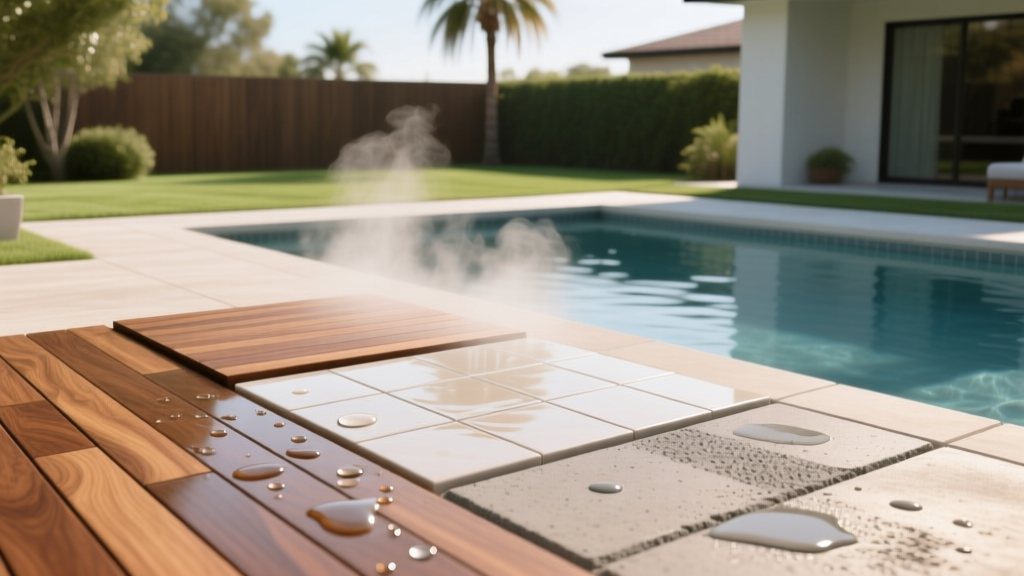
When evaluating pool deck ideas, aesthetic appeal must be subordinate to thermal dynamics and friction physics. Bare human skin sustains contact burns at 125°F (51.6°C). In direct summer sunlight, dark, dense materials easily exceed 150°F. Therefore, material selection hinges on two critical metrics: the Solar Reflectance Index (SRI) and the Dynamic Coefficient of Friction (DCOF).
The Solar Reflectance Index measures a surface's ability to reject solar heat. Standard black asphalt has an SRI of 0, while pure white is 100. For barefoot pool decks in unshaded environments, specify materials with an SRI of 50 or higher. Light-colored travertine typically scores between 60 and 75, whereas dark bluestone scores below 30.
Slip resistance is governed by the ANSI A326.3 standard. While interior wet areas require a minimum DCOF of 0.42, the Association of Pool & Spa Professionals (APSP) and leading exterior tile manufacturers recommend a wet DCOF of 0.60 or greater for pool coping and immediate splash zones to account for algae growth and chemical residues over time.
Material Taxonomy: 5 Core Categories for Poolside Use
To systematically narrow down your options, we categorize poolside materials into five distinct taxonomic groups, each with specific structural properties and failure modes.
1. Poured and Stamped Concrete (The Baseline)
Poured concrete remains the most common pool deck substrate. For poolside applications, a standard trowel finish is unacceptable due to severe slip hazards when wet. You must specify a heavy broom finish, exposed aggregate, or a stamped pattern with deep grout lines.
Failure Mode: The most common error is applying an acrylic film-forming sealer to stamped concrete. Acrylic sealers create a glossy, impermeable plastic layer that drastically reduces the DCOF, turning the deck into an ice rink when wet. Always specify penetrating silane/siloxane sealers, which waterproof the concrete pores without altering the surface friction.
2. Porcelain Pavers (The Modern Standard)
Specifically, 20mm (3/4-inch) thick exterior porcelain pavers have become the premium standard for modern pool decks. Fired at extreme temperatures, porcelain boasts a water absorption rate of less than 0.5%, making it virtually impervious to freeze-thaw cycles and pool chemical staining.
Installation Note: 20mm porcelain can be dry-laid on a compacted gravel base, set in a mortar bed, or installed on adjustable pedestal systems for elevated decks. When dry-laying, ensure joint widths are at least 3mm to 5mm to accommodate thermal expansion and prevent edge-chipping.
3. Natural Stone (Travertine and Bluestone)
Natural stone offers unmatched geological variation, but its porosity dictates its poolside viability.
- Travertine: Highly porous with a naturally high SRI, keeping it exceptionally cool underfoot. However, its calcium carbonate composition makes it vulnerable to etching from muriatic acid and low-pH pool water. It requires annual sealing with a high-quality impregnating sealer.
- Bluestone (Thermal Finish): Extremely dense and durable with a naturally textured, slip-resistant surface. Its major drawback is thermal absorption; dark bluestone will burn bare feet in direct sunlight. Only use bluestone in heavily shaded environments or northern climates.
4. Interlocking Concrete Pavers
Concrete pavers offer modular flexibility and excellent load distribution. For pool decks, select pavers with a tumbled or textured finish rather than smooth-faced varieties. The joints are filled with polymeric sand, which hardens to resist washout and weed growth while allowing for minor subgrade shifting without cracking the deck surface.
5. Capped Composite and PVC Decking
For elevated pools or rooftop pool decks where weight is a constraint, composite decking is viable. However, you must specify fully capped composite or pure PVC boards (such as AZEK or Trex Transcend). Uncapped or first-generation composite boards are highly susceptible to staining from sunscreen oils and chlorine splashes, and they retain significant heat due to their dense wood-plastic core.
Comparative Matrix: Heat Retention vs. Slip Resistance
The following matrix synthesizes the physical properties of the primary material categories to aid in rapid decision-making.
| Material Category | Est. SRI Score | Wet DCOF | Chemical Resistance | Heat Comfort |
|---|---|---|---|---|
| Light Travertine | 60 - 75 | 0.65+ | Low (Etches easily) | Excellent |
| 20mm Porcelain (Light) | 50 - 65 | 0.60 - 0.70 | Exceptional | Very Good |
| Exposed Aggregate Concrete | 35 - 50 | 0.70+ | Good (If sealed) | Moderate |
| Dark Bluestone | 20 - 30 | 0.60 - 0.65 | Excellent | Poor (Burns feet) |
| Capped PVC Decking | 40 - 55 | 0.50 - 0.60 | Very Good | Moderate to Poor |
Chemical Exposure: Saltwater vs. Chlorine Environments
The sanitization method of your pool fundamentally alters the material taxonomy you should select. The Tile Council of North America (TCNA) provides strict guidelines for exterior wet areas exposed to chemical agents.
Saltwater pools generate chlorine via electrolysis, but the ambient salt spray (sodium chloride) is highly corrosive. Avoid using soft, porous limestones or unsealed sandstones, as salt crystallization within the stone's pores will cause spalling and surface flaking within 2 to 3 years. Furthermore, ensure all concealed metal fasteners, joist hangers, and railing bases are marine-grade 316 stainless steel; standard galvanized steel will rust rapidly.
Traditional liquid chlorine or salt systems pose a different threat: oxidation and pH imbalance. High concentrations of splashed chlorine will bleach the pigments in standard interlocking concrete pavers and low-quality stamped concrete over time. If using colored concrete products, specify UV-stable, iron-oxide pigments and apply a penetrating sealer annually to lock out chemical penetration.
Cost Breakdown and Installation Timelines
Budgeting for a pool deck requires analyzing both the raw material cost and the specialized labor required for exterior wet-area installation. The following 2026 pricing estimates reflect fully installed costs (materials, base preparation, and labor) for a standard 600-square-foot pool deck in a moderate-cost region.
- Poured Broom-Finish Concrete: $8 – $14 per sq. ft. | Timeline: 3–5 days (including curing)
- Stamped Concrete: $16 – $26 per sq. ft. | Timeline: 5–7 days
- Interlocking Concrete Pavers: $18 – $30 per sq. ft. | Timeline: 4–6 days
- Light Travertine (Dry-laid): $22 – $35 per sq. ft. | Timeline: 5–8 days
- 20mm Porcelain Pavers (Mortar-set): $28 – $45 per sq. ft. | Timeline: 7–10 days
Hidden Cost Factor: Pool coping—the specialized cap that borders the pool edge—often costs 30% to 50% more per linear foot than the field pavers due to the requirement for bullnose edges, specialized thin-set mortars, and expansion joint foams.
Final Selection Framework
Use this step-by-step decision tree to finalize your material choice based on your specific site conditions.
- Assess Sun Exposure: If the deck receives more than 6 hours of direct, unshaded summer sunlight, immediately eliminate dark bluestone, dark stamped concrete, and uncapped composites. Restrict your taxonomy to light travertine, light-colored porcelain, or exposed aggregate.
- Evaluate Subgrade Stability: If the soil is highly expansive clay or prone to settling, avoid rigid poured concrete, which will inevitably crack. Pivot to flexible, modular systems like interlocking pavers, dry-laid travertine, or pedestal-mounted porcelain.
- Define Maintenance Tolerance: If the homeowner desires a zero-maintenance environment, eliminate natural stone and concrete (which require annual sealing). Specify 20mm porcelain pavers with epoxy grout or tight, sand-filled joints.
- Verify Local Codes: Consult the American National Standards Institute (ANSI) and local municipal codes regarding pool barrier requirements. Some materials, like smooth poured concrete, may require additional slip-resistant coatings to pass local commercial or multi-family residential inspections.
By prioritizing thermal reflectance, friction coefficients, and chemical resilience over superficial color trends, you ensure the pool deck remains safe, comfortable, and structurally sound for decades.