Labor Cost to Build a Deck Calculator: 2026 Complete Guide
Master your 2026 deck budget. Learn how a labor cost to build a deck calculator actually works, with real pricing data, hidden fees, and regional rates.

The Reality Behind Online Deck Labor Calculators
Most online estimating tools rely on a flawed mathematical premise: multiplying total square footage by a flat, blended labor rate. In 2026, this approach yields wildly inaccurate projections. A 400-square-foot ground-level platform deck and a 400-square-foot elevated wraparound deck with dual staircases require vastly different labor hours, even though their square footage is identical. Professional contractors do not bid on square footage alone; they bid on component complexity, site access, and structural engineering requirements.
To accurately use a labor cost to build a deck calculator, you must abandon the 'price per square foot' mindset and adopt a component-based labor breakdown. This guide deconstructs the actual variables that drive installation costs, providing the specific data points needed to audit contractor bids and calibrate your budget.
Generic calculators often output an average labor cost of $25 to $35 per square foot. This metric only applies to simple, ground-level rectangular decks using pressure-treated pine. For elevated composite decks with hidden fasteners, aluminum railings, and complex stair geometry, actual labor costs frequently exceed $55 to $80 per square foot. Always adjust calculator outputs based on the structural complexity matrix below.
Deconstructing the Labor Cost to Build a Deck Calculator
A precise labor estimate divides the project into four distinct phases. Understanding the time and skill required for each phase allows you to manually adjust calculator outputs when your specific project deviates from the 'average' baseline.
Phase 1: Demolition, Site Prep, and Footings
Labor for footings is heavily dependent on soil conditions and local frost line requirements. According to the 2021 International Residential Code (IRC) Chapter 5, deck footings must extend below the frost line, which in northern climates can mean digging 48 to 60 inches deep. Hand-digging these sonotubes in clay-heavy soil adds significant man-hours. Many 2026 builds are shifting toward helical piles, which require specialized hydraulic drive equipment but drastically reduce manual excavation labor.
Phase 2: Framing and Structural Hardware
Framing labor is dictated by joist spacing and structural spans. While traditional wood decking allows for 16-inch on-center (OC) joist spacing, most composite and PVC decking manufacturers (such as Trex and TimberTech) mandate 12-inch OC spacing for standard installations and 8-inch OC for diagonal patterns. This increases the number of joists, blocking, and hanger installations by 33% to 50%, directly scaling up framing labor hours. Furthermore, integrating lateral load connectors (like the Simpson Strong-Tie DTT2Z) to meet modern uplift codes adds precision work that general calculators often overlook.
Phase 3: Decking Installation Complexity
The method of fastening dictates the decking labor multiplier. Face-screwing pressure-treated lumber is the fastest and cheapest labor option. Conversely, installing composite decking with hidden clip systems (e.g., TimberTech CONCEALoc or Trex Hideaway) requires precise spacing, pre-grooved boards, and specialized pneumatic or manual installation tools. Expect hidden fastener systems to increase decking installation labor time by 20% to 30% compared to traditional face-screwing.
Phase 4: Stairs, Railings, and Skirting
Stairs and railings are the primary reasons calculator estimates fail. Stair building is a specialized carpentry skill. Cutting stringers, installing tread covers, and securing risers on composite stairs is notoriously time-consuming. Similarly, installing cable railings requires tensioning equipment and precise post-drilling, whereas standard aluminum baluster systems are relatively modular and fast to assemble.
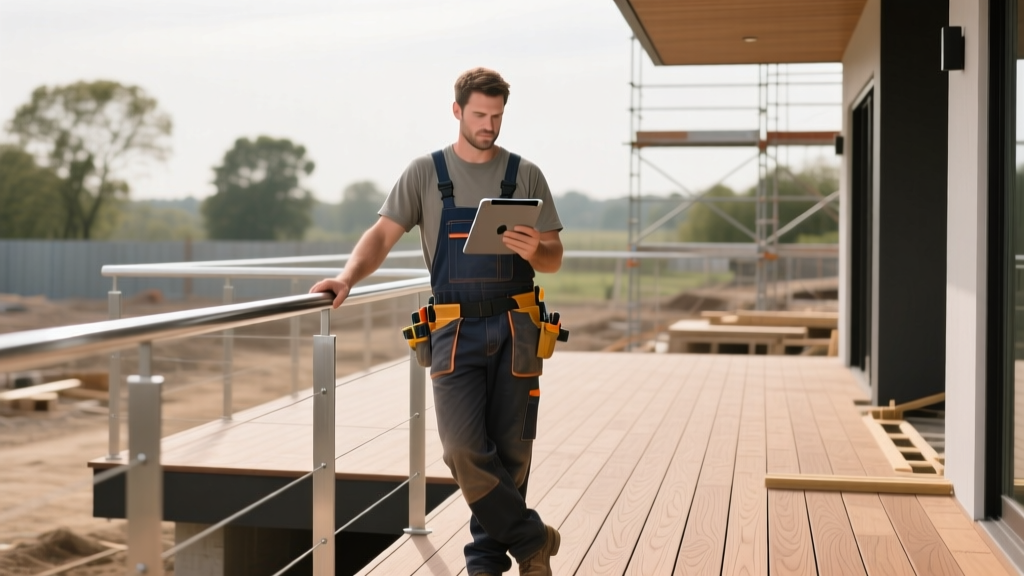
2026 Deck Labor Cost Matrix by Component
Use this matrix to build a bottom-up labor estimate, bypassing the inaccuracies of flat-rate square-foot calculators. These rates reflect national averages for licensed, insured deck builders in 2026.
| Project Component | Unit of Measure | 2026 Avg Labor Cost | Time/Complexity Factor |
|---|---|---|---|
| Old Deck Demolition & Haul | Per Sq. Ft. | $3.50 - $6.00 | Higher if multi-level or concrete footings remain |
| Concrete Sonotube Footings | Per Footing | $120 - $250 | Varies by frost depth and soil type |
| Helical Pile Installation | Per Pile | $180 - $350 | Requires specialized drive equipment |
| Framing (PT Lumber) | Per Sq. Ft. | $12.00 - $18.00 | Increases with multi-level or cantilever designs |
| Wood Decking (Face Screw) | Per Sq. Ft. | $7.00 - $11.00 | Fastest installation method |
| Composite (Hidden Fasteners) | Per Sq. Ft. | $14.00 - $22.00 | Adds 20-30% time for clip alignment and spacing |
| Composite Stairs | Per Tread/Step | $175 - $300 | Includes stringer cutting, fascia, and nosing |
| Aluminum Baluster Railing | Per Linear Ft. | $35 - $60 | Modular systems reduce assembly time |
| Cable Railing System | Per Linear Ft. | $65 - $110 | Requires precision drilling and tensioning |
Regional Labor Multipliers: Where You Build Matters
A calculator calibrated for the national median will fail if you live in a high-cost-of-living (HCOL) area. According to the U.S. Bureau of Labor Statistics (BLS) Occupational Employment and Wage Statistics for Carpenters, mean hourly wages vary drastically by state. To adjust a national calculator output, apply the following regional multipliers to your labor total:
- Pacific & Northeast HCOL (CA, NY, MA, WA): Multiply base labor by 1.35x to 1.60x. Prevailing wage requirements and high union density push framing rates above $95/hour.
- Mountain & Midwest Median (CO, IL, OH, MN): Multiply base labor by 1.00x (baseline). These regions represent the national median for deck construction labor.
- Southern & Rural LCOL (MS, AL, AR, rural TX): Multiply base labor by 0.75x to 0.85x. Lower overhead and non-union labor pools reduce hourly rates, though material shipping costs may offset some savings.
'The biggest mistake homeowners make with online calculators is ignoring site access. If a skid steer or concrete truck cannot reach the backyard, every bag of concrete and every 16-foot joist must be moved by hand or wheelbarrow. This alone can add 15 to 25 hours of unbillable-feeling labor to a project, which contractors will absolutely bake into their final quote.'
— Senior Estimator, Custom Outdoor Living Design
Hidden Labor Variables Most Calculators Miss
When your contractor's bid exceeds the online calculator's estimate by 20% or more, the discrepancy usually stems from these unquantified site-specific variables:
1. Permitting and Engineering Fees
Calculators rarely include the labor hours required to draft CAD plans, submit permit applications, and schedule municipal inspections. In jurisdictions requiring a licensed structural engineer's stamp for elevated decks or heavy snow-load zones, add $800 to $1,500 in professional service labor.
2. Utility Rerouting and Clearance
If your deck footprint overlaps with buried gas lines, irrigation systems, or exterior HVAC units, labor costs will spike. DigSafe or 811 utility marking is mandatory, but physically trenching and rerouting a sprinkler line or moving an AC condenser pad requires specialized subcontractors, adding $500 to $2,000 to the site prep phase.
3. Fascia, Skirting, and Lattice Work
Leaving the underside of a deck open is cheap. Enclosing it with composite fascia boards, vertical skirting, or custom lattice requires extensive cutting, blocking, and ventilation integration. Skirting labor often rivals the cost of installing the deck surface itself, particularly on sloped lots where the skirting height varies from 12 inches to 6 feet.
How to Manually Audit Your Calculator Output
Before signing a contract, use this framework to verify if a contractor's labor quote aligns with market realities:
- Isolate Material Costs: Ask the contractor for a line-item material list. Price the materials yourself at a local lumberyard or via a pro-desk account. Subtract this from the total bid to reveal the true labor and overhead margin.
- Calculate Estimated Man-Hours: Divide the isolated labor cost by the local prevailing carpenter wage (e.g., $65/hour). Does the resulting hour count make logical sense for the project scope? A 400 sq. ft. composite deck typically requires 120 to 180 man-hours. If the math implies 400 hours, the labor rate is inflated.
- Verify Insurance and Licensing Overhead: A contractor charging 15% less than the calculator average is likely operating without general liability insurance or workers' compensation. This shifts the financial risk of job-site accidents directly onto the homeowner.
Frequently Asked Questions
Why does a composite deck cost more in labor than a wood deck?
Composite decking requires tighter joist spacing (12-inch OC vs 16-inch OC), meaning the framing crew spends more time cutting, blocking, and hanging joists. Additionally, hidden fastener systems require meticulous alignment, and composite stair treads require specialized routing and gluing techniques that slow down the finish carpentry phase.
Should I pay a contractor by the hour or by the project?
Always opt for a fixed-price, project-based contract with defined milestone payments. Hourly billing in deck construction removes the incentive for crew efficiency and exposes you to financial risk if the crew encounters unexpected soil conditions or material delays. Fixed pricing forces the contractor to absorb the risk of their own labor miscalculations.
How accurate are free online deck calculators for DIY budgeting?
Free calculators are highly accurate for material volume (board feet, fastener counts, concrete yardage) but notoriously poor for labor estimation. Use them exclusively to generate your materials shopping list, then apply the component-based labor matrix provided in this guide to estimate the cost of hiring professional installation.
Written by
David NakamuraDavid Nakamura is a licensed architect (AIA) and construction technology writer focused on sustainable building methods, mass timber engineering, and high-performance building envelopes. He holds a Master of Architecture from the University of Washington and is a certified Passive House Consultant (CPHC). David spent eight years at the Seattle firm Mithun, where he led the design of three LEED Platinum projects, before founding his own practice specializing in net-zero residential design. He serves on the editorial advisory board of GreenBuilder Magazine and has authored peer-reviewed papers on cross-laminated timber (CLT) connections for the Journal of Structural Engineering. In his spare time, David teaches woodworking at Pratt Fine Arts Center and kayaks the Puget Sound.
More from David Nakamura
View all
Construction Cost
Labor Cost to Build a Deck Per Sq Ft: 2026 Installation Guide
Discover the exact labor cost to build a deck per sq ft in 2026. This installation guide breaks down contractor rates, complexity factors, and hidden fees.
Aug 4, 2026

Construction Cost
How Much Does It Cost to Build a 3 Bedroom House? Financing Guide
Learn exactly how much it costs to build a 3 bedroom house and explore 2026 financing options, construction loan types, and budget frameworks for your build.
Aug 4, 2026

Construction Cost
Cost to Build a Tennis Court: 2026 Guide
How much does it cost to build a tennis court in 2026? Breakdowns for asphalt, concrete, and synthetic surfaces plus fencing and lighting.
Jul 30, 2026