Maintenance Schedules for Common Materials for Building a Deck
Discover exact maintenance schedules, cleaning protocols, and 15-year cost breakdowns for the most popular materials for building a deck.

The True Cost of Deck Ownership: Beyond the Initial Build
When selecting materials for building a deck, homeowners often fixate on the upfront cost per square foot. However, the financial and temporal reality of a deck is defined by its long-term maintenance profile. A pressure-treated pine deck might cost half as much to install as a capped polymer composite deck, but over a 15-year lifecycle, the cumulative cost of cleaning, sanding, and sealing wood frequently eclipses the initial savings. This guide provides exact maintenance protocols, chemical specifications, and structural audit checklists for the primary decking materials used in modern construction.
The Deck Material Maintenance Matrix
The following matrix outlines the baseline maintenance requirements for the three dominant decking categories. Use this as a decision framework before finalizing your material takeoffs.
| Material Category | Annual Routine Tasks | Deep Clean / Prep | Refinish / Seal Interval | Est. 15-Yr Maint Cost (per 500 sq ft) |
|---|---|---|---|---|
| Pressure-Treated Wood | Sweeping, mild wash | Brightener, 80-grit sand | Every 1-3 years | $2,800 - $4,500 |
| Capped Composite | Sweeping, rinse | Sodium percarbonate wash | Never | $400 - $700 |
| Advanced PVC | Sweeping, rinse | Vinegar/water solution | Never | $300 - $500 |
| Marine-Grade Aluminum | Sweeping, hose off | Mild automotive soap | Never | $150 - $250 |
Protocol 1: Pressure-Treated Lumber and Cedar
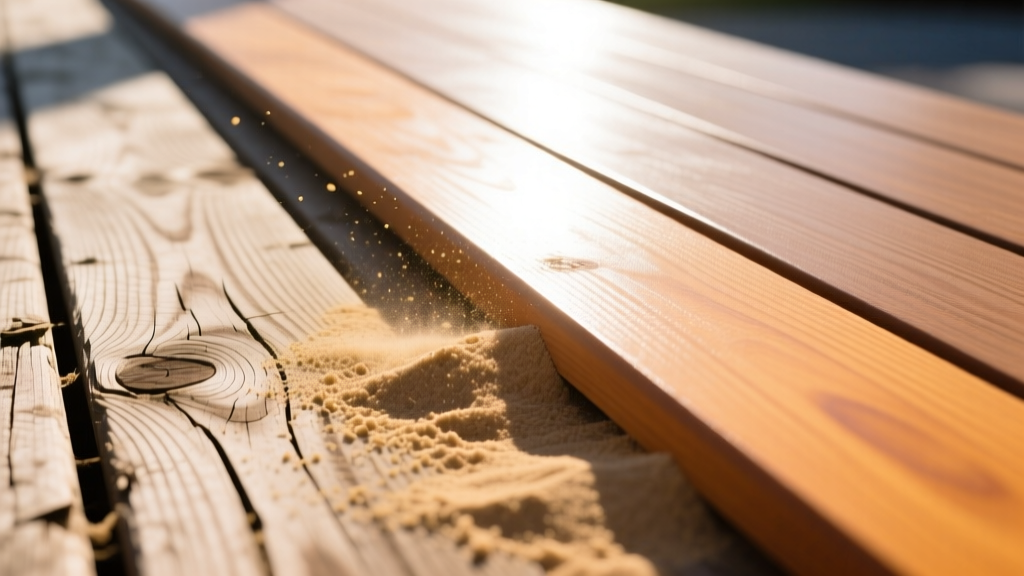
Wood is a hygroscopic material that constantly exchanges moisture with its environment. Without intervention, UV radiation degrades the surface lignin, turning the wood gray, while moisture ingress invites fungal decay. Maintaining wood requires strict adherence to moisture thresholds and chemical compatibility.
The Moisture and Sanding Prerequisites
Never apply a sealer to wood based on a calendar schedule; apply it based on moisture content. Use a pin-type moisture meter to test the deck boards. For oil-based penetrating sealers, the wood must read below 15% moisture content. For water-based acrylics, it must be below 12%. If the wood is too wet, the sealer will trap moisture inside, accelerating rot from the inside out.
Chemical Cleaning: Avoid Chlorine Bleach
Many DIYers use household chlorine bleach (sodium hypochlorite) to kill mold and mildew on wood decks. This is a critical error. Chlorine bleach destroys lignin—the natural glue that holds wood fibers together—leaving the surface fuzzy and structurally compromised. Instead, use oxygen bleach (sodium percarbonate) or cleaners certified by the EPA Safer Choice program. Oxygen bleach lifts organic stains without degrading the wood cellular structure.
Protocol 2: Capped Composite and Advanced PVC
Modern composite boards feature a high-density polyethylene (HDPE) core wrapped in a polymer cap, while advanced PVC boards are solid cellular polyvinyl chloride. Both are marketed as 'low maintenance,' which is accurate, but 'zero maintenance' is a myth. The polymer caps are susceptible to surface scratching, heat retention, and specific chemical reactions.
Managing Tannin Bleed and Mold
While the polymer cap prevents internal rot, organic debris (leaves, pollen, dirt) left on the surface will foster mold growth. Unlike wood, you cannot sand mold out of composite. Furthermore, if your composite deck features wood-flour in the core and the cap gets deeply scratched, moisture can reach the core, causing 'tannin bleed' (dark brown stains leaching to the surface).
- Routine Cleaning: Sweep weekly during pollen season. Use a soft-bristle push broom; stiff bristles will micro-scratch the polymer cap, creating grooves where dirt accumulates.
- Mold Removal: Mix two parts white vinegar to one part water. Apply, let sit for 15 minutes, and scrub with a soft nylon brush. Rinse thoroughly.
- Pressure Washing Limits: Never exceed 3,100 PSI, and keep the fan-tip nozzle at least 8 inches from the surface. High pressure will etch the protective polymer cap, voiding most manufacturer warranties.
Protocol 3: Aluminum Decking Systems
Extruded 6061-T6 marine-grade aluminum decking is the ultimate low-maintenance material. It will not rot, splinter, warp, or harbor insects. However, its maintenance protocol revolves entirely around preventing galvanic corrosion and protecting the powder-coated finish.
To clean powder-coated aluminum, avoid harsh alkaline cleaners, steel wool, or abrasive scouring pads, which will strip the coating. Use a pH-neutral automotive wash soap and a microfiber mitt. Inspect the powder coating annually for deep scratches down to the bare metal; touch up any exposed aluminum immediately with a manufacturer-approved zinc-rich primer and matching topcoat to prevent oxidation.
The 5-Year Structural Deck Audit
Surface maintenance is irrelevant if the substructure fails. The North American Decking and Railing Association (NADRA) emphasizes that structural failures cause the majority of deck collapses. Adhere to this 5-point structural audit every spring, regardless of your decking material. For comprehensive safety standards, refer to the guidelines published by the American Wood Protection Association (AWPA) regarding treated lumber degradation.
- The Ledger Board Connection: Inspect where the deck attaches to the house. Look for lag screws or through-bolts (never just nails). Check for water infiltration behind the ledger flashing, which rots the house rim joist.
- Joist Hangers and Fasteners: Check for rust, missing nails, or bent hangers. Ensure every hole in the joist hanger is filled with the correct structural nail (e.g., 1.5-inch galvanized joist hanger nails, not roofing nails).
- Post Bases and Footings: Inspect the bottom 6 inches of support posts. This is the primary splash zone where USDA Forest Products Laboratory data shows wood decay initiates most rapidly. Ensure posts are elevated above concrete bases via metal standoffs, not buried in concrete.
- Stair Stringers: Check the connection points at the top (stringer hangers) and bottom (concrete pads). Stair stringers are highly prone to splitting at the notches due to dynamic live loads.
- Railing Rigidity: Apply firm lateral pressure to all railing posts. They must not wobble. Check the internal tension ties or structural screws securing the posts to the joists.
Total Cost of Ownership (TCO): A 15-Year Perspective
When evaluating materials for building a deck, calculating the 15-year TCO provides a much clearer financial picture than initial material quotes. Based on 2026 average labor and material rates for a 500-square-foot platform:
Pressure-Treated Pine: Initial build: $8,500. Maintenance (professional cleaning and sealing every 2 years at $450/visit + 2 full board replacements): $4,200. 15-Year TCO: $12,700.
Capped Composite: Initial build: $16,000. Maintenance (annual DIY cleaning supplies + 1 professional deep clean): $800. 15-Year TCO: $16,800.
While composite remains more expensive overall, the gap narrows significantly when factoring in the 40 to 60 hours of physical labor a homeowner will invest in maintaining a wood deck over a decade and a half. Choose wood if you view annual sanding and oiling as a rewarding ritual; choose composite, PVC, or aluminum if you view your deck strictly as a space for living, not working.
Written by
James ThorntonJames Thornton is a construction industry veteran with 25 years of hands-on experience in wood framing, lumber grading, and residential building codes. He started as a framing carpenter in rural Oregon, earned his ICC Residential Building Inspector certification, and eventually became a senior plan reviewer for the City of Portland Bureau of Development Services. James holds a B.S. in Wood Science & Technology from Oregon State University and is a certified lumber grader through the West Coast Lumber Inspection Bureau (WCLIB). He has inspected over 3,000 residential construction sites and authored the city's internal guide on advanced framing techniques (2x6 at 24" O.C.). James lives in Bend, OR, where he builds custom timber-frame cabins and competes in lumberjack sports.
More from James Thornton
View all
Insulation
Best Home Insulation Materials: Complete 2026 Guide
Compare top home insulation materials for 2026. Find R-values, installed costs per square foot, and best uses for fiberglass, spray foam, and mineral wool.
Aug 4, 2026

Sustainable Building
Certify Your Green Building Material for LEED and WELL
Step-by-step guide to certifying a green building material for LEED v5 and WELL v2. Master EPDs, HPDs, and VOC limits for 2026 project specifications.
Aug 4, 2026

Stone & Masonry
Veneer Stacked Stone Panels: Interior Design & Style Showcase
Discover how veneer stacked stone panels transform interiors. Explore modern design profiles, material pairings, and technical installation specs.
Aug 4, 2026