Best Material for Decking: 2026 Cost Breakdown Guide
Compare the top material for decking options in 2026. Get exact per-square-foot costs, lifespan data, and ROI analysis for wood, composite, and PVC.

The True Cost of Decking Materials Beyond the Sticker Price
Selecting the right material for decking requires looking past the initial per-square-foot board price. In 2026, the decking market has stratified into distinct tiers based on polymer technology, preservative treatments, and structural metallurgy. While big-box store tags might show pressure-treated pine at a fraction of the cost of capped composite, the 15-year Total Cost of Ownership (TCO) tells a radically different story when factoring in substructure requirements, hidden fastener systems, and mandatory chemical maintenance.
• Pressure-Treated Pine: $2.50 – $4.00
• Capped Wood-Plastic Composite: $8.50 – $13.50
• Cellular PVC: $12.00 – $16.00
• Marine-Grade Aluminum: $18.00 – $26.00
Pressure-Treated Wood: The Budget Baseline
Pressure-treated Southern Yellow Pine remains the most common material for decking framing and budget-conscious deck surfaces. However, not all treated lumber is equal. For decking boards, you must specify Above Ground (UC3B) preservative retention levels, while any joists or beams contacting concrete or the ground require Ground Contact (UC4A) treatment. Using UC3B lumber for joists resting on concrete piers is a critical failure mode that leads to substructure rot within 5 to 7 years.
Material Specs and Hidden Costs
The initial board cost for #1 Grade 5/4x6 pressure-treated decking sits between $2.50 and $4.00 per square foot. However, wood is hygroscopic. It expands, contracts, cups, and splinters. To mitigate this, you must budget for annual cleaning and bi-annual sealing with a high-quality penetrating oil or semi-transparent stain (such as Armstrong Clark or TWP), which adds $1.50 to $2.50 per square foot in maintenance materials every two years. Furthermore, standard face-screwing is required; hidden fastener systems generally fail on natural wood due to its extreme seasonal dimensional movement.
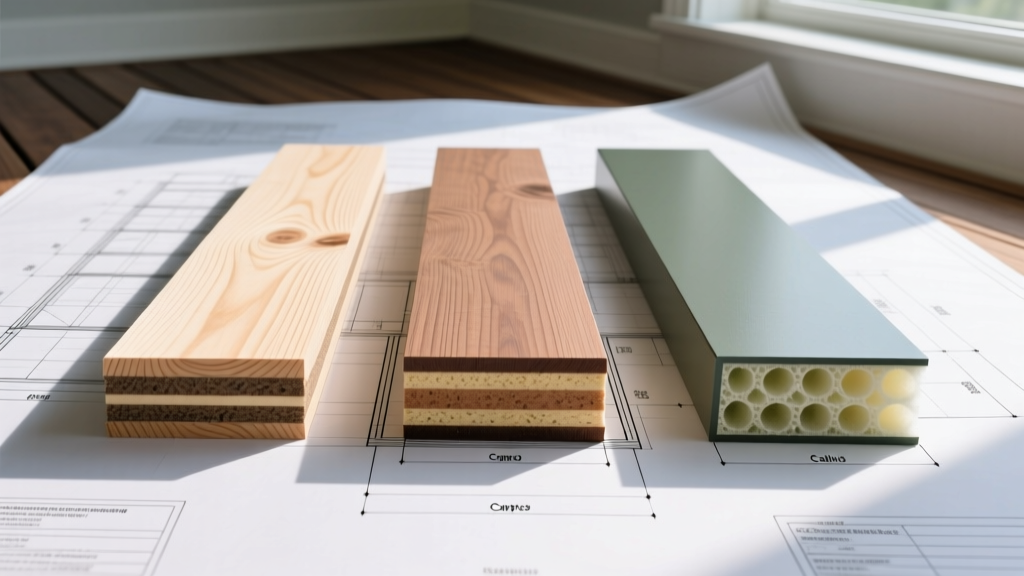
Capped Composite: The Mid-Range Market Leader
Capped wood-plastic composite (WPC) dominates the mid-to-high-tier market. Modern composite boards feature a dense recycled wood-flour core wrapped in a high-density polyethylene (HDPE) or polypropylene cap. This cap provides the UV and stain resistance that early-generation composites lacked.
Product Tiers and Pricing
When evaluating composite as your material for decking, pricing scales with the realism of the surface embossing and the thickness of the polymer cap. Entry-level composites (like Trex Enhance) cost $6.50 to $8.50 per square foot, featuring a thinner cap and repeating grain patterns. Premium lines (such as Trex Transcend Lineage or TimberTech Advanced PVC) range from $11.00 to $14.50 per square foot, offering deep, randomized wood-grain embossing and superior scratch resistance.
Cellular PVC and Aluminum: The Premium Tier
For maximum longevity and zero organic decay, cellular PVC and aluminum represent the pinnacle of decking materials.
Cellular PVC (Polyvinyl Chloride)
Unlike composite, cellular PVC contains no wood fibers. Products like AZEK Landmark are engineered from uniform polymer cells, making them completely impervious to moisture absorption, mold, and termite damage. Cellular PVC costs between $12.00 and $16.00 per square foot. A unique advantage of cellular PVC is its thermoplastic nature; it can be heated and bent to create custom curved deck perimeters and radiused stair treads, a feat impossible with WPC or aluminum.
Marine-Grade Aluminum
Aluminum decking (such as Wahoo Decks or Craft-Bilt) is extruded from 6061-T6 marine-grade aluminum and finished with AAMA 2604 powder coating. At $18.00 to $26.00 per square foot, it is the most expensive material for decking. However, it is non-combustible, making it the only code-compliant surface option for homes in Wildland-Urban Interface (WUI) fire zones in states like California and Colorado. Aluminum decks also feature integrated water-shedding channels, creating a dry space underneath without secondary under-deck drainage systems.
2026 Decking Material Cost and Lifespan Matrix
| Material Type | Initial Board Cost (Per Sq. Ft.) | 15-Year Maintenance Cost | Expected Lifespan | Joist Spacing Requirement |
|---|---|---|---|---|
| Pressure-Treated Pine | $2.50 – $4.00 | $18.00 – $25.00 | 15 – 20 Years | 16' O.C. |
| Capped Composite (WPC) | $8.50 – $13.50 | $2.00 – $4.00 | 25 – 30 Years | 16' O.C. (12' for diagonal) |
| Cellular PVC | $12.00 – $16.00 | $1.50 – $3.00 | 30 – 50 Years | 16' O.C. (12' for diagonal) |
| Extruded Aluminum | $18.00 – $26.00 | $0.00 | 50+ Years | 24' O.C. (High span rating) |
The Hidden 40%: Substructure and Fastener Costs
A common budgeting error is calculating the deck cost based solely on the surface material for decking. The substructure (joists, beams, ledger boards, and blocking) and hardware typically consume 35% to 45% of the total material budget. If you are installing a $14-per-square-foot PVC surface over standard pressure-treated pine joists, the substructure will still only last 20 years, creating a bottleneck that defeats the purpose of a 50-year PVC surface.
Upgrading the Substructure
For premium composite or PVC installations, consider upgrading the framing. Options include:
- Heavy-Duty PT Lumber: Using #1 or Select Structural grade Ground Contact (UC4A) joists instead of standard #2 grade.
- Joist Tape: Applying butyl-based flashing tape (like Trex Protect or G-Tape) to the top edge of all wood joists. This costs roughly $0.75 per linear foot but prevents water infiltration and joist rot at the fastener penetration points.
- Light-Gauge Steel Framing: Systems like Fortress Evolution or Trex Elevations cost 30% to 50% more than wood framing but offer perfectly straight spans, zero warping, and a lifespan that matches premium decking surfaces.
Additionally, hidden fastener systems (such as Trex Hideaway or TimberTech CONCEALoc) add $1.15 to $1.80 per square foot to the project but are mandatory for achieving a clean, screw-free surface on composite and PVC boards.
Calculating Your 15-Year Total Cost of Ownership (TCO)
To make an accurate financial decision, calculate the TCO rather than the day-one invoice. A 400-square-foot deck provides a clear comparative model:
Pressure-Treated Pine: $1,200 (Initial) + $3,600 (Staining/Maintenance over 15 years) = $4,800 Total
Premium Capped Composite: $4,800 (Initial) + $400 (Soap/Water Cleaning) = $5,200 Total
As demonstrated, the 15-year financial gap between wood and composite is negligible, yet the composite deck eliminates dozens of hours of labor-intensive sanding, stripping, and staining. When selecting your material for decking, prioritize the polymer cap thickness, verify the required joist span ratings with your local building department, and ensure your substructure budget aligns with the lifespan of your chosen surface boards.
Written by
Elena RodriguezElena Rodriguez is a civil engineer and technical writer specializing in concrete technology, masonry systems, and ASTM/ACI compliance. She earned her B.S. in Civil Engineering from Texas A&M University and spent a decade at a materials testing laboratory, performing over 2,000 concrete compressive strength tests and masonry prism evaluations. Elena is an ACI-certified Field Testing Technician (Grade I) and a member of ASTM Committee C12 on Natural Building Stone. She currently consults on forensic engineering cases involving concrete failures and moisture intrusion. Based in San Antonio, TX, Elena is a proud member of the Society of Women Engineers (SWE) and coaches her daughter's FIRST Robotics team.
More from Elena Rodriguez
View all
Walls & Panels
Cost Analysis: Light Gauge Steel Framing Advantages and Disadvantages
Evaluate light gauge steel framing advantages and disadvantages through a strict cost analysis lens, comparing material, labor, and lifecycle expenses.
Aug 4, 2026

Walls & Panels
Gypsum Board Types: Exact Specifications, Thickness & Dimensions
Compare standard, Type X, and moisture-resistant gypsum board types. Get exact specifications, thicknesses, dimensions, and ASTM standards for your project.
Aug 4, 2026

Fire Resistance
Best Fire-Resistant Outdoor Decking Materials: 2026 Buyer Guide
Discover the best fire-resistant outdoor decking materials for 2026. Compare Class A PVC, aluminum, and hardwood options for WUI compliance and safety.
Aug 4, 2026