Lifespan of Decking Boards for Decking: Durability Analysis
Compare the lifespan and failure modes of wood, composite, and PVC decking boards for decking. Get real-world durability data and maintenance costs.
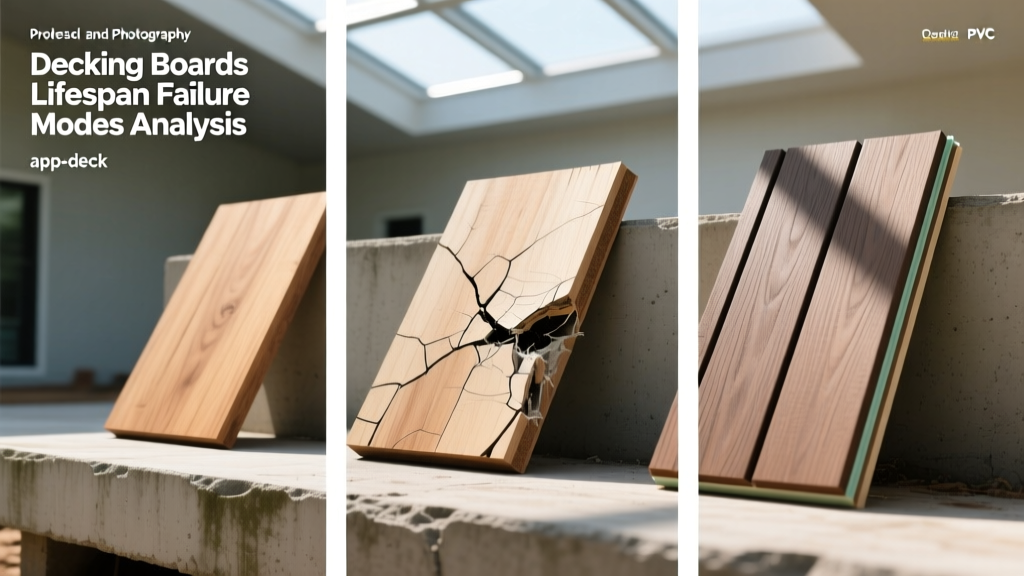
The Reality of Decking Board Lifespans
When selecting decking boards for decking projects, understanding the true lifecycle of the material requires looking past manufacturer warranties and analyzing actual failure modes. The longevity of any deck surface is dictated by its resistance to moisture intrusion, ultraviolet (UV) degradation, thermal movement, and biological decay. According to the National Association of Home Builders (NAHB), the baseline life expectancy of a wood deck is 10 to 15 years, while composite and PVC alternatives push this threshold to 25 years or more. However, these averages mask the specific mechanical and chemical breakdowns that dictate when a deck actually requires replacement.
Material Degradation Timelines
Before analyzing specific materials, it is critical to establish the primary vectors of degradation. All decking boards for decking structures face three universal stressors: hygroscopic expansion (moisture absorption), photodegradation (UV breakdown of lignin or polymers), and mechanical fatigue (load-bearing deflection). The rate at which these stressors compromise the board depends entirely on the material's cellular or extruded structure.
Wood Decking Boards: Rot, Splintering, and UV Decay
Wood remains a popular choice, but its organic nature makes it highly susceptible to environmental fluctuations. The lifespan of wood decking boards ranges from 10 years for standard pressure-treated southern yellow pine to over 40 years for dense tropical hardwoods like Ipe.
Moisture Thresholds and Fungal Decay
The primary failure mode for wood decking is fungal decay, which strictly requires a moisture content (MC) exceeding 20%. The USDA Forest Products Laboratory Wood Handbook notes that keeping wood below this 20% MC threshold effectively halts biological degradation. Pressure-treated lumber relies on copper-based preservatives (like Alkaline Copper Quaternary - ACQ or Copper Azole - CA-C) to resist rot, but these chemicals do not prevent the physical checking, cupping, and splitting caused by repeated wet-dry cycles.
Hardness and Surface Wear
Surface splintering is a direct result of UV radiation breaking down the lignin that binds wood fibers together. Tropical hardwoods resist this due to their extreme density. Ipe, for example, boasts a Janka hardness rating of 3,680 lbf, compared to just 690 lbf for pressure-treated pine. This density prevents physical wear and splintering, but it also makes the wood highly prone to surface checking if not sealed annually with a penetrating UV-inhibiting oil. If left unsealed, even Ipe will turn a silvery-gray within six months as the surface lignin degrades, though its structural integrity remains intact for decades.
Composite and PVC Decking Boards: Hidden Failure Points
Modern composite and PVC decking boards for decking applications are engineered to eliminate rot and splintering, but they introduce new mechanical failure modes related to thermal dynamics and core moisture intrusion.
Thermal Expansion and Fastener Pop
Polymeric materials expand and contract significantly more than wood. The Coefficient of Thermal Expansion (CTE) for cellular PVC is approximately 3.0 x 10^-5 in/in/°F, whereas wood is roughly 0.3 x 10^-5 in/in/°F. This means PVC decking boards move up to ten times more than wood under the same temperature swings. If a 16-foot PVC board experiences a 100°F temperature increase from a cold winter morning to a hot summer afternoon, it can expand by nearly 1/2 inch. If the installer fails to use slotted mounting holes or hidden fastener systems designed to accommodate this movement, the boards will buckle, or the fasteners will pop through the surface.
Warning: The 'Capped' Composite Misconception
Many homeowners assume 'capped' composite decking is entirely waterproof. The polymer cap is only 1/16th to 1/8th of an inch thick and wraps around the top and sides, but the core is typically a porous blend of high-density polyethylene (HDPE) and wood flour. If the cap is deeply scratched, or if the board ends are left unsealed during cutting, moisture wicks into the wood-flour core. This causes the core to swell, leading to a phenomenon known as 'mushrooming' around screw holes and eventual delamination of the polymer cap from the core.
Comparative Lifespan and Lifecycle Cost Matrix
To accurately evaluate decking boards for decking projects, you must calculate the lifecycle cost, which factors in the initial material cost, expected lifespan, and cumulative maintenance expenses over a 30-year period.
| Material Type | Avg. Cost (Per Lin. Ft.) | Expected Lifespan | Primary Failure Mode | 30-Year Maint. Cost |
|---|---|---|---|---|
| Pressure-Treated Pine | $3.50 - $5.00 | 10 - 15 Years | Fungal rot, severe cupping | $1,200 - $1,800 |
| Cedar / Redwood | $6.00 - $9.00 | 15 - 20 Years | Surface checking, UV graying | $900 - $1,400 |
| Tropical Hardwood (Ipe) | $12.00 - $18.00 | 40+ Years | End-grain checking, fading | $600 - $1,000 |
| Capped Composite | $8.00 - $14.00 | 25 - 30 Years | Core swelling, cap scratching | $150 - $300 |
| Cellular PVC | $10.00 - $16.00 | 30 - 50 Years | Thermal expansion, staining | $100 - $200 |
Environmental Stressors and Regional Lifespan Adjustments
The baseline lifespans listed above assume a temperate climate. Regional environmental stressors drastically alter the degradation curve of decking boards for decking structures.
Coastal and Marine Environments
In coastal regions, salt spray and high humidity accelerate both biological and chemical degradation. For wood decking, the American Wood Protection Association (AWPA) mandates higher chemical retention levels (Use Category UC4B or UC4C) for ground contact and severe moisture exposure. For composite and PVC, salt spray does not cause rot, but it can pit the surface of lower-quality polymer caps, creating micro-crevices where dirt and organic matter accumulate, leading to surface mold.
Alpine and High-UV Climates
At higher elevations, UV radiation is significantly more intense. Untreated wood will gray and degrade in a single season. Even high-end capped composites can experience accelerated photodegradation if the manufacturer's UV inhibitors are not rated for high-altitude exposure. In these regions, PVC decking boards often outperform composites because the solid PVC extrusion contains UV stabilizers throughout the entire thickness of the board, not just in a thin surface cap.
Fastener Compatibility and Galvanic Corrosion
A frequently overlooked factor in deck lifespan is the interaction between the decking boards and the fasteners. The preservatives used in modern pressure-treated lumber (ACQ and CA-C) are highly corrosive to standard steel and even electroplated galvanized fasteners. Using incompatible fasteners will result in severe galvanic corrosion, causing the fastener heads to snap off within 3 to 5 years, compromising the structural attachment of the decking boards.
- Hot-Dipped Galvanized (HDG): Must meet ASTM A153 standards. Suitable for standard ACQ and CA-C treated lumber in dry or moderate climates.
- Stainless Steel Type 304: Required for cedar, redwood, and tropical hardwoods to prevent tannin staining and black halos around the fastener heads.
- Stainless Steel Type 316: Mandatory for all decking materials installed within 10 miles of a saltwater coastline to resist chloride-induced pitting corrosion.
Actionable Maintenance Frameworks to Maximize Lifespan
To push decking boards to their absolute maximum lifespan, maintenance must shift from reactive cleaning to proactive moisture management.
- Clear the Joist Tape: Ensure that the butyl flashing tape applied to the top of the wooden joists is intact. This prevents the joists from rotting, which is the actual reason 60% of 'failed' decks require board removal and rebuilding.
- Maintain the 1/8-Inch Gap: For wood and composite boards, strictly maintain a 1/8-inch gap between boards during installation. This allows for hygroscopic expansion and ensures debris does not dam up water on the deck surface.
- Seal End Cuts Immediately: Whenever a wood or composite board is cut on-site, the exposed end-grain or core must be sealed. Use a copper naphthenate end-cut preservative for wood, and a manufacturer-approved end-cap sealant for composites to block the primary entry point for moisture wicking.
By aligning the material selection with the specific environmental stressors and adhering to strict fastener and moisture-management protocols, the functional lifespan of your decking boards can reliably meet or exceed the upper limits of industry expectations.