True Cost to Build a Deck Yourself: DIY Material & Labor Guide
Discover the true cost to build a deck yourself. We break down DIY material prices, hidden fasteners, and tool rentals for a standard 12x16 wood build.
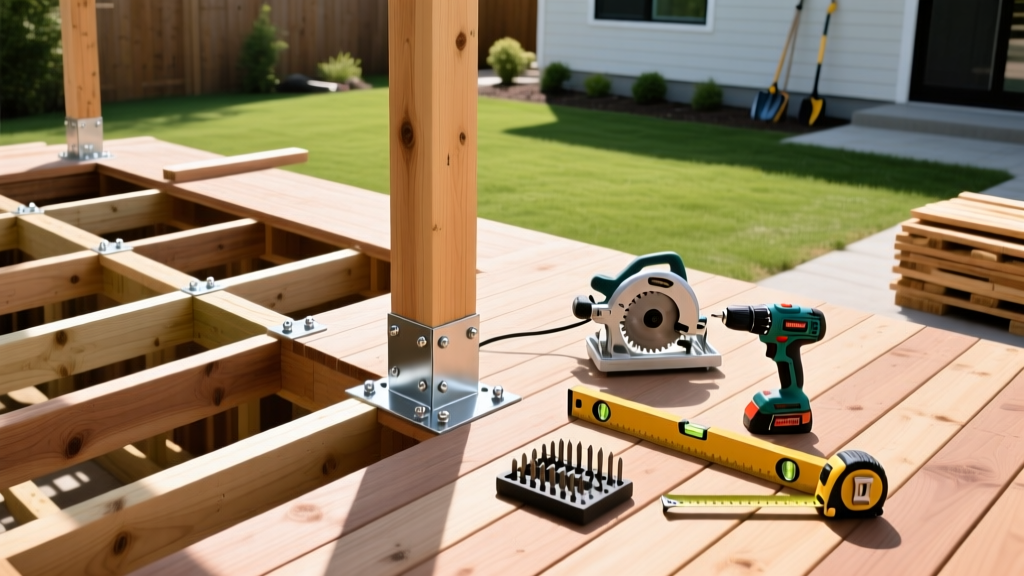
The Baseline: Material Costs for a 12x16 Pressure-Treated Deck
When homeowners search for the cost to build a deck themselves, online calculators often return deceptively low estimates by only calculating the raw decking boards and joists. A realistic DIY budget must account for the entire structural assembly, from below-grade concrete to the final railing cap. For a standard 12x16 foot (192 square feet) ground-level or low-elevation deck using #2 Southern Yellow Pine (SYP) pressure-treated lumber, the baseline material cost sits between $1,800 and $2,400. This assumes a 16-inch on-center (OC) joist spacing and standard 5/4x6 decking boards.
| Component | Material Specification | Estimated Quantity | Approx. Cost |
|---|---|---|---|
| Footings | Sonotubes & 80lb High-Strength Concrete Mix | 6 tubes / 18 bags | $145 |
| Posts & Beams | 6x6 PT Posts & 2x10 PT Double Beams | 6 posts / 8 beams | $280 |
| Joists | 2x8 PT SYP (16" OC) | 14 joists (12' length) | $310 |
| Decking | 5/4x6 PT SYP (Standard Radius Edge) | ~460 linear ft (incl. 10% waste) | $620 |
| Hardware & Fasteners | Joist hangers, structural screws, galvanized nails | Assorted boxes | $190 |
| Stairs & Railings | PT stringers, treads, 4x4 posts, 2x4 balusters | 1 stair run / 30 LF railing | $550 |
| Total Baseline | Raw Materials for 192 Sq. Ft. PT Wood Deck | $2,095 | |
The Hidden DIY Deck Expenses That Destroy Budgets
The gap between a $2,100 DIY deck and a $3,500 DIY deck is almost entirely composed of 'hidden' ancillary materials and tool rentals. Professional contractors absorb these into their overhead; DIYers must buy them at retail.
If your deck attaches to your home, skipping continuous ledger flashing is the leading cause of structural rot and home interior water damage. A roll of 9-inch Grace Vycor or Trex Protect ledger flashing costs roughly $45. Failing to install this behind the house wrap and over the ledger board will cost thousands in rim joist repairs later.
1. Joist Tape and Moisture Barriers
Pressure-treated joists will eventually check, crack, and rot if water pools on their horizontal surfaces. Applying butyl-based joist tape (like Trex Protect or G-Tape) to the top of every joist and beam extends the framing lifespan to match composite decking. For a 12x16 deck, expect to spend $75 to $110 on joist tape.
2. Structural Screws vs. Galvanized Nails
While 16d galvanized nails are cheap, modern building codes and best practices heavily favor structural screws for critical load paths. FastenMaster LedgerLok or Simpson Strong-Tie SDWS structural screws eliminate the need for pre-drilling and prevent the wood splitting that nails often cause near board ends. Budget an extra $85 for a box of 250 structural screws for framing connections.
3. Tool and Equipment Rentals
Unless you already own a comprehensive woodworking setup, you will need to rent equipment. Digging six footing holes below the local frost line by hand is grueling; a two-man gas auger rental costs about $75 per day. A 10-inch sliding compound miter saw rental runs $50 per day. Add $150 to your budget for weekend tool rentals.
Material Tier Comparison: Wood vs. Composite vs. PVC
If you are weighing the cost to build a deck yourself using alternative materials, the framing costs remain largely identical, but the decking and fastener expenses scale dramatically. Below is a 2026 market comparison for a 192 sq. ft. deck surface.
| Material Tier | Example Product | Cost per Linear Ft | Total Decking Cost (192 sq ft) | Fastener Requirement |
|---|---|---|---|---|
| Pressure-Treated Wood | #2 SYP 5/4x6 | $1.35 - $1.60 | $620 - $740 | Standard deck screws ($40) |
| Capped Composite | Trex Transcend Lineage | $6.50 - $8.20 | $2,900 - $3,700 | Hidden clips or color-matched Cortex screws ($180) |
| Cellular PVC | Azek Landmark Series | $9.50 - $12.00 | $4,300 - $5,400 | Hidden fasteners + PVC-specific glue ($220) |
When upgrading to composite or PVC, you must also account for expansion and contraction. Composite boards require specific gapping tools (usually provided in the hidden fastener box) and cannot be face-screwed without specialized plug systems. Furthermore, composite decking is heavier than wood; if you are building a second-story deck, you may need to upgrade your joists from 2x8 to 2x10 or reduce spacing to 12-inch OC, adding $150 to $250 to your framing budget.
Code Compliance and Structural Connectors
Building inspectors do not grade on a curve for DIYers. Your deck must meet the International Residential Code (IRC) and local amendments. The definitive industry standard is the AWC DCA-6 Prescriptive Residential Wood Deck Construction Guide, which outlines exact spans, footing depths, and connection requirements.
Expert Insight: The most common DIY framing failure is inadequate lateral load resistance. If a deck pulls away from the house during a crowded party, it is usually due to missing lateral ties. Code requires hold-down tension devices (like the Simpson DTT2Z) to anchor the deck joists directly to the home's interior floor joists, transferring the lateral load safely into the structure.
Do not skimp on the Simpson Strong-Tie deck connector catalog. Using the correct hanger for your specific joist and beam configuration is mandatory. For example, a standard LUS210-18 hanger is designed for 2x10 joists resting on a 2x10 beam or ledger. Using the wrong hanger, or nailing it with drywall screws instead of 1.5-inch structural joist hanger nails (like the Simpson HN150), will result in an automatic inspection failure.
Frost Line and Footing Depth
Your concrete footings must extend below the local frost line to prevent frost heave from lifting the deck and snapping the ledger board connection. In northern climates, this means digging 42 to 48 inches deep. In southern climates, 12 inches may suffice. Always call your local building department to confirm the exact frost depth before renting an auger. For deep digs in rocky soil, many DIYers pivot to helical deck piers (like Diamond Pier), which are driven into the ground with a rotary hammer and cost about $65 to $90 per pier, eliminating the need for wet concrete and sonotubes entirely.
Frequently Asked Questions on DIY Deck Costs
Is it cheaper to build a deck yourself or hire a contractor?
Building a standard pressure-treated deck yourself saves roughly 50% to 60% compared to hiring a licensed contractor. A 12x16 PT deck costs about $2,500 in DIY materials and rentals, whereas a professional crew will charge $6,500 to $9,000 for the same structure, factoring in labor, overhead, insurance, and profit margins. However, if you make critical structural errors, the cost to remediate them will erase your savings.
How much does it cost to replace an existing deck vs. building new?
If you are tearing down an existing 12x16 deck, factor in $300 to $500 for a heavy-duty demolition trailer rental and dump fees. Demolition typically takes a weekend for two people. You can often reuse the existing concrete footings if they are below the frost line, undamaged, and properly aligned with your new framing plan, saving roughly $150 in concrete and digging labor.
Do I need a permit to build a DIY deck?
In most municipalities, any deck attached to a house, or any freestanding deck over 30 inches above grade, requires a building permit. Permit fees typically range from $75 to $250 depending on the valuation of the project. Skipping the permit risks fines, forced demolition, and severe complications when selling your home, as unpermitted structures must be disclosed or retroactively certified by a structural engineer.
Written by
Priya KapoorPriya Kapoor is a real estate market analyst and construction economics researcher with expertise in housing affordability, development feasibility, and infrastructure investment. She holds a Master of Regional Planning from Cornell University and previously worked as a senior analyst at CBRE's Investment Properties group, where she modeled returns for $4B in mixed-use development pipelines. Priya now runs an independent research practice advising developers, municipalities, and REITs on construction cost forecasting and market timing. She publishes the quarterly "BuildMat Market Pulse" report tracking material price indices across 12 commodity categories. Based in Austin, TX, Priya serves on the board of Habitat for Humanity Austin and is a marathon runner.
More from Priya Kapoor
View all
Construction Cost
Cost to Build a 1600 Sq Ft Home in 2026: Full Breakdown
Accurate 2026 cost to build a 1600 sq ft home—material, labor, and regional pricing breakdowns included. Plan your budget with real-time estimates.
Aug 11, 2026

Wood & Lumber
Name the Types of Wood for Pressure Treatment and Preservation
Learn how to name the types of wood best suited for pressure treatment. Compare species treatability, chemical retention levels, and 2026 preservation costs.
Aug 4, 2026

Stone & Masonry
Stone Veneer Suppliers Lindenhurst: 2026 Cost Analysis
Analyze 2026 stone veneer costs in Lindenhurst, NY. Compare local supplier pricing, delivery fees, and Suffolk County installation labor rates.
Aug 4, 2026