How to Stain a Deck: Premium Brand Lines & Pro Application Guide
Learn how to stain a deck using premium product lines. We deep-dive into Armstrong Clark, TWP 1500, and Defy Extreme with pro application specs.
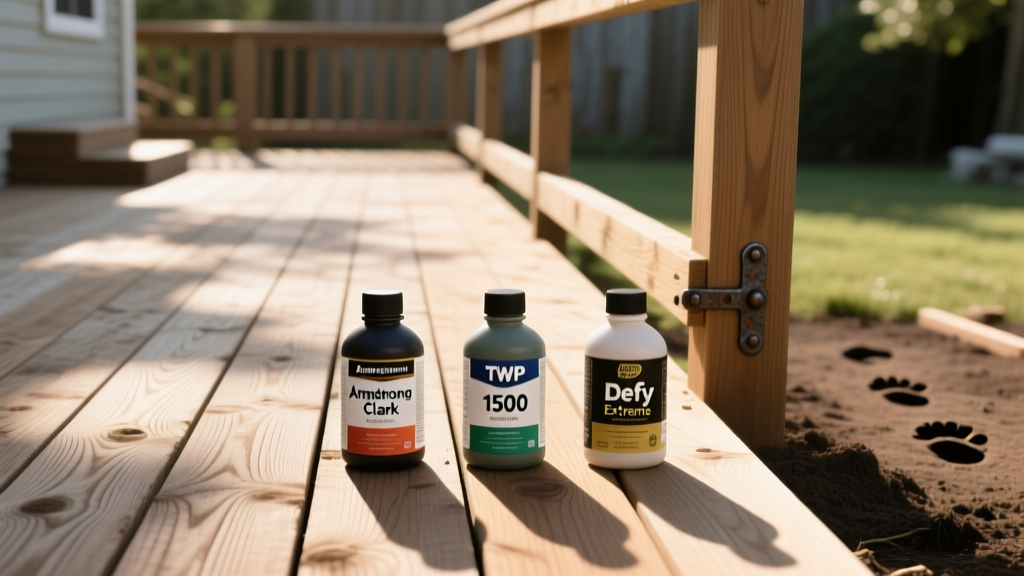
The Chemistry of Premium Deck Stains: Oil vs. Water
When figuring out how to stain a deck for long-term durability, the first decision is the chemical base of the coating. The market is dominated by two distinct categories: penetrating alkyd/oil-based stains and film-forming or penetrating water-based acrylics. According to the USDA Forest Products Laboratory, penetrating finishes are vastly superior for horizontal exterior wood surfaces because they do not form a surface film that can trap moisture and peel.
Brand Deep-Dive: Armstrong Clark (Conditioning Oil Technology)
Armstrong Clark utilizes a proprietary dual-oil formula. The stain contains conditioning oils (non-drying) that penetrate deep into the wood cellular structure to replace natural resins lost to weathering, and drying oils that cure on the surface to lock in the pigment and conditioning agents.
Application Nuances
- Prep Requirement: Wood must be bare and porous. Use an oxalic acid-based brightener (like Restore-A-Deck) to open the grain and neutralize the pH after cleaning.
- Lap Mark Elimination: Because the conditioning oils do not flash-dry, you can stop and start application without creating overlap lap marks—a common failure point for DIYers using standard acrylics.
- Recoat Window: Unlike traditional oils, Armstrong Clark does not require a strict wet-on-wet application. You can apply the second coat days or even weeks later if the first coat absorbs fully.
Brand Deep-Dive: TWP 1500 Series (High-Solids Penetrating Oil)
The TWP 1500 Series is an EPA-compliant, high-solids penetrating oil stain designed to meet strict VOC regulations across all 50 states. It relies on a blend of natural oils and synthetic alkyd resins, fortified with mildewcides and UV-blocking trans-oxide pigments.
The 'Wet-on-Wet' Mandate
For new or heavily stripped wood, TWP requires a specific application protocol. The first coat acts as a primer, penetrating the empty wood cells. The second coat must be applied wet-on-wet (within 20 to 60 minutes of the first coat) to ensure the surface polymers cross-link properly. Applying the second coat after the first has dried will result in a sticky, tacky surface that attracts dirt and fails prematurely.
Brand Deep-Dive: Defy Extreme (Water-Based Zinc Nano-Technology)
Defy Extreme represents the pinnacle of modern water-based stain technology. Instead of relying solely on chemical UV absorbers (which degrade over time), Defy suspends zinc oxide nano-particles in a water-based acrylic resin. These particles physically scatter and reflect UV radiation, much like sunscreen, resulting in significantly longer color retention.
Step-by-Step: How to Stain a Deck Based on Your Chosen Line
Proper preparation accounts for 80% of a stain's lifespan. Penn State Extension emphasizes that applying stain over mildew, mill glaze, or oxidized wood fibers guarantees premature failure.
- Moisture Testing: Use a pinless moisture meter (e.g., Wagner MMC220) to verify the wood moisture content is below 15%. Applying penetrating oil to damp wood traps moisture, causing rot.
- Alkaline Cleaning: Apply a sodium percarbonate-based cleaner to remove gray oxidized wood fibers and dirt. Agitate with a stiff bristle broom.
- Acid Brightening: Apply an oxalic acid brightener to neutralize the alkaline cleaner, lower the wood pH to around 5.5, and open the cellular pores for maximum stain penetration.
- Rinse and Dry: Rinse thoroughly with a pressure washer set to a maximum of 800 PSI with a 40-degree fan tip. Allow 48 hours of dry time.
- Application: Apply the stain using an airless sprayer (0.013 to 0.015 tip) followed immediately by back-brushing with a synthetic or natural bristle block to force the stain into the pores and eliminate puddles.
Cost & Coverage Matrix: 2026 Pricing Expectations
Budgeting for a premium deck restoration requires understanding the true coverage rates, which vary heavily based on wood porosity and the age of the deck.
| Brand & Product Line | Chemistry | 2026 Cost (Per Gallon) | Coverage (Sq Ft/Gal) | Coats Required |
|---|---|---|---|---|
| Armstrong Clark | Dual-Oil (Conditioning/Drying) | $82 - $88 | 150 - 200 | 1 to 2 |
| TWP 1500 Series | High-Solids Penetrating Oil | $72 - $78 | 150 - 200 (1st coat) | 2 (Wet-on-Wet) |
| Defy Extreme | Water-Based Zinc Acrylic | $80 - $85 | 150 - 200 | 2 (Wet-on-Wet) |
Common Failure Modes and Troubleshooting
Failure Mode 1: Surface Tackiness and Dirt Accumulation
Cause: Over-application of oil-based stains. The wood cells reach saturation, leaving excess resin on the surface that never cures.
The Fix: Within 30 minutes of application, wipe down any pooling or shiny areas with clean, lint-free cotton rags soaked in mineral spirits. Never leave puddles on horizontal surfaces.
Failure Mode 2: Black Mildew Spotting Under the Stain
Cause: Staining over wood that was not properly treated with a mildewcide, or applying stain while the wood moisture content was above 18%.
The Fix: The stain must be stripped entirely using a sodium hydroxide-based stripper, followed by a heavy application of oxalic acid to kill the spores, before restaining.
Failure Mode 3: Flaking and Peeling (Water-Based Stains)
Cause: Applying water-based acrylics to 'mill glaze' (planer's glaze) on new pressure-treated lumber, or applying in direct, high-heat sunlight causing the acrylic to flash-dry before penetration.
The Fix: New pressure-treated wood must weather for 3 to 6 months and be sanded with 60-grit paper or aggressively brightened to break the mill glaze before any water-based product is applied.