Cost Per SF to Build a Deck: 2026 Material Comparison Guide
Compare the true cost per SF to build a deck. We break down installed pricing, maintenance, and ROI for wood, composite, PVC, and aluminum options.
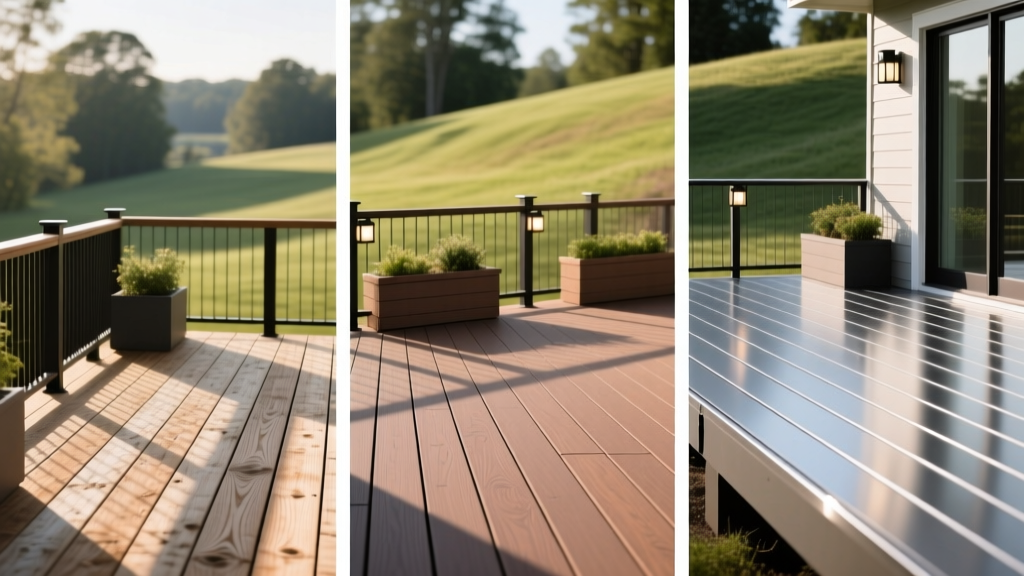
The True Cost Per SF to Build a Deck: Beyond the Board Price
When calculating the cost per sf to build a deck in 2026, homeowners often fixate on the sticker price of the decking boards. This is a critical miscalculation. The decking surface typically accounts for only 30% to 40% of the total project budget. Framing, footings, labor, and long-term maintenance drastically alter the real financial footprint of your outdoor space.
According to Angi's comprehensive deck cost data, the national average for a professionally installed deck ranges from $18 to $65 per square foot. However, this broad average obscures the massive variances between material categories. Below, we dissect the exact cost per sf to build a deck across the four primary material classes, factoring in installation realities and 20-year lifecycle costs.
Material Comparison Matrix: Wood vs. Composite vs. PVC vs. Aluminum
The following matrix breaks down the financial reality of each material. Note that "Total Installed Cost" includes standard pressure-treated wood framing, concrete footings, and basic labor, but excludes premium upgrades like steel framing or helical piles.
| Material Type | Board Cost / SF | Total Installed Cost / SF | 20-Year Maintenance Cost / SF | Expected Lifespan |
|---|---|---|---|---|
| Pressure-Treated Wood | $3 - $6 | $18 - $28 | $25 - $35 | 15 - 20 Years |
| Capped Composite | $7 - $12 | $30 - $48 | $2 - $5 | 25 - 30 Years |
| Advanced PVC | $11 - $16 | $40 - $58 | $1 - $3 | 30 - 50 Years |
| Aluminum | $18 - $25 | $65 - $90 | $0 - $2 | 50+ Years |
Pressure-Treated Wood: The Budget Baseline
Pressure-treated lumber remains the most common decking material due to its low upfront cost. In 2026, #2 grade Southern Yellow Pine treated with Copper Azole (CA-C) or Alkaline Copper Quaternary (ACQ) costs between $3 and $6 per square foot for the boards alone.
However, the hidden cost of wood lies in its chemical treatment and maintenance requirements. ACQ-treated wood is highly corrosive to standard aluminum and galvanized fasteners. You must use hot-dipped galvanized or stainless steel hardware, which adds roughly $0.40 to $0.60 per square foot to your hardware budget. Furthermore, wood requires annual cleaning and bi-annual sealing. Over a 20-year period, the cumulative cost of stains, sealants, and labor to maintain a wood deck often exceeds the original cost of building it, pushing the true lifecycle cost per sf to build a deck well past $45.
Capped Composite Decking: The Mid-Range Sweet Spot
Capped composite boards blend wood flour with recycled high-density polyethylene (HDPE), wrapped in a protective polymer shell. Premium lines like Trex Transcend Lineage or TimberTech Legacy dominate this space, with material costs ranging from $7 to $12 per square foot.
The critical differentiator in composite pricing is the cap thickness and coverage. Budget composites feature a 3-sided cap (leaving the bottom exposed to moisture wicking), while premium options utilize a full 4-sided polymer cap. When calculating your cost per sf to build a deck with composite, factor in the cost of specialized hidden fastener systems (like the Trex Hideaway clips), which add approximately $1.25 per square foot but provide a clean, screw-free surface. While composite eliminates the need for sanding and staining, it still requires seasonal washing to prevent mold spores from taking root in micro-scratches on the polymer cap.
Advanced PVC Decking: Premium Pricing for Zero Wood Content
Advanced PVC (Polyvinyl Chloride) decking contains zero organic wood fibers, making it entirely impervious to rot, termites, and moisture absorption. Leading products like AZEK Landmark utilize proprietary Alloy Armour Technology to resist fading and staining, commanding a premium material price of $11 to $16 per square foot.
PVC expands and contracts significantly more than wood or composite. The thermal expansion rate is roughly 1/8 inch per 10 feet for every 40-degree temperature swing. Installers must leave precise 3/16-inch gaps at end-joints and use specialized slotted fasteners to allow the boards to slide without buckling. Failure to account for this will void the manufacturer warranty and result in warped boards.
Because PVC is lighter and more flexible than composite, it requires stricter joist spacing—typically 12 inches on-center compared to the 16 inches on-center standard for wood and composite. This tighter framing requirement increases your substructure lumber costs by approximately 15%, directly impacting your overall cost per sf to build a deck.
Aluminum Decking: The Niche High-End Option
Aluminum decking, such as Wahoo Decks Ariddek or Nexan Building Products, is engineered from marine-grade 6061-T6 extruded aluminum. It is the only decking material that is entirely non-combustible, making it mandatory for homes in severe Wildland-Urban Interface (WUI) fire zones in California and Colorado. Material costs range from $18 to $25 per square foot.
Aluminum decking features an interlocking tongue-and-groove design that creates a watertight seal, allowing you to capture rainwater and route it via integrated gutters to keep the space below completely dry. While the upfront cost per sf to build a deck with aluminum is the highest on the market, it requires virtually zero maintenance beyond an occasional hose-down, and it will never splinter, rot, or warp.
Hidden Cost Multipliers That Skew Your Cost Per SF
Focusing solely on decking boards will ruin your budget. The following substructure and site variables drastically alter the final price tag:
- Framing Upgrades: Standard pressure-treated SPF (Spruce-Pine-Fir) framing lasts 15-20 years. Upgrading to light-gauge steel framing (like Fortress Evolution) adds $4 to $7 per square foot but ensures the substructure outlasts premium PVC or aluminum decking, which can last 50 years.
- Footings and Site Prep: Traditional poured concrete Sonotubes cost $80 to $120 per pier. If you are building on sloped terrain or poor soil, switching to helical piles (such as Diamond Pier) costs $150 to $250 per pier but eliminates curing time and requires no heavy excavation equipment.
- Railing Systems: Railings are priced per linear foot, not square foot. A standard pressure-treated wood railing with aluminum balusters costs $35 to $50 per linear foot. Upgrading to a composite railing with glass infill can easily push this cost to $120 to $180 per linear foot, heavily inflating the overall project average.
Decision Framework: Which Material Fits Your ROI Timeline?
According to Remodeling Magazine's Cost vs. Value Report, a well-built deck recoups a significant portion of its cost at resale, but the material you choose should align with your timeline. Use this framework to finalize your decision:
- If you plan to sell in 1 to 5 years: Build with Pressure-Treated Wood. The low upfront cost per sf to build a deck maximizes your immediate ROI upon resale. Buyers expect a functional wood deck, and you will not recoup the premium of PVC or aluminum in a short window.
- If you plan to stay for 10 to 15 years: Choose Capped Composite. The crossover point where composite becomes cheaper than wood (factoring in maintenance) occurs around year 7. You gain a decade of low-maintenance enjoyment before selling.
- If you are building a forever home or waterfront property: Invest in Advanced PVC or Aluminum. As noted by the North American Decking and Railing Association (NADRA), moisture and ground contact are the primary enemies of deck longevity. PVC and aluminum eliminate organic decay entirely, providing a permanent outdoor living space that outlasts the mortgage.
By evaluating the total installed cost alongside the 20-year maintenance burden, you can accurately determine the true cost per sf to build a deck and select a material that aligns with both your immediate budget and your long-term property goals.
Written by
Elena RodriguezElena Rodriguez is a civil engineer and technical writer specializing in concrete technology, masonry systems, and ASTM/ACI compliance. She earned her B.S. in Civil Engineering from Texas A&M University and spent a decade at a materials testing laboratory, performing over 2,000 concrete compressive strength tests and masonry prism evaluations. Elena is an ACI-certified Field Testing Technician (Grade I) and a member of ASTM Committee C12 on Natural Building Stone. She currently consults on forensic engineering cases involving concrete failures and moisture intrusion. Based in San Antonio, TX, Elena is a proud member of the Society of Women Engineers (SWE) and coaches her daughter's FIRST Robotics team.
More from Elena Rodriguez
View all
Walls & Panels
Cost Analysis: Light Gauge Steel Framing Advantages and Disadvantages
Evaluate light gauge steel framing advantages and disadvantages through a strict cost analysis lens, comparing material, labor, and lifecycle expenses.
Aug 4, 2026

Walls & Panels
Gypsum Board Types: Exact Specifications, Thickness & Dimensions
Compare standard, Type X, and moisture-resistant gypsum board types. Get exact specifications, thicknesses, dimensions, and ASTM standards for your project.
Aug 4, 2026

Fire Resistance
Best Fire-Resistant Outdoor Decking Materials: 2026 Buyer Guide
Discover the best fire-resistant outdoor decking materials for 2026. Compare Class A PVC, aluminum, and hardwood options for WUI compliance and safety.
Aug 4, 2026