Black Metal Fence Selection: Aluminum vs Steel vs Wrought Iron
Compare black metal fence materials: aluminum, steel, wrought iron, and vinyl chain link. Includes costs, specs, and failure modes for 2026 projects.
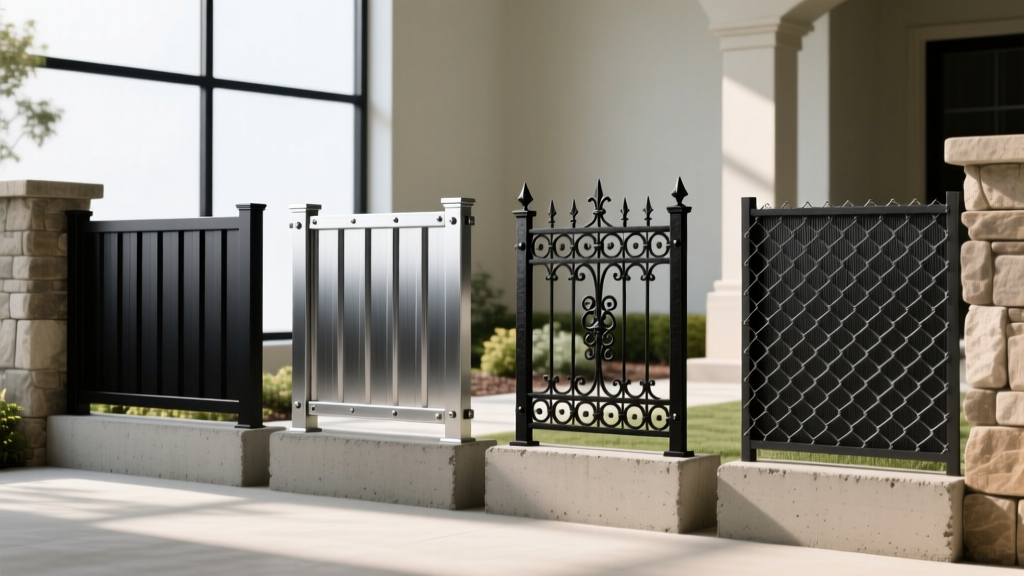
The Core Taxonomy of Black Metal Fencing
When architects and property owners specify a 'black metal fence,' they are referencing a visual aesthetic rather than a single metallurgical standard. The black metal fencing category encompasses four distinct material profiles, each with unique structural properties, corrosion resistance mechanisms, and price points. Selecting the correct taxonomy for your specific site conditions—soil alkalinity, coastal salt exposure, and security requirements—is the difference between a 40-year lifespan and a catastrophic failure in year five.
• Coastal/High Moisture: Extruded Aluminum or Class B PVC Chain Link
• High Security/Commercial: 12-Gauge Tubular Steel with anti-climb finials
• Historic/HOA Heritage: Custom forged mild steel (marketed as wrought iron)
• Budget Perimeter/Acreage: Black Vinyl-Coated Chain Link
Material Deep Dive: Properties, Pricing, and Failure Modes
Extruded Aluminum (The Rust-Free Standard)
Modern black aluminum fencing is extruded from 6061-T6 or 6005-T5 aluminum alloys. It is the dominant choice for residential pool enclosures and perimeter lines where rust is a primary concern. The black finish is achieved through a baked-on TGIC polyester powder coat. Because aluminum naturally forms a protective oxide layer, it does not suffer from red rust. However, its primary failure mode is galvanic corrosion when it comes into direct contact with dissimilar metals (like untreated steel fasteners) in the presence of an electrolyte (rain or sprinkler water).
- Standard Wall Thickness: 0.062" (16 gauge) to 0.125" (8 gauge) for commercial grades.
- Installed Cost Range: $40 to $65 per linear foot.
- Critical Specification: Ensure the manufacturer uses a chromate conversion coating or zinc-rich primer beneath the black powder coat to prevent sub-surface oxidation.
Galvanized & Powder-Coated Steel (The Security Workhorse)
Black tubular steel fencing provides the sheer mass and tensile strength required for security and large animal containment. The core material is typically carbon steel, which must be protected by a multi-stage coating process. According to the American Galvanizers Association, steel fencing intended for exterior use should feature a hot-dip galvanized zinc undercoat or an electroplated zinc-rich epoxy primer before receiving the black topcoat. If a manufacturer skips the zinc layer and applies powder directly to bare steel, a single micro-chip from a lawnmower will initiate red rust creep that will blister the black coating within 18 months.
- Standard Wall Thickness: 14-gauge (0.0747") for residential; 12-gauge (0.1046") or 11-gauge (0.1196") for commercial.
- Installed Cost Range: $55 to $85 per linear foot.
- Critical Specification: Demand compliance with Architectural Manufacturers Association (AAMA) 2604 (high-performance exterior) or 2605 (superior exterior) standards for the black powder coat.
True Wrought Iron vs. Ornamental Mild Steel
The term 'wrought iron' is heavily misused in the fencing industry. True wrought iron (ASTM A200) is a fibrous, slag-containing iron alloy that is virtually immune to deep corrosion but has not been manufactured at scale since the 1970s. What is sold as 'black wrought iron fencing' today is actually custom-forged mild steel (ASTM A36). While mild steel allows for intricate scrolls, spears, and custom estate gates, it requires rigorous maintenance. True wrought iron is only available through architectural salvage or specialty blacksmiths.
- Modern 'Wrought Iron' (Mild Steel) Cost: $120 to $250+ per linear foot (custom fabrication).
- Primary Failure Mode: Moisture trapping in tight scrollwork and forge-welded joints, leading to internal rust jacking that splits the metal.
Black Vinyl-Coated Chain Link (The Budget Perimeter)
For expansive properties where ornamental aesthetics are secondary to function, black vinyl-coated chain link offers the lowest cost per linear foot while blending into wooded backgrounds. The black PVC coating is bonded to a galvanized steel core wire. The American Fence Association categorizes these coatings by thickness and adhesion method. Class A coatings are extruded and mechanically bonded, while Class B coatings are thicker and thermally fused.
- Core Wire Spec: 9-gauge (0.148") or 11-gauge (0.120") galvanized steel.
- Coating Thickness: Minimum 0.015" for Class A; 0.020"+ for Class B.
- Installed Cost Range: $22 to $38 per linear foot.
Comparative Data Matrix: Cost, Lifespan, and Maintenance
| Material Profile | Core Specification | Coating Standard | Installed Cost (per LF) | Expected Lifespan | Primary Failure Mode |
|---|---|---|---|---|---|
| Extruded Aluminum | 6061-T6 Alloy, 0.080" wall | AAMA 2604 Powder | $40 - $65 | 30-50 Years | Galvanic corrosion at fastener joints |
| Tubular Steel | 14-Gauge Carbon Steel | Zinc Primer + AAMA 2605 | $55 - $85 | 20-30 Years | Sub-surface rust creep from impact chips |
| Custom Mild Steel | 1/2" Solid Square Bar (A36) | Hot-Dip Galvanized + Paint | $120 - $250+ | 40-60 Years (if maintained) | Moisture trapping in forged joints |
| Vinyl Chain Link | 9-Ga Core, Class B PVC | Thermally Fused Black PVC | $22 - $38 | 15-25 Years | UV degradation and coating delamination |
Hardware Compatibility and the Galvanic Trap
The most common reason black aluminum and steel fences fail prematurely is improper hardware selection during installation. When aluminum fence panels are fastened to steel posts, or when galvanized steel brackets are used to mount aluminum rails, a bimetallic couple is created.
Never drive standard galvanized or zinc-plated lag screws directly into black aluminum fence posts. The zinc and aluminum will react in the presence of moisture, causing the aluminum to pit and crumble (galvanic corrosion). You must use 304 or 316 stainless steel fasteners, or insert a nylon/dielectric washer between the dissimilar metals to break the electrical pathway.
Site-Specific Installation Framework
Material selection must dictate the installation methodology. A black steel fence installed in highly alkaline clay soil requires different post-setting techniques than an aluminum fence set in sandy loam.
Post Hole Depth and Concrete Specifications
For all rigid black metal fencing (aluminum, steel, wrought iron), terminal posts (corners, ends, and gate hinges) must bear the brunt of lateral wind loads and gate sag. Terminal posts should be embedded a minimum of 36 inches deep, or 6 inches below the local frost line, whichever is deeper. Line posts can be set 24 to 30 inches deep.
Use a 4000 PSI concrete mix with air-entrainment additives if you are in a freeze-thaw climate. The air bubbles provide microscopic expansion chambers for freezing water, preventing the concrete collar from spalling and cracking the black powder coat at the ground line.
Ground Clearance and Sprinkler Deflection
Maintain a strict 2-inch minimum clearance between the bottom rail of your black metal fence and the soil grade. This prevents soil-borne moisture from wicking up the pickets and stops string trimmers from chipping the black coating at the base. If the property utilizes high-pressure irrigation sprinklers that hit the fence line, install deflector shields on the sprinkler heads; constant impact from hard water will eventually etch and dull the black powder coat, leaving a chalky white residue that is impossible to wash off.
'When specifying black metal fencing for coastal environments within 1,500 feet of the ocean, aluminum is the only ornamental option that will survive without catastrophic coating failure. Even AAMA 2605 powder coats on steel will succumb to chloride-induced corrosion if the zinc underlayer is compromised.' — Industrial Coatings Engineering Guidelines
FAQ: Black Metal Fence Nuances
Can I paint over a fading black powder-coated steel fence?
Yes, but preparation is critical. You cannot simply brush paint over chalky powder coat. The surface must be scuff-sanded with 220-grit abrasive, cleaned with a trisodium phosphate (TSP) solution, and primed with a direct-to-metal (DTM) acrylic epoxy primer before applying a polyurethane topcoat. Failure to use a DTM primer will result in the new paint peeling off in sheets within two years.
Does black chain link fade to gray in the sun?
Lower-tier Class A PVC coatings lack sufficient UV inhibitors and will chalk and fade to a dull gray within 7 to 10 years in high-sun environments. To prevent this, specify Class B thermally fused coatings that contain minimum 2% carbon black and UV stabilizers, which retain their deep black color for 20+ years.
Are black aluminum fences strong enough for large dogs?
Standard residential black aluminum (0.062" wall thickness) can be bent by a 70+ lb dog repeatedly jumping against it. For large breeds, specify 'Commercial Grade' or 'Pet Grade' aluminum fencing, which utilizes 0.125" thick walls and reinforced bottom rails to resist impact deformation.