Chain and Link Fence Specs: Gauge, Mesh, and Wind Ratings
Master chain and link fence specifications. Compare wire gauges, mesh sizes, ASTM framework standards, and wind load ratings for 2026 installations.
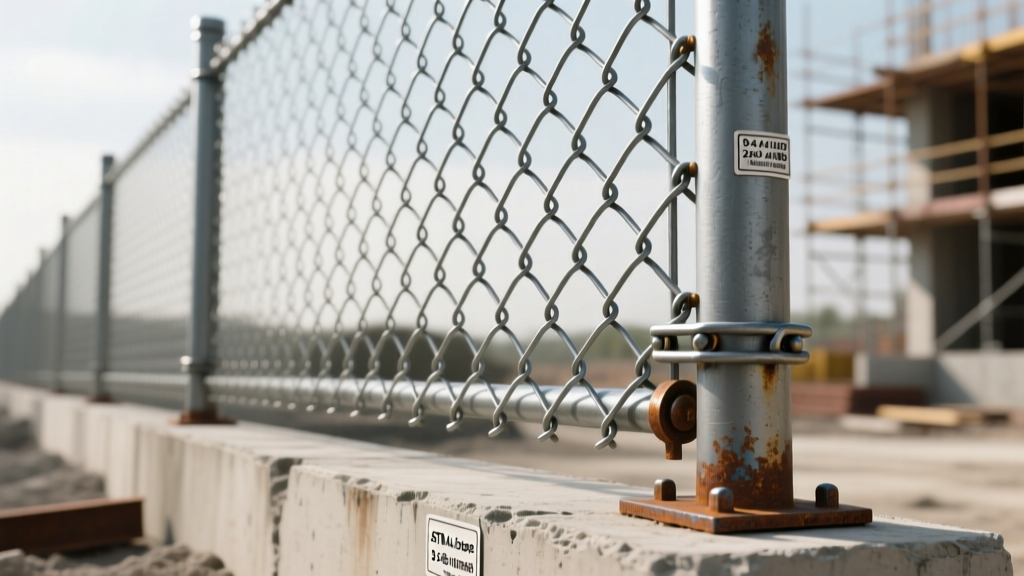
Decoding Wire Gauge and Tensile Strength
When engineers and contractors specify a chain and link fence for commercial, industrial, or high-security residential perimeters, the wire gauge is the primary determinant of structural integrity and cut-resistance. The industry operates on the Standard Wire Gauge (SWG) system, where a lower numerical value indicates a thicker, stronger wire. For 2026 installations, material costs for galvanized fabric range from $6 to $9 per linear foot for 11-gauge, scaling up to $14 to $18 per linear foot for heavy-duty 6-gauge polymer-coated options.
The tensile strength of the steel core typically falls between 60,000 and 85,000 psi (pounds per square inch). High-security applications demand a minimum of 75,000 psi to resist bolt cutter attacks and mechanical spreading.
| Wire Gauge | Decimal Thickness (in.) | Primary Application | Estimated Material Cost (2026) |
|---|---|---|---|
| 11 Gauge | 0.120 in. | Standard residential, temporary construction fencing | $6.00 - $9.00 / lin. ft. |
| 9 Gauge | 0.148 in. | Commercial perimeters, school yards, public parks | $9.50 - $13.00 / lin. ft. |
| 6 Gauge | 0.192 in. | Correctional facilities, military bases, high-security | $14.00 - $18.00 / lin. ft. |
Mesh Dimensions and Security Ratings
The mesh size—the clear opening between the woven wires—dictates both the visual permeability and the physical security of the barrier. According to guidelines published by the Chain Link Fence Manufacturers Institute (CLFMI), mesh sizing must be matched to the specific threat model of the site.
Standard vs. High-Security Mesh Profiles
- 2-3/8 in. Mesh: The industry standard for general boundary demarcation and residential use. It provides adequate containment for large animals and basic property line definition but offers minimal resistance to climbing.
- 2 in. Mesh: Required for tennis courts and recreational facilities to prevent tennis balls from passing through. It also offers a marginal increase in cut-resistance due to the higher density of wire per square foot.
- 1 in. to 1-1/4 in. Mesh: Classified as high-security or 'prison mesh.' This dense weave prevents the insertion of fingers, toes, and standard bolt cutters, drastically slowing down breach attempts. It is typically woven from 6-gauge or 8-gauge wire.
Framework Specifications: ASTM F1083 Compliance
The fabric is only as strong as the framework supporting it. The ASTM International Fencing Standards, specifically ASTM F1083, govern the specifications for steel pipe framework. This standard dictates the Outside Diameter (OD) and wall thickness of line posts, terminal posts (end, corner, and gate posts), and top rails.
Terminal posts bear the entire tensile load of the stretched fabric. A standard 6 ft. high chain and link fence exerts approximately 1,200 to 1,500 lbs of tension per run. If the terminal post lacks sufficient wall thickness, it will bow inward over time, causing the fabric to sag.
| Framework Component | Residential OD (in.) | Commercial OD (in.) | Minimum Wall Thickness (in.) |
|---|---|---|---|
| Terminal / Corner Posts | 2.375 in. | 2.875 in. | 0.203 in. (Schedule 40 equiv.) |
| Line Posts | 1.900 in. | 2.375 in. | 0.145 in. |
| Top Rails | 1.660 in. | 1.900 in. | 0.145 in. |
Wind Load Performance and Porosity
One of the most critical performance metrics for any perimeter barrier is its wind load resistance. Solid fencing materials (wood, vinyl, composite) act as sails, capturing 100% of the wind force and transferring massive overturning moments to the post footings. A chain and link fence possesses an inherent openness area (porosity) of approximately 75% to 80%. When evaluated against ASCE 7 Minimum Design Loads for wind pressure, this high porosity allows wind to pass through the fabric, reducing the lateral design load by a factor of four compared to solid barriers.
Calculating Footing Requirements in High-Wind Zones
In regions prone to hurricanes or sustained high winds (e.g., Florida, Gulf Coast), engineers utilize the reduced drag coefficient of chain link to optimize concrete footing sizes. While a 6 ft. solid wood fence might require a 36 in. deep by 12 in. diameter concrete footing for a terminal post to resist a 115 mph wind load, a 6 ft. chain and link fence in the same zone typically requires only a 24 in. deep by 8 in. diameter footing. This 40% reduction in concrete volume yields significant cost savings on large commercial perimeters without compromising structural safety.
Coating Standards: Galvanized vs. Polymer
The longevity of the steel substrate is entirely dependent on the protective coating. ASTM standards divide chain link coatings into two primary categories, each with distinct performance thresholds.
ASTM A392: Zinc (Galvanized) Coatings
Galvanization involves hot-dipping the woven fabric in molten zinc. ASTM A392 specifies two classes of zinc coating weight:
- Class 1: Minimum 1.2 oz of zinc per square foot. Suitable for standard residential applications with a typical lifespan of 10 to 15 years before red rust appears at the knuckles and barbs.
- Class 2: Minimum 2.0 oz of zinc per square foot. The commercial standard. The thicker zinc layer provides 20 to 30 years of corrosion resistance, making it mandatory for municipal and industrial projects.
ASTM F668: Polymer and PVC Coatings
For environments requiring color matching or extreme chemical resistance (such as near chemical processing plants or saltwater marshes), polymer coatings are applied over a Class 1 galvanized core. The two dominant polymer types are:
- Thermally Fused PVC: A thick, durable coating (typically 0.015 in. to 0.020 in. thick) that is mechanically bonded and heat-shrunk. It resists UV degradation and impact but can be sliced by sharp tools.
- Extruded Polyethylene (PE): A thicker, softer coating (up to 0.035 in.) that offers superior moisture resistance but is more susceptible to UV fading over a 15-year period.
Expert Installation Tolerances
To ensure the specified performance ratings are achieved in the field, installation tolerances must be strictly enforced. Fabric must be stretched to a minimum tension of 1,000 lbs per 50 ft. run using a mechanical come-along or winch bar. Terminal posts must be set in concrete with a minimum compressive strength of 3,000 psi, cured for at least 48 hours before tensioning begins. Failure to observe these curing and tensioning specifications will result in immediate fabric relaxation, negating the engineered security and wind-load ratings of the system.