Cyclone Fence Cost & Wind Load Specs: 2026 Pricing Guide
Analyze 2026 cyclone fence cost per linear foot, heavy-duty framework specs, wind load ratings, and footing depths for high-velocity hurricane zones.
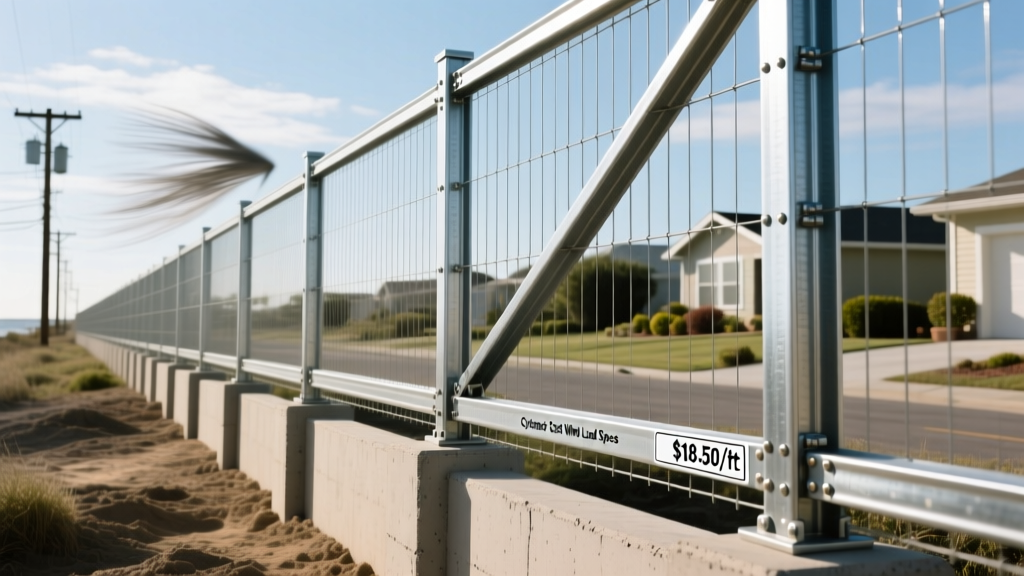
The Engineering Reality of Cyclone Fencing
The term 'cyclone fence' is frequently misapplied to standard chain link fencing. In structural engineering and coastal construction, a true cyclone-rated fence is a heavy-duty, wind-engineered perimeter system designed to survive the extreme uplift and lateral shear forces of high-velocity hurricane zones (HVHZ). Standard residential chain link fails catastrophically in winds exceeding 90 mph due to inadequate post yield strength, shallow footings, and high fabric drag. When evaluating cyclone fence cost, property owners must look beyond the price per linear foot of the fabric and calculate the total installed cost of the reinforced framework, deep-set concrete footings, and specialized tensioning systems required to meet the ASCE 7-22 wind load standards.
2026 Cyclone Fence Cost Breakdown
Pricing for wind-rated chain link systems is heavily dictated by the local wind speed map (Exposure Category C or D) and the resulting framework requirements. The following table outlines the current installed cost per linear foot (LF) for a 6-foot-tall fence, excluding complex site preparation or demolition of existing structures.
| System Classification | Fabric Gauge | Framework Spec | Post Spacing | Installed Cost (per LF) |
|---|---|---|---|---|
| Standard Chain Link (Non-Rated) | 11.5 Gauge | Schedule 40 (Light) | 10 ft | $18.00 - $24.00 |
| Category 1 Cyclone Rated | 9 Gauge | Schedule 40 (Heavy) | 8 ft | $34.00 - $42.00 |
| Category 2 Extreme Wind | 6 Gauge | Schedule 80 Steel | 6 ft | $48.00 - $58.00 |
| HVHZ Marine-Grade (Coastal) | 6 Gauge Polymer | Schedule 80 Stainless/Coated | 6 ft | $65.00 - $82.00 |
Installing standard 11.5-gauge fabric with 10-foot post spacing in a designated 130+ mph wind zone will result in structural failure. The lateral load will bend standard line posts at the concrete collar, and the tension bands will shear off the terminal posts. Always verify your local wind speed requirements via the FEMA Building Science guidelines before accepting a low-ball bid based on standard materials.
The Solidity Ratio Paradox: Mesh Size vs. Wind Drag
A common misconception is that chain link fencing is 'transparent' to wind. According to the Chain Link Fence Manufacturers Association (CLFMA), standard 2-inch chain link mesh has a solidity ratio of approximately 0.50. This means it blocks 50% of the wind, acting as a semi-solid wall.
When calculating wind load, the formula relies on the basic wind speed, exposure category, and the solidity ratio. If a property owner attempts to reduce wind drag by installing privacy slats, the solidity ratio jumps to 1.0 (100% solid), effectively doubling the lateral force exerted on the posts and footings. Conversely, using a larger mesh (e.g., 3-inch or 4-inch) reduces the solidity ratio to roughly 0.35, lowering the wind drag but compromising security and debris containment. For true cyclone performance, engineers typically maintain the standard 2-inch mesh for security but compensate for the 0.50 solidity ratio by upgrading the framework yield strength and reducing post spacing to 6 or 8 feet.
Framework and Footing Engineering Specifications
The fabric itself rarely fails in a cyclone; the failure points are almost always the post-to-rail connections, the tension bands, or the concrete footings. A properly engineered cyclone fence utilizes the following minimum specifications for a 6-foot fence in a 140 mph wind zone:
Steel Framework Requirements
- Terminal (Corner/Gate) Posts: 2-3/8 inch Outside Diameter (OD), Schedule 40 minimum, with a yield strength of 50,000 PSI. In HVHZ zones, Schedule 80 (2-7/8 inch OD) is mandatory.
- Line Posts: 1-7/8 inch OD, Schedule 40, spaced at a maximum of 8 feet on center (reduced from the standard 10 feet to decrease the bending moment on the top rail).
- Top Rail: 1-5/8 inch OD continuous steel, sleeved at every joint to prevent localized buckling under torsional stress.
- Tension Bars and Bands: 3/16 inch thick steel tension bars (standard is 1/8 inch) with heavy-duty forged tension bands bolted, not just clamped, to the terminal posts.
Concrete Footing Dimensions
Standard chain link footings are typically poured at 24 inches deep with a diameter three times the post width. Cyclone-rated footings require significantly more mass to resist overturning moments:
- Depth: Minimum 36 inches, extending below the local frost line. In sandy coastal soils (Exposure D), footings must be driven to 48 inches or utilize a bell-bottom auger to increase the pull-out resistance at the base.
- Diameter: Minimum 10 to 12 inches for terminal posts, and 8 inches for line posts.
- Reinforcement: A #4 rebar cage is recommended inside the concrete collar for terminal posts to prevent shear cracking during extreme gusts.
Material Comparison Matrix: Galvanized vs. Marine-Grade Polymer
Coastal environments introduce salt spray, which rapidly degrades standard galvanized steel. Selecting the right coating is critical for long-term structural integrity, as rust compromises the wire diameter and lowers the breaking strength of the fabric.
| Material Type | Core Wire Protection | Corrosion Resistance | Cost Premium | Best Application |
|---|---|---|---|---|
| Class 2 Galvanized | Zinc Coating (0.80 oz/sq ft) | Moderate (Fails in 5-7 yrs coastal) | Baseline | Inland, low-salt environments |
| Class 3 Galvanized | Zinc Coating (1.20 oz/sq ft) | High (10-15 yrs coastal) | + 15% | Near-coast, moderate salt |
| Polymer-Coated (Fused) | Zinc + 20-mil PVC/Polymer | Exceptional (20+ yrs) | + 35% | Direct oceanfront, HVHZ |
| Stainless Steel (316L) | Solid Marine-Grade Alloy | Maximum (Lifetime) | + 250% | Critical infrastructure, ports |
Wind Zone Decision Framework
Use this framework to determine the minimum specifications required for your project based on the ASCE 7-22 Ultimate Design Wind Speed (Vult) map for your specific zip code.
- Zone 1: Vult less than 115 mph (Inland/Standard)
Standard 9-gauge fabric with Schedule 40 framework and 8-foot post spacing is sufficient. Footings at 30 inches deep. - Zone 2: Vult 115 to 140 mph (Coastal/Inland Hurricane Prone)
Upgrade to 6-gauge fabric. Terminal posts must be Schedule 80. Line post spacing reduced to 6 feet. Footings at 36 inches deep with 10-inch diameter. - Zone 3: Vult greater than 140 mph (High-Velocity Hurricane Zone)
Requires 6-gauge polymer-coated fabric over Schedule 80 framework. Post spacing at 6 feet maximum. Footings must be engineered by a local structural engineer, typically requiring 48-inch depth with rebar reinforcement and specific concrete PSI ratings (minimum 3,500 PSI).
Frequently Asked Questions
Does adding wind slats to a cyclone fence void its wind rating?
Yes. Adding solid privacy slats increases the fence's solidity ratio from 0.50 to 1.0, effectively doubling the lateral wind load. A framework engineered for a 0.50 ratio will likely fail if privacy slats are inserted. If privacy is required in a high-wind zone, you must upgrade the framework to handle solid-wall wind loads or use specialized 50% wind-filtering privacy screens that are structurally rated.
Can I use aluminum framework to prevent rust in coastal areas?
While aluminum resists corrosion, its yield strength and modulus of elasticity are significantly lower than steel. Aluminum posts will bend and permanently deform under the high lateral loads of a cyclone. For coastal cyclone fences, the industry standard is to use heavy-duty galvanized or polymer-coated steel, or stainless steel for critical applications, rather than aluminum.
How does terrain affect cyclone fence engineering?
ASCE 7 defines Exposure Categories based on surface roughness. A fence built in Exposure B (urban/suburban with surrounding buildings and trees) experiences less wind shear than the exact same fence built in Exposure D (flat, unobstructed coastal areas or mudflats). Fences in Exposure D require heavier framework and deeper footings to account for the unbuffered wind velocity, directly increasing the overall cyclone fence cost.